

Ketamine for Anxiety: Research, Treatment Options, and 2026 Industry Trends
Last updated: April 20, 2026
Something has shifted in mental health care. For the past decade, depression dominated the ketamine conversation. That is no longer true. Based on HealingMaps’ aggregated demand trends over the past 12 months, anxiety has overtaken depression as the number one condition patients cite when searching for ketamine treatment. This is the first time in the history of our aggregated trend data that this crossover has occurred. The pattern mirrors what clinicians have been reporting in treatment rooms for years. Generalized anxiety, panic disorder, PTSD, and social anxiety have become some of the most common reasons patients walk into a ketamine clinic. The depression evidence keeps maturing as well, with a new review finding ketamine may ease depression across multiple trial designs.
| Key Takeaway | Why It Matters |
|---|---|
| Anxiety is now the #1 reason patients seek ketamine | Anxiety-related searches now lead depression-related searches in our trend data — a first |
| Ketamine’s mechanism is different from SSRIs | Glutamate-NMDA pathway works in hours, not weeks |
| Evidence is strongest for specific anxiety subtypes | PTSD, generalized anxiety, and treatment-resistant cases show the best response |
| It’s not FDA-approved for anxiety | Use is off-label — this affects insurance coverage and clinical oversight |
| Cost is a leading patient concern | Affordability is among the most frequent questions in patient research |
| Ketamine is not a cure — it’s a catalyst | Best outcomes pair medication with therapy and integration work |
For patients considering ketamine for anxiety, the research has matured enough to offer real guidance. Here is what the evidence shows, what treatment actually looks like, and how to decide whether ketamine therapy is right for your specific anxiety presentation.
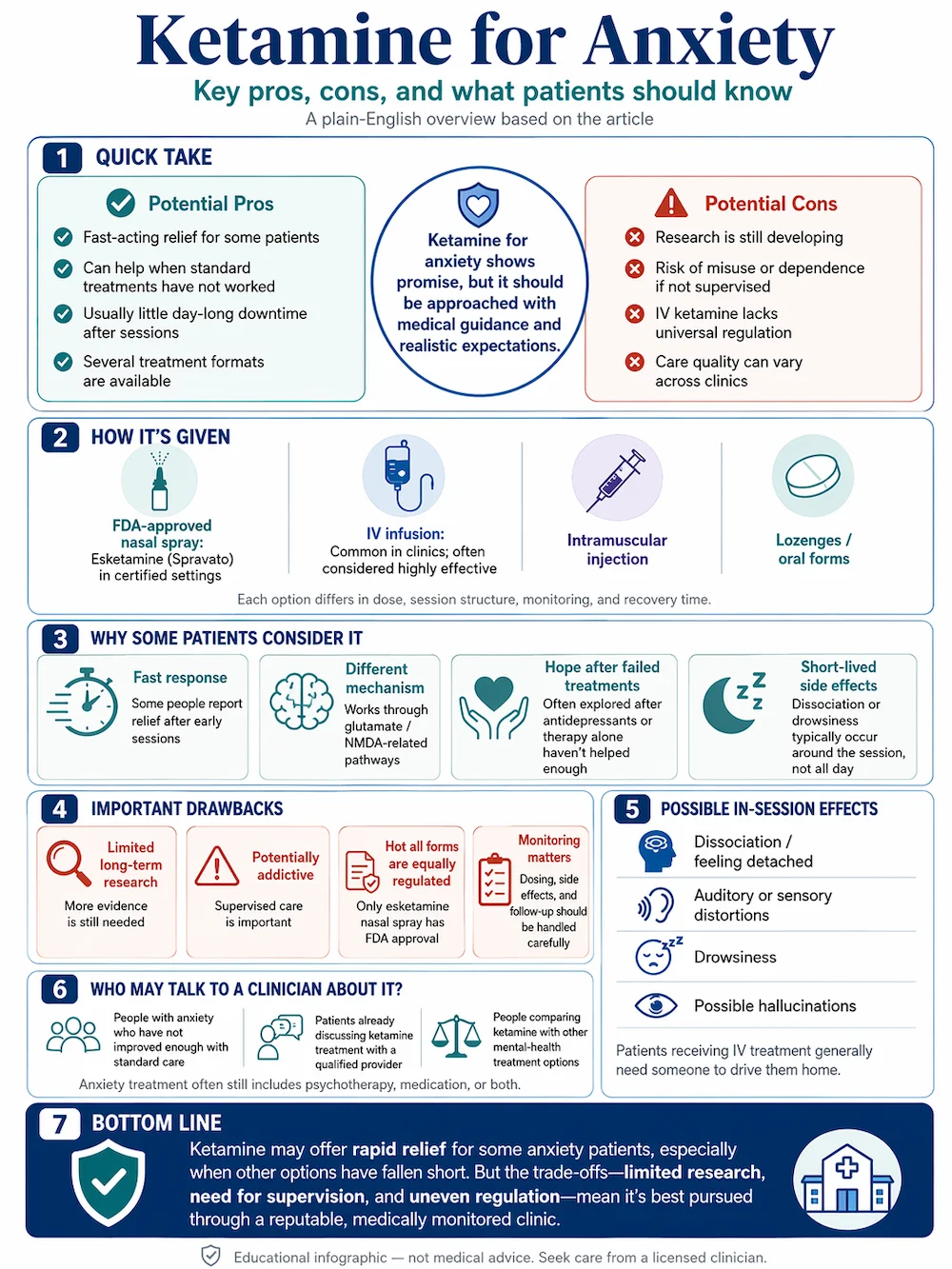
Why Anxiety Patients Are Turning to Ketamine
Traditional anxiety treatments have real limits. SSRIs and SNRIs take weeks to begin working and produce a meaningful response in roughly half of patients. Benzodiazepines work quickly but carry dependence risks and are not a long-term solution. Cognitive behavioral therapy is evidence-based and effective but requires time, trained clinicians, and patient engagement over months.
Ketamine does something different. It works within hours for many patients and reaches patients who have not responded to first-line treatments. A meaningful share of patients researching ketamine describe themselves as having “tried everything else” before considering it. This is a highly screened population. They have already cycled through medications, therapy, and often multiple providers. Ketamine is often the last door they have not walked through.
The clinical case for anxiety is not as mature as the case for treatment-resistant depression. But the evidence is growing. A 2024 meta-analysis in The Journal of Clinical Psychiatry reviewed 22 studies covering more than 1,100 patients with anxiety disorders and found ketamine produced rapid and clinically significant reductions in anxiety symptoms, particularly in patients with generalized anxiety disorder, social anxiety disorder, and post-traumatic stress disorder.
How Ketamine Works in the Anxious Brain
Most anxiety medications target serotonin, GABA, or norepinephrine. Ketamine targets something different: the glutamate system. Specifically, ketamine is an N-methyl-D-aspartate (NMDA) receptor antagonist. By briefly blocking NMDA receptors, ketamine triggers a cascade of downstream effects that appear to be responsible for its antidepressant and anxiolytic properties.
The most important of these effects is a surge in brain-derived neurotrophic factor (BDNF) and an increase in synaptic plasticity. Anxiety is associated with hyperactive fear circuits in the amygdala and a weakened prefrontal cortex that cannot effectively regulate those circuits. Ketamine appears to temporarily loosen those patterns, creating a window where the brain can form new connections and break out of entrenched loops.
This mechanism is why ketamine can work in hours instead of weeks. It is also why the effects often require reinforcement. A single infusion can produce dramatic relief, but without follow-up therapy, maintenance doses, or integration work, those effects often fade within days or weeks.
Which Anxiety Conditions Respond Best?
The evidence is not uniform across all anxiety presentations. Here is how the research stacks up by condition:
Post-Traumatic Stress Disorder (PTSD)
The strongest evidence outside of depression. Multiple randomized controlled trials have shown ketamine produces rapid reductions in PTSD symptoms, particularly intrusive thoughts and hyperarousal. A landmark 2021 trial at Mount Sinai found that repeated ketamine infusions produced a significant reduction in PTSD symptoms in treatment-resistant patients compared to placebo. This is the anxiety subtype most frequently treated at ketamine clinics.
Generalized Anxiety Disorder (GAD)
Moderate but growing evidence. Several open-label studies and small randomized trials have shown ketamine reduces GAD symptoms within hours of administration. The response rate in treatment-resistant GAD appears similar to what is seen in treatment-resistant depression — roughly 50-70% of patients experience meaningful improvement.
Social Anxiety Disorder
Emerging evidence. A 2017 Yale study found ketamine produced a significant reduction in social anxiety symptoms within a few hours, with effects lasting up to two weeks. Replication studies are still limited, but early results are promising.
Panic Disorder
Mixed evidence. Some patients report significant relief from panic attacks following ketamine therapy, but controlled trials are limited. The dissociative effects of ketamine may feel similar to panic symptoms for some patients, which makes patient screening particularly important.
Obsessive-Compulsive Disorder (OCD)
Growing interest. Though OCD is technically reclassified out of the anxiety disorder category in the DSM-5, it is often treated alongside anxiety conditions. A 2013 Columbia study found ketamine produced rapid and significant reductions in OCD symptoms in patients with treatment-resistant cases.
What Treatment Looks Like
Ketamine for anxiety is administered in several forms, each with different clinical profiles, cost structures, and evidence bases.
| Modality | Typical Protocol | Average Session Cost | Best For |
|---|---|---|---|
| IV Ketamine Infusion | 40-60 min session, 6-session induction series | $525 | Severe or treatment-resistant anxiety; PTSD |
| IM Ketamine Injection | 10-20 min session, similar induction pattern | $375 | Patients without easy IV access; lower-cost alternative |
| Sublingual Lozenges (at-home) | Twice-weekly self-administration under protocol | $275 per session equivalent | Mild to moderate anxiety; maintenance phase |
| Spravato (Esketamine) | Twice-weekly for 4 weeks, then weekly, then biweekly | $950 (often insurance-covered) | Treatment-resistant depression with comorbid anxiety |
Most anxiety patients at dedicated ketamine clinics follow a protocol adapted from the treatment-resistant depression playbook: an induction phase of six infusions over two to three weeks, followed by maintenance infusions scheduled based on symptom return. A minority of patients respond to a single infusion. Most need repeated sessions to achieve lasting results.
The Cost Conversation
Cost is consistently among the most common patient concerns when considering ketamine therapy — and for anxiety patients specifically, that concern is amplified because ketamine for anxiety is almost always off-label and therefore almost never covered by insurance.
The national clinic average for IV ketamine is around $525 per session, and what many patients expect to pay falls slightly below that benchmark. A full induction series of six IV infusions typically costs $3,000 to $3,600, with maintenance infusions adding $500 to $600 every four to six weeks for most responders.
Spravato is the one significant exception. Because Spravato is FDA-approved for treatment-resistant depression (not anxiety), it is covered by most major insurers — including Medicare and Medicaid. For anxiety patients whose condition overlaps with treatment-resistant depression, Spravato can be a cost-effective entry point into ketamine-based care.
What to Expect From a Session
A ketamine session for anxiety typically runs 40 to 60 minutes. The patient is seated or reclined in a quiet, dimly lit room. An IV line or IM injection is administered at a sub-anesthetic dose calibrated to body weight. Within 10 to 15 minutes, most patients experience a dissociative state — a sense of distance from the body, altered perception of time, and sometimes vivid imagery or emotional releases.
The dissociative experience is not incidental. For many anxiety patients, it is part of what makes ketamine effective. The temporary suspension of the default mode network — the brain circuitry associated with self-referential worry — provides relief from the anxious loop that typically dominates waking consciousness. Some patients describe it as the first quiet their mind has experienced in years.
A clinician or trained technician monitors vitals throughout the session. Blood pressure typically rises modestly during treatment and returns to baseline within 30 to 45 minutes. Patients are observed until they are fully oriented, then discharged with a companion driver. Most are back to normal activity the following day.
The Role of Therapy and Integration
Ketamine alone is not enough for most anxiety patients. The evidence consistently shows that pairing ketamine with psychotherapy produces better and more durable outcomes than ketamine used in isolation. This is particularly true for anxiety conditions rooted in trauma, unresolved life transitions, or deeply held cognitive patterns.
Ketamine-assisted psychotherapy (KAP) formalizes this pairing. In KAP, a licensed therapist is present during or immediately following the ketamine session, helping the patient process the experience and extract lasting behavioral change. Between sessions, integration work continues through talk therapy or structured self-reflection protocols.
Clinics that offer only ketamine administration — sometimes called “infusion-only” models — are appropriate for some patients but generally produce shorter-lived benefits for anxiety. Patients who can access integrated KAP tend to report more durable improvements.
Who Is Not a Good Candidate
Ketamine for anxiety is not universally appropriate. The following conditions may rule out treatment or require enhanced monitoring:
- Active psychosis or a history of psychotic disorders. Ketamine’s dissociative effects can worsen or trigger psychotic symptoms.
- Uncontrolled hypertension or severe cardiovascular disease. The mild blood pressure increase during treatment can be dangerous for these patients.
- Active substance use disorder involving ketamine or other dissociatives. Treatment requires careful risk-benefit evaluation.
- Pregnancy. Limited safety data; most clinics will not treat pregnant patients.
- Severe liver disease. Ketamine is metabolized by the liver; impaired function affects dosing safety.
Reputable clinics conduct a thorough intake — medical history, current medications, psychiatric diagnosis, and goals — before any treatment begins. Skipping this step is a red flag.
The Bottom Line
Ketamine for anxiety is no longer an edge case. It has become one of the most common reasons patients seek out a ketamine clinic, and the research now supports its use for specific anxiety presentations — particularly PTSD, treatment-resistant generalized anxiety, and social anxiety. The treatment is not a cure. It is a catalyst that works best when paired with therapy, lifestyle support, and realistic expectations.
For the growing share of anxiety patients who have exhausted first-line options, ketamine represents a legitimate next step. The field’s challenge is matching the right patient to the right protocol, at a cost that does not become its own barrier to care. For many, that conversation starts with finding a qualified clinic and having an honest screening conversation.
Anxiety and Ketamine in 2026: What the Demand Trends Show
- Anxiety is now the leading condition patients cite when researching ketamine therapy — surpassing depression for the first time in our trend data
- A meaningful share of patients describe themselves as having “tried everything else” before considering ketamine
- Cost and insurance remain among the top questions patients ask before starting treatment
- The national IV ketamine session average sits near $525, while many patients expect to pay slightly less
Source: HealingMaps aggregated industry demand trends, October 2022 – March 2026. Data is anonymized and aggregated at the trend level; no individual patient information is referenced.
Frequently Asked Questions
Is ketamine FDA-approved for anxiety?
No. Ketamine is FDA-approved as an anesthetic. Its use for anxiety is off-label, meaning a physician prescribes it based on clinical judgment and published research rather than formal FDA approval for the anxiety indication. Spravato (esketamine) is FDA-approved but only for treatment-resistant depression, not anxiety specifically.
How fast does ketamine work for anxiety?
Faster than any traditional anxiety medication. Most patients report noticeable symptom reduction within hours of the first session, though durable benefits typically require a series of six sessions over two to three weeks.
Will insurance cover ketamine for anxiety?
Usually not for IV or IM ketamine, because the use is off-label. Spravato is often covered by insurance, including Medicare and Medicaid, but only when prescribed for treatment-resistant depression.
How long do the effects last?
Highly variable. Some patients experience weeks or months of relief from a single induction series. Others need ongoing maintenance infusions every 4 to 8 weeks. Pairing ketamine with therapy significantly extends the duration of benefit.
Is ketamine addictive?
Recreational or high-dose ketamine use carries addiction risk. At clinical doses administered by a licensed provider in a monitored setting, addiction risk is low. Clinics screen patients for substance use history before beginning treatment.
Can I take ketamine while on SSRIs?
In most cases, yes. SSRIs and ketamine work through different pathways and are commonly used together. Your prescribing clinician should review all medications before treatment to check for interactions.




Zachary Tomlinson
June 8, 2022 at 11:49 pmI appreciate how the article explained that ketamine treatment helps alleviate the signs and symptoms of anxiety. I think it should be a priority to get your mindset straight after mourning a huge loss. This seems like a good way to do that and get a person working again.
Luke Smith
November 18, 2022 at 12:26 amIt’s nice that you pointed out how ketamine treatments are completely painless and create a fast response. I was reading a health magazine last night and I saw an article all about the use of ketamine for anxiety. It seems a lot of people are suffering from anxiety nowadays, so it’s good to hear that there are effective treatments for it now.
Alice Carroll
February 14, 2024 at 1:47 pmThanks for the reminder that the accessibility of treatments should also be considered when planning to undergo anxiety therapy. I’m interested in looking for a good clinic for that because I had a pretty bad anxiety attack recently. That made me realize that my condition wouldn’t get any better without professional help.