
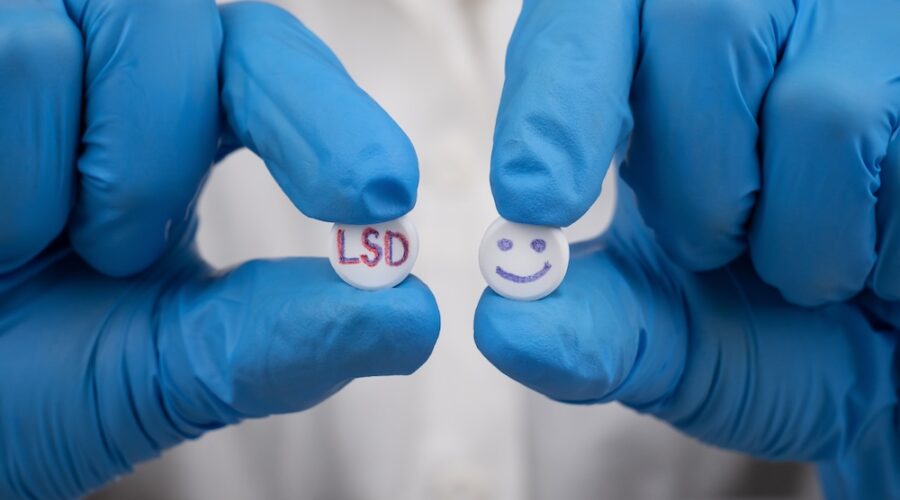
LSD Shows Promise as Single Dose Treatment for Severe Anxiety
Scientists have achieved a breakthrough in anxiety treatment that could reshape psychiatric care. A rigorous clinical trial demonstrates that a single dose of LSD significantly reduces anxiety symptoms in people with generalized anxiety disorder. This marks the first time researchers have studied LSD with modern scientific standards for treating mental health conditions.
New: Interested in Being Part of a Psychedelics-Focused Clinical Trial? Sign Up Here
| Key Takeaway | Details |
|---|---|
| Study Type | Phase 2b randomized, double-blind, placebo-controlled trial |
| Participants | 198 adults with moderate to severe generalized anxiety disorder |
| Effective Doses | 100 µg and 200 µg showed significant improvement |
| Results | 7.6-point improvement on anxiety scale with 100 µg dose |
| Timeline | First new GAD medication approach since 2007 |
| Next Steps | Phase 3 trials now underway |
Looking for treatment? Find ketamine clinics closest to you as well as other psychedelic therapies in your area.
Most clinics spend 4-6 weeks navigating Spravato REMS certification — chasing paperwork, decoding FDA requirements, and wondering if they missed a step. Our AI-powered REMS Certification Assistant cuts that to one sitting. Get a personalized checklist of exactly what you need, and walk into the REMS portal ready to submit.
Get the REMS Certification Assistant →A Critical Need for New Treatments
Generalized anxiety disorder affects 26 million American adults. Current first line treatments fail half of all patients. No new medications have received approval since 2007, leaving millions without effective relief.
Consider the daily reality for someone with GAD. They experience overwhelming worry that disrupts sleep, work, and relationships. Physical symptoms include muscle tension and fatigue. Mental symptoms involve constant overthinking and inability to manage uncertainty.
The condition often occurs alongside depression, affecting nearly 50% of GAD patients. This combination drives up healthcare costs and complicates treatment approaches.
Studying LSD with Scientific Rigor
Researchers conducted the MMED008 study across multiple centers. They tested MM120, a synthetic form of LSD, at four different dose levels. The 198 participants received either 25, 50, 100, or 200 micrograms in a single treatment session.
Scientists measured results using the Hamilton Anxiety Rating Scale, a standard clinical assessment tool. The study design prevented both patients and researchers from knowing who received which dose, eliminating bias from the results.
MM120 works by partially activating serotonin receptors in the brain. This mechanism differs from traditional anxiety medications, potentially explaining why it helps patients who don’t respond to existing treatments.
Promising Results and Future Implications
The 100 microgram dose produced the strongest results. Patients showed a 7.6 point improvement on the anxiety scale compared to placebo. The 200 microgram dose achieved a 5.5 point improvement, while lower doses showed no significant effect.
Side effects matched expectations for LSD, including visual changes, nausea, and headaches. Researchers report these effects were manageable and temporary.
Think about what this means for anxiety treatment. A single dose could provide lasting relief where daily medications have failed. Three Phase 3 trials are now testing this approach for both anxiety and depression.
This research represents more than a new treatment option. It opens the door for studying other psychedelic compounds with rigorous scientific methods. The field of psychiatry may be entering a new era of innovative treatments for mental health conditions that have resisted traditional approaches.


