Survey: 1.6 Million Americans Received Ketamine Treatment Last Year
A major new survey found that 1.6 million American adults received ketamine treatment in a supervised medical facility last year. That number represents the clearest picture yet of the clinical ketamine industry’s scale. It also shows how far the field has come in just a few years.
Do you work in the ketamine industry? Save thousands on overhead and other fees by joining the first GPO for ketamine clinics and practitioners. There’s no cost to join and zero obligations. Sign up here!
| Clinical Ketamine Metrics | Finding |
|---|---|
| Patients treated at supervised facilities | 1.66 million |
| Used with trained professional supervision | 1.74 million |
| Used to treat medical symptoms | 40.5% of all users |
| Reported mental health improvement | 57.2% |
| New patients in 2024 | 728,000 |
| Use monthly or more frequently | 31.9% |
RELATED: Solving the Insurance Puzzle: How to Get Your Ketamine Therapy Covered
The Survey Behind the Numbers
The National Survey Investigating Hallucinogenic Trends collected over 57,000 responses in 2024. Rocky Mountain Poison and Drug Safety conducted the study with funding from SAMHSA. It represents the largest ongoing research into psychedelic use in America.
The survey asked detailed questions about prescription ketamine and esketamine use. It distinguished between settings, motivations, and supervision levels. This granularity allows practitioners to understand the clinical market specifically rather than relying on headline figures that mix therapeutic and recreational use.
Of the 3.2 million total prescription ketamine users identified, 51.5% reported using at a supervised facility. That translates to approximately 1.66 million patients receiving care in clinical settings.
Looking for treatment? Find ketamine clinics closest to you as well as other psychedelic therapies in your area.
Here’s the Survey’s Ketamine Overview
Who Seeks Clinical Ketamine Treatment?
The demographics of supervised ketamine patients tell practitioners who is walking through their doors.
| Demographic | Users | Prevalence |
|---|---|---|
| Age 18 to 25 | 787,000 | 2.2% |
| Age 26 to 49 | 2.1 million | 2.0% |
| Age 50 and older | 313,000 | 0.3% |
| Female | 1.1 million | 0.8% |
| Male | 2.1 million | 1.7% |
The 26 to 49 age bracket dominates the patient population. This aligns with the demographic most likely to experience treatment resistant depression and seek alternatives to conventional antidepressants. Men currently use ketamine at more than twice the rate of women. That gender gap may represent an opportunity for clinics to expand outreach to underserved female patients.
New: Interested in Being Part of a Psychedelics-Focused Clinical Trial? Sign Up Here
Treatment Motivations Support Clinical Value
The survey asked users why they chose ketamine. Among all prescription ketamine users, 40.5% cited treating a medical symptom. That represents the highest therapeutic motivation of any psychedelic surveyed.
| Substance | Used to Treat Medical Symptoms |
|---|---|
| Prescription Ketamine/Esketamine | 40.5% |
| Psilocybin | 26.8% |
| LSD | 19.8% |
| MDMA | 17.1% |
Ketamine users are more likely to approach the substance as medicine than users of any other psychedelic. This validates the clinical positioning of ketamine therapy and suggests patients already understand its therapeutic purpose.
Mental Health Outcomes Lead All Psychedelics
The efficacy data should encourage every practitioner. Ketamine delivered the strongest perceived mental health benefits of any substance in the survey.
| Substance | Reported Mental Health Improvement |
|---|---|
| Prescription Ketamine/Esketamine | 57.2% |
| Psilocybin | 46.7% |
| LSD | 46.1% |
| MDMA | 38.4% |
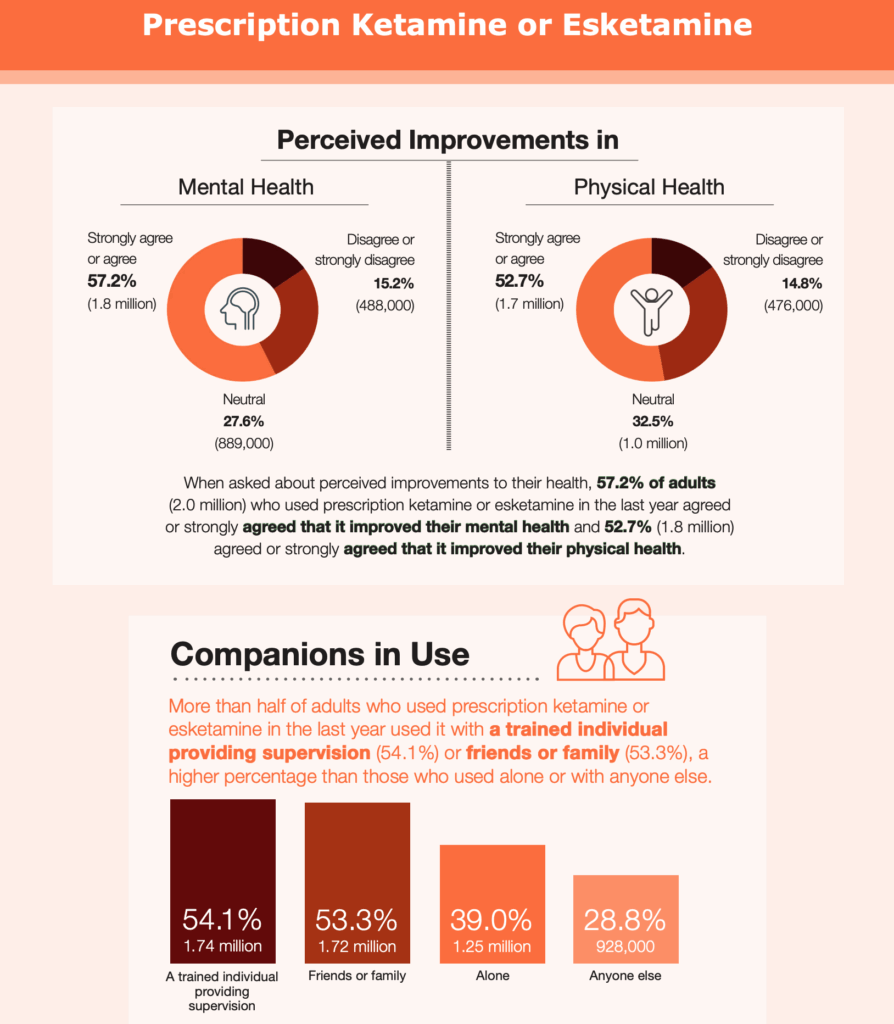
More than 1.8 million ketamine users agreed or strongly agreed that the substance improved their mental health. Another 1.7 million reported physical health improvements. The dissatisfaction rate was the lowest among all psychedelics studied. Only 15.2% disagreed that ketamine helped their mental health.
| Perceived Mental Health Outcome | Percentage | Estimated Users |
|---|---|---|
| Strongly agree or agree improved | 57.2% | 1.84 million |
| Neutral | 27.6% | 889,000 |
| Disagree or strongly disagree | 15.2% | 488,000 |
These numbers reflect all prescription ketamine users, not just those in clinical settings. But they demonstrate that ketamine works for the majority of people who try it.
The Supervision Advantage
The survey captured detailed data on who accompanied patients during ketamine use. For clinical practitioners, the key finding is that supervised use correlates with the facility-based treatment numbers.
| Companion During Use | Percentage | Estimated Users |
|---|---|---|
| Trained professional | 54.1% | 1.74 million |
| Friends or family | 53.3% | 1.72 million |
| Alone | 39.0% | 1.25 million |
| Anyone else | 28.8% | 928,000 |
Just over half of all prescription ketamine users had a trained professional present. That 54.1% figure closely matches the 51.5% who used at supervised facilities. The alignment suggests that facility-based treatment and professional supervision go hand in hand.
The survey also found that facility use was the most common setting specifically for prescription ketamine and esketamine. This distinguishes ketamine from other psychedelics where private home settings dominated.
| Setting for Prescription Ketamine Use | Percentage |
|---|---|
| At a facility under supervision | 51.5% |
| In a private setting | 47.3% |
| At a ceremonial site or retreat | 30.7% |
| In a public setting | 28.8% |
| In nature | 25.2% |
Patient Frequency Indicates Ongoing Relationships
Ketamine patients return more often than users of other psychedelics. Nearly one in three uses ketamine monthly or more frequently.
| Frequency of Use | Percentage |
|---|---|
| Monthly or more | 31.9% |
| Several times per year | 42.0% |
| Once | 26.1% |
Compare that to psilocybin where only 18.3% use monthly. The higher frequency reflects ketamine’s role in ongoing treatment protocols. For practitioners, this translates to recurring patient relationships rather than one-time encounters.
The data also showed strong treatment persistence. Only 26.1% of ketamine users tried it just once. Nearly three quarters returned for additional sessions.
New Patients Continue Entering the Market
The pipeline of new ketamine patients remains robust. An estimated 728,000 people tried prescription ketamine for the first time in 2024. That 22.6% initiation rate signals that demand continues growing.
| Initiation Rate by Substance | Percentage |
|---|---|
| Prescription Ketamine/Esketamine | 22.6% |
| Psilocybin | 22.8% |
| MDMA | 22.3% |
| LSD | 15.8% |
Ketamine’s initiation rate matches or exceeds other psychedelics despite being available longer through legal channels. The market has not saturated. New patients continue discovering ketamine therapy.
Regional Opportunities
Geography shapes where ketamine patients seek care. The data reveals both saturated and underserved markets.
| Region | Users | Prevalence |
|---|---|---|
| South | 1.2 million | 1.2% |
| West | 956,000 | 1.5% |
| Northeast | 645,000 | 1.4% |
| Midwest | 422,000 | 0.8% |
The West leads in prevalence at 1.5%. The South has the most patients by raw numbers at 1.2 million. The Midwest lags at just 0.8% prevalence. That gap suggests significant room for clinic expansion in Midwestern markets.
Sizing the Clinical Market
Using the survey data, practitioners can estimate the clinical ketamine market more precisely than previous reports allowed.
| Segment | Estimated Patients | Avg Annual Spend | Market Value |
|---|---|---|---|
| Supervised clinical treatment | 1.66 million | $2,000 to $4,000 | $3.3B to $6.6B |
If 1.66 million patients each spend between $2,000 and $4,000 annually on supervised ketamine treatment, the clinical market falls between $3.3 billion and $6.6 billion. That range aligns with and validates recent market research estimates.
The trajectory from $8.3 million in 2017 revenue to a multi-billion dollar industry in 2024 represents compound annual growth exceeding 100%. Few healthcare sectors have expanded this quickly.
What This Means for Practitioners
The 1.66 million supervised patient figure gives practitioners a concrete benchmark. The clinical ketamine industry has reached meaningful scale. Patients understand ketamine as medicine. Outcomes data supports its value. Growth continues.
Several strategic implications emerge from the data.
The market is large and still growing. With 728,000 new patients initiating treatment last year, demand shows no signs of slowing. Practitioners positioned to capture these new patients will benefit from the ongoing expansion.
Outcomes support premium positioning. The 57.2% mental health improvement rate gives clinics concrete efficacy data to share with prospective patients. Ketamine works for the majority of people who try it.
Recurring relationships drive revenue. With 74% of patients returning for multiple sessions and 32% using monthly, the business model supports ongoing patient relationships rather than one-time transactions.
Regional expansion opportunities exist. The Midwest’s 0.8% prevalence rate compared to the West’s 1.5% suggests underserved markets where new clinics could establish themselves without intense competition.
Professional supervision differentiates. With roughly half of all prescription ketamine use happening outside supervised settings, clinical practitioners can emphasize the safety, screening, and support that distinguishes their care.
The data confirms what practitioners experience daily. Ketamine therapy has moved from experimental fringe to established treatment modality. The 1.66 million patients who received supervised care last year represent both validation of the field’s growth and a foundation for continued expansion.