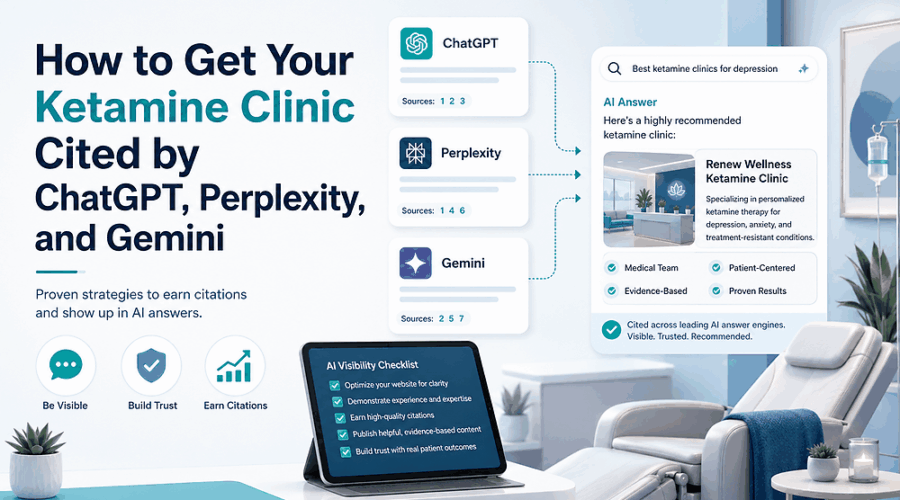
How to Get Your Ketamine Clinic Cited by ChatGPT, Perplexity, and Gemini
The way patients find ketamine clinics changed in 2026. Last year, someone with treatment-resistant depression Googled “ketamine clinic near me” and clicked one of the top three results. This year, they’re more and more likely to type that same question into ChatGPT, Claude, or Perplexity, and read a generated answer that names three to five specific clinics. If your clinic isn’t in those citations, you don’t exist to that patient — even if you rank #1 on Google.
This isn’t hypothetical. At HealingMaps, we now see hundreds of monthly visits from AI-tool referrers — ChatGPT, Perplexity, Gemini, and Microsoft Copilot — and that number is climbing every quarter. Across the 1,600+ ketamine clinics we list, the ones earning AI citations share a specific set of attributes. Most of them have nothing to do with what your SEO agency told you to do five years ago.
Here’s what actually works in 2026, drawn from two independent bodies of research: a meta-analysis of 55 AI citation experiments and patents from researcher Cyrus Shepard at Zyppy, and a separate large-scale correlation study from Oppalerts that tracked 29,562 domains across 145 industries and 105,000+ ChatGPT prompts. Both studies point in the same direction. Below, we’ve translated their findings into actions you can take on your ketamine clinic website this week.
Save 40%+ on Your Medical Supplies
GPO-level pricing negotiated through Pipeline Medical, exclusively for Healing Health Alliance members. One member practice is projected to save $38,000+ a year. Find out how much we can save your clinic — no obligation, no contracts.
See Your Clinic’s Savings →(43% reduction on supply spend)
Why AI search matters for ketamine clinics specifically
Ketamine therapy is a high-consideration, high-anxiety purchase. Patients spend weeks researching before they ever fill out an inquiry form. They’re comparing protocols (IV vs. Spravato vs. IM vs. KAP), evaluating prescriber credentials, weighing insurance coverage, and trying to understand what a course of treatment actually costs. That research used to happen on Google. Increasingly, it happens inside an AI chat.
A few reasons this is uniquely consequential for ketamine clinics:
- Patients ask conversational, comparison questions (“which is more effective for treatment-resistant depression — IV ketamine or Spravato?”). Google ranks pages. AI tools generate answers that name specific providers.
- Insurance coverage is confusing, and patients lean on AI to decode it. If your site clearly answers “does insurance cover ketamine therapy in Arizona?”, you become the cited source.
- Cost transparency is rare in this industry, and AI tools heavily favor clinics that publish specific pricing.
- Local intent dominates. AI tools now generate “best ketamine clinic in [city]” answers, and the citations come from a narrow handful of sources.
If you’re not optimizing for this, you’re losing patients to clinics that are.
The 6 factors that actually move the needle
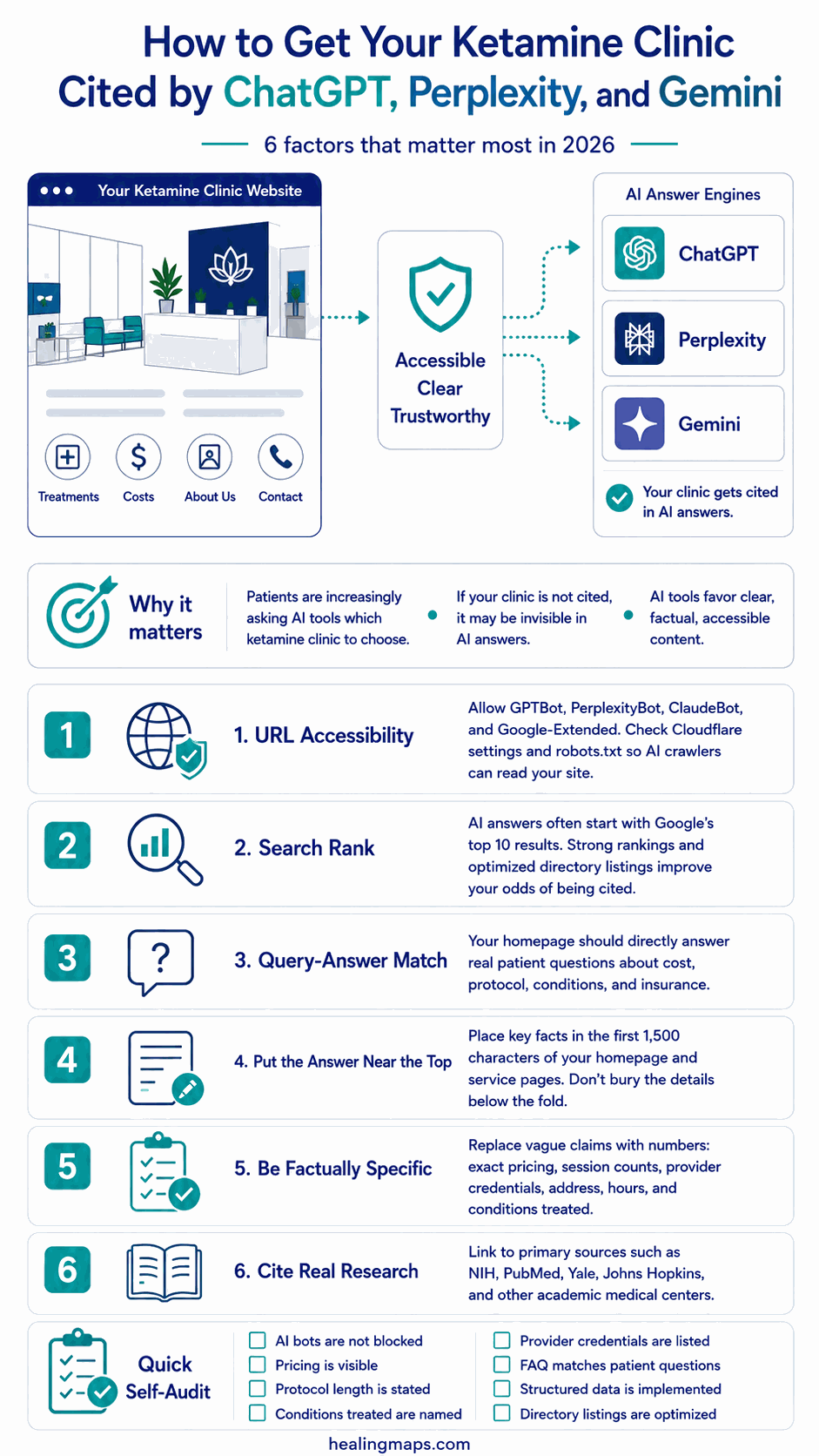
Of the 22 ranking factors identified in Shepard’s analysis, six stand out as both high-impact and directly actionable for ketamine clinic owners. We’re skipping the rest because most either overlap with the six below or aren’t things you can fix without rebuilding your entire site.
One honest caveat before we dive in: AI-citation behavior is mostly internal to the model. The Oppalerts correlation study found that all measurable external signals combined explain only about 15–20% of variance in which brands get recommended by ChatGPT. The other 80–85% lives inside the model itself, and isn’t something you can directly influence. That sounds discouraging, but it isn’t — the 15–20% is exactly what your competitors aren’t optimizing for. In local ketamine markets where AI tools surface only a handful of clinics, small edges compound fast.
1. URL Accessibility (9.5/10) — Make sure AI bots can actually read your site
This is the single biggest silent killer of AI citation eligibility, and most clinic websites fail it without realizing.
When your developer set up your site, they probably enabled bot protection through Cloudflare or a similar CDN. That protection blocks malicious crawlers — but it also blocks GPTBot (OpenAI), PerplexityBot, ClaudeBot, and Google-Extended (Google’s AI crawler, separate from Googlebot). If those bots can’t access your site, your clinic literally cannot be cited. You’re invisible to the AI layer.
How to fix it in 5 minutes:
- Log into Cloudflare or whatever CDN you use
- Find “Bot Fight Mode” or your bot management settings
- Verify GPTBot, PerplexityBot, ClaudeBot, and Google-Extended are explicitly allowed
- Open your
robots.txt(yourdomain.com/robots.txt). If you see lines likeUser-agent: GPTBotfollowed byDisallow: /, remove them
This single fix moves more clinics from “uncitable” to “citable” than anything else on this list.
2. Search Rank (9.4/10) — AI tools start from Google’s top 10
ChatGPT, Perplexity, and Gemini don’t crawl the entire web independently. They use a combination of training data and live web search, and that live search overwhelmingly pulls from Google’s top 10 organic results.
This is the most important and most replicated finding across both studies cited above. The Oppalerts correlation analysis — tracking 29,562 domains across 145 industries and over 105,000 ChatGPT prompts — found that SERP appearances, SERP rank, and outbound links from search results pages are the three strongest measurable signals predicting whether a brand gets recommended by an AI tool. Two independent studies, the same conclusion: traditional search authority is the foundation of AI visibility, not a separate channel.
Translation: traditional SEO didn’t go away. If you don’t rank for “ketamine clinic [your city]” or “ketamine therapy [your city]” in Google’s top 10, you’re highly unlikely to be cited by AI tools answering those queries either. Start with our guide to getting your clinic to the top of Google Maps, because map pack visibility feeds the same authority signals the AI tools read.
For most independent clinics, breaking into Google’s top 10 is hard. The directories — HealingMaps, Psychology Today, Healthgrades — already occupy most of those spots, and they have the domain authority to hold them. The fastest path is to ensure your clinic is listed and well-optimized on those directories, where their authority does the heavy lifting for you. If a patient asks ChatGPT for “best ketamine clinic in Phoenix,” and you’re prominently featured on HealingMaps’ Phoenix page, you inherit that visibility.
3. Query-Answer Match (9.2/10) — Your homepage must literally answer patient questions
AI tools cite passages that contain the exact answer to the user’s question. If a patient asks “how much does IV ketamine cost in Phoenix?”, the AI is scanning for a passage that contains those words and a specific dollar figure.
Audit your homepage right now. Find the first paragraph and read it. Does it actually answer questions a patient would type into ChatGPT? Or does it open with “Welcome to [Clinic Name], where compassionate care meets cutting-edge science”?
The clinics earning citations open with content like:
IV ketamine therapy at our Phoenix clinic costs $425 per session. The standard treatment-resistant depression protocol is six infusions over two to three weeks, for a total course cost of $2,550. We accept HSA and FSA payments, and Spravato may be partially reimbursed by insurance. Free 15-minute consultations are available with our board-certified psychiatrist.
That’s three sentences of citable, specific, query-matching content. Compare that to “compassionate care meets cutting-edge science” and you can see why one gets cited and the other doesn’t.
4. Answer Near the Top (8.8/10) — Don’t bury the lead
AI tools weight content heavily by where it appears on the page. The first ~1,500 characters of your homepage and key service pages carry significantly more citation weight than content below the fold.
Most ketamine clinic websites are structured around a hero image, a value statement, and a CTA — and then bury the actual treatment information several scrolls down. That’s a citation killer.
Restructure your above-the-fold content to include:
- One sentence stating exactly what you offer (IV ketamine, Spravato, IM, KAP — be specific)
- Specific pricing, or a starting price with a clear range
- Treatment protocol length (number of sessions, weeks of treatment)
- Conditions you treat (depression, PTSD, anxiety, OCD — name them)
- Who provides treatment (MD, NP, PA, RN, with credentials)
Keep the hero image. Front-load the substance.
5. Factually Specific (8.3/10) — Replace adjectives with numbers
AI tools filter out vague marketing language. Phrases like “affordable,” “experienced,” “leading,” “compassionate,” and “personalized” are essentially invisible to citation engines. They don’t disqualify you — they just don’t earn you anything.
Specific facts get cited. Specific facts include:
- Exact pricing ($425 per infusion, not “competitive pricing”)
- Exact protocol counts (6 infusions over 2–3 weeks, not “a series of treatments”)
- Exact provider credentials (board-certified psychiatrist, MD, 12 years treating mood disorders)
- Exact conditions and outcomes (treatment-resistant depression, PTSD, with response rates from clinical literature)
- Exact addresses, phone numbers, and hours of operation
Run a find-and-replace across your homepage. Every time you find an adjective like “experienced,” ask whether you can replace it with a number. Usually you can.
6. Cites Sources (8.0/10) — Link to real research, not other clinics
Clinic blogs that link to peer-reviewed research from the NIH, Yale, Mt. Sinai, Johns Hopkins, and similar institutions consistently outperform clinics that link only to other clinics or commercial sources.
This is partly a trust signal and partly a network effect: AI tools are far more likely to cite a clinic page that demonstrates connection to authoritative medical sources, because some of that authority transfers to your page.
Practical move: every blog post you publish should link to at least one primary research source on PubMed, NIH, or a major academic medical center. Not a competitor’s blog post about that research — the actual research. If you write about ketamine for PTSD, link to the original NIH study, not to another clinic’s summary of it.
What to skip
While you’re optimizing, two AI-citation tactics being heavily marketed to clinics in 2026 that the data doesn’t support. Both show up in nearly every “GEO consulting” or “AEO audit” pitch — neither moves the citation needle.
llms.txt files. The pitch: add an llms.txt file to your root domain — branded as “robots.txt for AI assistants” — that tells ChatGPT, Claude, and Perplexity which pages to crawl and how to summarize you. Some consultants charge $500–$2,000 to implement it as part of an “AI visibility audit.” The data: in Thomas Peham’s 2026 GEO experiments across hundreds of test sites, AI crawlers accessed llms.txt files at just 0.1% of normal page-traffic rates, and pages with the file actually performed 3x worse than pages without. The proposal has been around for over a year and no major AI tool has committed to honoring the spec. Spend that budget on factor #1 (bot accessibility in your CDN/robots.txt) and factor #3 (homepage query-answer match) instead — both have measurable effects.
Schema markup as an AI-citation booster. The pitch: bolt LocalBusiness, MedicalBusiness, FAQPage, Review, and Person schema onto every page on your clinic site and watch citations roll in across every AI tool. The data: in the largest controlled study to date, Ahrefs tracked 1,885 pages that added JSON-LD between August 2025 and March 2026 against 4,000 control pages, using a matched difference-in-differences design. Schema produced −4.6% on Google AI Overviews, +2.4% on Google AI Mode, and +2.2% on ChatGPT. None of those changes was distinguishable from noise. Their causal explanation: major AI systems read rendered HTML, not JSON-LD, during real-time retrieval. (Earlier informal experiments from Thomas Peham suggested huge Google AI surface lifts; the controlled study contradicts them.) Separately, Google fully deprecated FAQPage rich results on May 7, 2026 — they no longer appear on any Google surface, AI or otherwise. The reality for clinic owners: implement MedicalBusiness or LocalBusiness with consistent NAP (name/address/phone) — those are still genuinely useful for Google Local Pack, Maps, and the Knowledge Graph. Drop FAQPage markup; keep your FAQ content in standard headings and paragraphs instead — that’s what AI tools actually parse. Don’t add schema because you think it’ll get you cited by AI tools. It won’t.
The 10-point self-audit
Run this on your own site in the next 30 minutes. If you check fewer than 7 boxes, your clinic is leaving AI citations on the table.
- My website is not blocking GPTBot, PerplexityBot, ClaudeBot, or Google-Extended in
robots.txtor Cloudflare - I rank in Google’s top 10 for “ketamine clinic [my city]” or “ketamine therapy [my city]”
- My homepage’s first paragraph answers a real patient question (cost, conditions, protocol)
- Specific pricing is visible on my site without a patient having to fill out a form
- The first 1,500 characters of my homepage contain pricing, protocol length, and conditions treated
- I list specific provider credentials (degree, years of experience, specialty) on a publicly indexed page
- My most recent blog post links to peer-reviewed research from NIH, Yale, or a major academic medical center
- My FAQ matches the way real patients ask questions, not the way marketing teams write them
- My clinic’s address, phone, and hours are in
LocalBusinessorMedicalBusinessstructured data (schema.org) - My clinic is claimed and fully optimized on HealingMaps and other major ketamine directories
The line between optimization and manipulation
One necessary caveat before you sprint through that checklist: SEO researcher Lily Ray recently studied 220+ websites that aggressively optimized for AI citations. 54% of them lost 30% or more of their peak organic traffic. 22% lost 75% or more. The common thread was content built primarily for AI extraction — programmatic FAQ farms, location pages with minimal unique content, “best X for Y” listicles created at scale — rather than for real patients.
Her gut-check question is the right one to apply to every change you make based on this article: “Does this page exist because a real customer needs it, or because an LLM might cite it?”
The six factors above all pass that test. URL accessibility, query-answer match, factual specificity, and source citations are tactics that also serve patients trying to make a real decision about their care. AI optimization tips into manipulation when you start building content no real patient would ever actually want to read.
The shortcut
Most independent ketamine clinics don’t have the in-house resources to manage all of this — and shouldn’t have to. You’re running a clinic, not a content marketing agency.
The Healing Health Alliance — HealingMaps’ GPO for the ketamine industry — was built partly to solve this. Member clinics get their HealingMaps listings continuously optimized for both traditional SEO and AI citation, including the URL accessibility, query-answer match, factual specificity, and structured data work this article describes. Combined with group purchasing power on supplies, pharmaceuticals, and platform tools, member clinics typically see ROI within the first quarter.
If reading this list felt like a lot of work, that’s the point. Membership in the Healing Health Alliance handles most of the on-page citation lift across HealingMaps’ 1,600+ listings, and the savings on supplies and software typically more than cover membership cost on their own.
Learn more about the Healing Health Alliance →
Sources
- Shepard, C. — AI Citation Ranking Factors: Analysis of 55 experiments, patents, and case studies. Zyppy
- Oppalerts — LLM Ranking Factors: A correlation study of 29,562 domains across 145 industries and 105,000+ ChatGPT prompts. Oppalerts
- Ray, L. — It Works Until It Doesn’t: AI Content Risks (220-site study). Lily Ray on Substack
- Peham, T. — GEO Experiments 2026: What We Tested, What Failed, and What Actually Works. SpeakerDeck
- Ahrefs — Does Schema Markup Help You Get Cited in AI Search? A controlled study of 1,885 pages. Ahrefs Blog
- de Valk, J. — The FAQ Schema Cycle: Why Google killed FAQPage rich results, and what to do instead (May 2026). joost.blog