
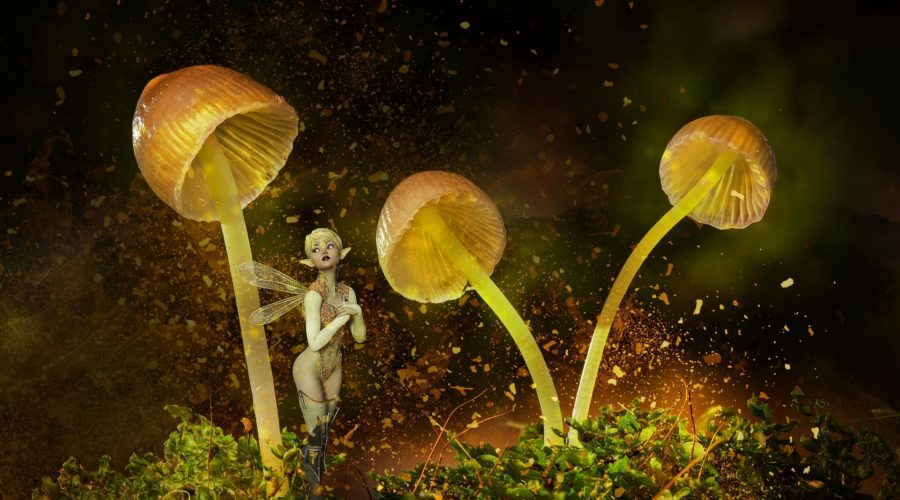
Let’s All Argue About DMT Elves: Are They Real or Not?
Last reviewed and updated: June 21, 2026.
Key Takeaways
| Research scale | JHU 2020 survey: 2,561 DMT entity encounter reports; 99% perceived entities as conscious; 78% benevolent; 58% “more real than real” |
| Ontological impact | 41% said the encounter changed their belief that such entities exist independently — the most striking and studied aftereffect |
| Common entity types | Guides/helpers, aliens, elf- or gnome-like beings; appear in consistent “DMT space” (geometric, dome-like, crystalline) |
| Scientific status | No fully satisfying mechanistic explanation; social neural network activation and predictive processing proposed; extended-state IV DMT (Timmermann 2023) enabling clinical study |
| Ontological debate | Three positions: purely psychological projection • psychologically real but metaphysically uncertain • independently existing — science cannot currently distinguish them |
One of the hallmarks of the DMT trip experience is seeing, meeting, and interacting with entities. These entities, seemingly conscious and intelligent, can take on many different forms. However, “machine elves” (or DMT elves) is the term that the psychedelic activist and lecturer Terence McKenna used to describe them.
DMT elves are strange entities, as you can tell by the name McKenna assigned to them. But what are they exactly? And why do people see them? There are no clear-cut answers to these questions, but there are certainly different interpretations, which we will be delving into.
Interested in joining a Psychedelics Clinical Trial? Sign up here now and we will connect you with a clinical trial in your area when one becomes available.
What Are DMT Elves?
McKenna often speaks openly about his DMT experiences — and in great detail. In fact, he was one of the first and loudest psychedelic activists to talk about DMT in front of audiences.
The substance was around in the 60s, the heyday of the psychedelic movement. But it was pretty niche. Sure, figures like Timothy Leary, William Burroughs, and Nick Sand experimented with DMT, but it wasn’t widely used or known. That changed in the 90s, however, when McKenna raved enthusiastically about its bizarre effects.
Psychedelic users continue to appreciate McKenna’s descriptions of the DMT experience. Many of his recordings are available on YouTube, as well as in archives — like the one assembled by Psychedelic Salon.
Here are the Different Types of DMT Elves, What they Look Like and What They Can Mean
| Type of DMT Elf | Appearance | Behavior | Interpretation/Significance |
| Classic Elves | Often described as small, humanoid, and impish. They can appear bioluminescent or transparent, with some users reporting them wearing hats or engaging in comical behavior. | They often communicate telepathically, perform dances or songs, and seem to be playful, mischievous, or welcoming. They can show users complex geometric patterns or objects. | Often interpreted as guides or helpers, providing insights into the nature of reality, consciousness, or the self. Some believe they embody aspects of the user’s mind or subconscious. |
| Mechanical Elves | These entities have a mechanical or digital nature. They may appear robotic or composed of complex, ever-changing geometric patterns. | They are often seen working on complex tasks or showing users strange, intricate structures. They may impart knowledge or wisdom. | Many interpret them as architects of reality or as representatives of a higher intelligence. Their tasks can be seen as metaphoric for the complexity and interconnectedness of the universe. |
| Jester Elves | Appear as jesters, tricksters, or clowns, often with vibrant, fluctuating colors. | They engage in nonsensical or paradoxical behavior and speech, sometimes showing the user strange or absurd images/scenes. They can be either playful or unsettling. | These entities can symbolize the absurdity or paradoxical nature of existence. Their antics may provoke self-reflection or a reevaluation of one’s beliefs. |
| Alien Elves | These resemble extraterrestrials or have a distinctly non-human, otherworldly appearance. | They often communicate through complex symbols or telepathy. They may show users alien landscapes or technologies. | These entities can symbolize the vastness and diversity of the universe or consciousness. Interactions with them often lead to feelings of awe or a broader perspective. |
RELATED: What to Bring to a Psychedelic Treatment, And What to Leave Behind
McKenna’s Description Of The DMT Elves
In a recorded interview, McKenna says that in the DMT experience:
“I encounter self-transforming elf machines, which are creatures, entities perhaps, although they’re not made out of matter. They’re made out of, as nearly as I can figure it out, syntax-driving light.”
By syntax, McKenna really means language. McKenna continues:
“They use a language which you see. It is made out of sound, it is sound, but you see it. And the entire point of the encounter, from their perspective, is to teach you to do this.”
Elsewhere, McKenna has said:
“You pass through a membrane of some sort, and you’re in a place. You’re pushed through, and you see the tykes, as I call them. The self-transforming machine elves that are singing in a hyperdimensional language. They surround you and say, “Welcome, we’re so glad to see you.”
This is a common experience. Many other users perceive some sort of indecipherable language being spoken by the DMT elves but perceived visually. The language has often been referred to as runes or alien letters. And the DMT elves often tend welcome you to their space in a friendly and celebratory way. However, during some experiences, they may be more hostile or threatening.
McKenna introduced the terminology “machine elves” or “clockwork elves”, but he is not the only one to experience them. McKenna’s descriptions have helped many users describe and interpret their own (similar) experiences. “Machine elves” have now become part of the DMT lexicon.
McKenna also described these DMT entities as “jeweled self-dribbling basketballs”, “translinguistic elves”, “friendly fractal entities”, “elf legions of hyperspace”, “tykes”, “meme traders”, “art collectors”, and “syntactical homunculi”.
RELATED: How Psychedelics Help Somatic Therapy
What Do DMT Machine Elves Look Like?
There is no single form that the DMT machine elves take. From the name, you would think that they would be half-machine, half-elf — an elf made out of machine parts, in other words.
However, their existence does not come from gears, steam, computers, and engine parts. For many people, DMT machine elves are nothing like the robotic, mechanized creations you see in sci-fi films. So while a DMT machine elf may conjure up an image of a tiny robot with pointy, elfin features, the entity can look quite different in the trip itself.
Why Do People See DMT Elves?
It is a mystery why DMT machine elves are a common feature in DMT experiences. There are different explanations as to why they appear.
McKenna’s Speculations
McKenna presented some theories regarding what these entities were:
- Extraterrestrials. Aliens that have a different biology or that may not even be made of matter. In order to interact with humans, they hide inside the DMT experience, rather than visit us on starships.
- Entities in a Parallel Dimension. The DMT elves are entities that exist in a nearby world, accessible only through the ‘magical doorway’ of the DMT experience.
- Dead People. Human souls in another dimension.
- Humans From the Future. McKenna said that the DMT machine elves could be “humans from some extraordinarily advanced future world where human beings are now made of language and are only two-and-a-half feet tall, so I would put it rather far in the future.”
These are quite far-out theories, no doubt. There are other explanations based on human psychology.
Evolutionary Psychology
Michael Winkelman, an anthropologist who was a professor at Arizona State University for many years, wrote a 2018 paper on psychedelic entities from an evolutionary perspective.
He found that ayahuasca and DMT entities were similar to conceptions of gnomes, dwarves, elves, angels, and extraterrestrials. Psychedelic entities, he states, “exemplify the properties of anthropomorphism, exhibiting qualities of humans.”
Winkelman argues the features of these entities reflect certain innate aspects of human psychology, which evolved for our advantage. These capacities also help explain why people experience spirits and believe in them.
These human tendencies include:
- Agency Detection: Perceiving agents with intentions in one’s surroundings.
- Anthropomorphism: Attributing human characteristics to non-human things or events.
- Theory of Mind (ToM) or Mindreading: Inferring the mental state of another.
These faculties, if activated by DMT, could account for the anthropomorphic appearances and behaviors of the DMT entities.
The entities may be the end result of the brain trying to predict patterns in ambiguous stimuli, combined with agency detection and the complex fractal imagery that is characteristic of DMT. Indeed, many users report that these beings have a geometric flare to them. Certain fractal or geometric shapes may also lend a certain ‘elfin’ quality to the beings.
There is still a lot we don’t know about DMT machine elves. Scientific research may provide us with further insights into their nature and why they appear. However, the fact that they can seem so real still leaves many questions unanswered.
What Research Has Found About DMT Entity Encounters
The question of whether “machine elves” and other DMT entities are real has moved — at least partially — from philosophy forums into peer-reviewed research. Here is what the science has begun to establish.
A major survey documented DMT entity encounters systematically. In 2020, Johns Hopkins researchers published a landmark survey study in the journal Frontiers in Psychology (Timmermann et al.) examining entity encounters among 2,561 individuals who reported having encountered an entity during a DMT experience. The findings were striking: 58% reported the entities as “more real than real,” 99% perceived them as conscious beings, 78% perceived them as benevolent, and — most provocatively — 41% of respondents said the encounter changed their view of reality, often in the direction of believing that the entities exist in some real sense independently of the drug experience. The most commonly encountered entities were guides/helpers, aliens, and (yes) elves or gnomes. The survey was descriptive rather than mechanistic, but it provided the first large-scale systematic data on a phenomenon that had previously existed almost entirely in anecdote.
Extended-state DMT research has changed what’s possible to study. The development of IV DMT protocols that maintain plasma DMT levels for 30–75 minutes (Timmermann et al., 2023, Beckley Psytech) has created a research context in which entity encounters can be studied in a controlled clinical setting, with participants able to communicate during the experience. This extended-state methodology has allowed researchers to study the phenomenology of entity encounters more rigorously than was possible with brief smoked DMT experiences. The research has confirmed that entity encounters in extended DMT states share consistent phenomenological features across individuals — supporting the view that they represent a coherent psychological phenomenon rather than idiosyncratic hallucinations.
The ontological question remains genuinely open. The academic debate about what DMT entities “are” has become more sophisticated. The positions range from: (1) purely psychological — entities are projections of the user’s mind, constructed from archetypes, cultural material, and the brain’s predictive processing systems; (2) psychologically real but ontologically uncertain — entities are consistent psychological experiences that have genuine subjective reality regardless of their metaphysical status; (3) independently existing — entities have some form of existence outside the individual mind. Neuroscience currently has no tools to definitively distinguish between these positions. What the research has established is that entity encounters are consistent, cross-culturally present, meaningful to experiencers, and sometimes transformative — whether or not they are “real” in the sense that the chair you’re sitting on is real.
Frequently Asked Questions
What are DMT elves and why do so many people encounter them?
DMT elves — also called “machine elves,” “clockwork elves,” or more broadly “DMT entities” — are autonomous-seeming beings that many people report encountering during DMT experiences. The term “machine elves” was coined by ethnobotanist Terence McKenna to describe beings he encountered that appeared to be made of language, light, and impossible geometry. The consistency of entity encounters across different people, cultures, and time periods is striking: a Johns Hopkins survey of 2,561 DMT entity encounter reports found consistent descriptions of beings perceived as conscious, intelligent, and often communicating — despite respondents coming from diverse cultural backgrounds. The most common types reported were guides or helpers, aliens, and elf- or gnome-like beings. Why so many people encounter entities is not fully explained — the brain’s social processing and face-detection systems, pattern completion, and the powerful activation of DMT’s visual and conceptual networks are proposed but not proven mechanisms.
What do DMT entities actually look like?
Reports vary considerably but share some consistent features: entities are typically perceived as autonomous beings with apparent intelligence and intentionality — they communicate, respond to the experiencer, and seem to have agendas of their own. They frequently appear in impossible geometric spaces or environments that feel more real than ordinary reality. The “machine elf” or “clockwork elf” archetype involves beings that appear to be made of language, light, or self-transforming structures — often associated with Terence McKenna’s descriptions. Other common forms include humanoid beings of light, alien beings, ancestral figures, and occasionally frightening or threatening entities (roughly 22% in the Johns Hopkins survey, versus 78% benevolent). The environment they inhabit is frequently described as “the DMT space” — a consistent geometric, dome-like, or crystalline realm that experiencers recognize across encounters.
Is there a scientific explanation for DMT entity encounters?
No fully satisfying scientific explanation exists. Several mechanisms have been proposed: (1) The brain’s social neural network (the same system that detects faces and attributes intent to others) may be activated in unusual ways by DMT, producing the experience of encountering autonomous beings. (2) Predictive processing theories suggest the brain generates entities from deeply held priors about what the world contains — during DMT, with normal sensory input suppressed, internal models may generate autonomous agents. (3) Some researchers have proposed that DMT’s activation of sigma-1 receptors (which modulate sensory gating) and its effects on the default mode network may create the conditions for entity encounters. None of these explanations account for the cross-cultural consistency of the encounters, the sense of independent reality, or the profound meaning experiencers attribute to them.
Do people think DMT entities are real after their experience?
Yes, often. The Johns Hopkins survey (2020) found that 41% of respondents said their DMT entity encounter changed their belief that such entities exist — the encounter shifted their ontological worldview. 58% described the entities as “more real than real.” Many respondents who identified as atheists or agnostics before the encounter changed their beliefs afterward. This ontological aftereffect — the lasting conviction that what was encountered was genuinely real — is one of the most distinctive features of DMT entity encounters compared to other hallucinatory experiences, and is a primary focus of ongoing research into what makes these experiences so impactful and sometimes spiritually transformative.




Martin Benbow
March 4, 2023 at 10:04 pmMy ex girlfriend when dying, saw little men running around the room? Not freaked out about it, was it the drugs they were giving her?
Daniel P Shannon
March 26, 2023 at 1:05 amThis was one of the best articles I’ve ever read. This type of stuff blows my mind but I live thinking about if there are other dimensions or a afterlife. I would love to read more about this. Thank you for writing this