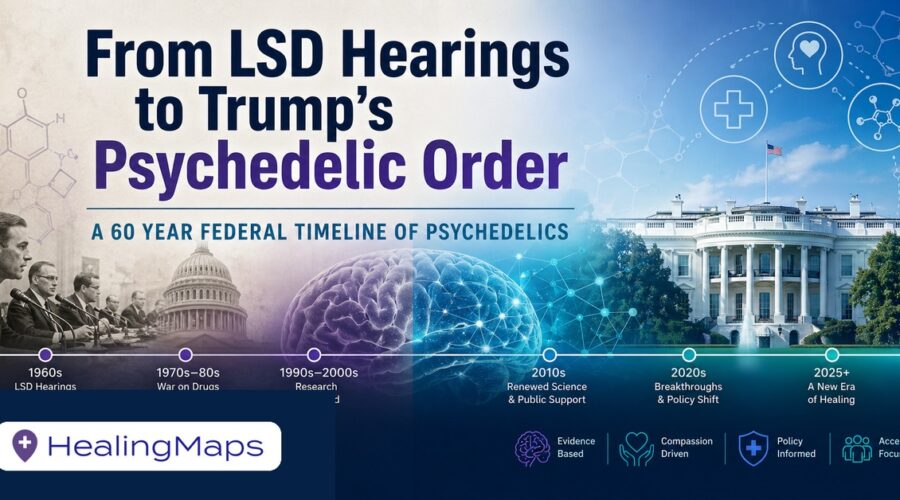
From LSD Hearings to Trump’s Psychedelic Order: A 60 Year Timeline of Washington’s Evolving View of Psychedelics
President Donald Trump’s new executive order on psychedelics did not come out of nowhere. It arrived after decades of political fear, medical caution, scientific persistence, and growing frustration with America’s mental health crisis. For anyone following psychedelic medicine, the order marks a striking moment. It is also part of a much longer story.
Looking for treatment? Find Spravato clinics (which is covered by insurance) and ketamine clinics closest to you as well as other psychedelic therapies in your area.
| Key takeaway | What it means |
|---|---|
| Psychedelics were once discussed openly as possible medical tools. | In the 1960s, federal officials acknowledged that LSD could have therapeutic value. |
| Public concern changed the conversation. | As unsupervised use rose, psychedelics moved from the lab into the politics of drug control. |
| The War on Drugs reshaped federal policy. | Psychedelics became grouped with other illegal drugs under a broad enforcement framework. |
| Research never fully disappeared. | Scientists continued to study psychedelics, even under strict federal limits. |
| The modern revival is institution driven. | FDA, NIH, VA, and academic researchers helped move psychedelics back into serious medical discussion. |
| Trump’s executive order marks a new federal posture. | The administration is not just allowing research. It is directing agencies to accelerate review, access, and study. |
Save 40%+ on Your Medical Supplies
GPO-level pricing negotiated through Pipeline Medical, exclusively for Healing Health Alliance members. One member practice is projected to save $38,000+ a year. Find out how much we can save your clinic — no obligation, no contracts.
See Your Clinic’s Savings →(43% reduction on supply spend)
The Federal Psychedelic Story Did Not Start With Trump
The current psychedelic medicine boom can feel new. In policy terms, it is more like a return.
In the 1950s and 1960s, LSD and other psychedelics were studied by psychiatrists, government funded researchers, and major medical institutions. Researchers explored whether these drugs could help with alcoholism, depression, anxiety, and other psychiatric conditions.
That early work did not happen on the fringe. It involved the Food and Drug Administration, the National Institute of Mental Health, the Veterans Administration, and federally funded scientists.
Then the mood changed.
As LSD spread beyond clinical settings, the federal government began to view psychedelics less as experimental medicines and more as a public danger. The drugs became linked to youth rebellion, social unrest, and the broader politics of the late 1960s.
By the 1970s, the government’s focus had shifted. Psychedelics were no longer primarily framed as possible treatments. They were treated as part of the national drug problem.
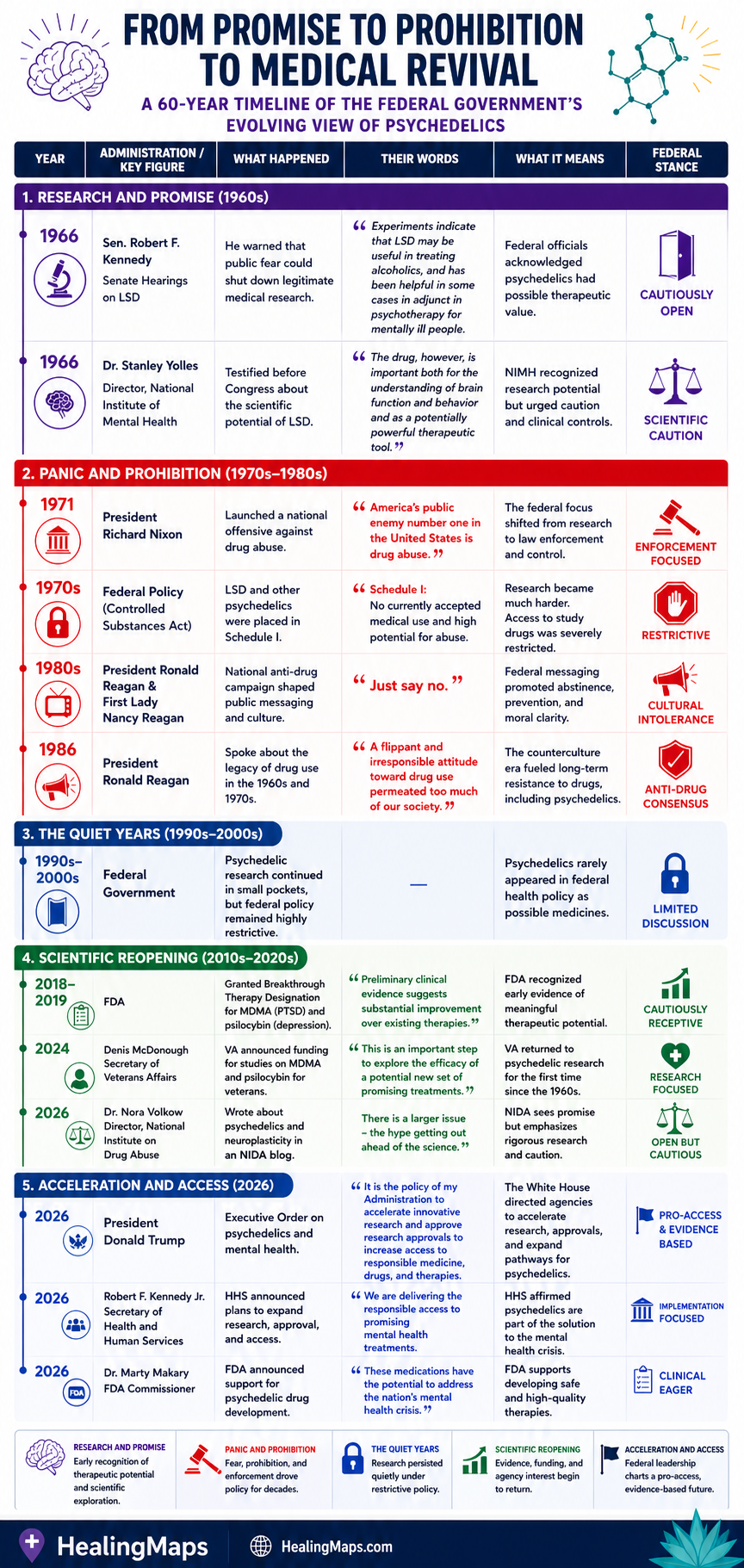
1966: Federal Officials Still Saw Medical Promise
One of the most revealing moments came in 1966, during Senate hearings on LSD.
Senator Robert F. Kennedy warned that public fear could damage serious medical research. He said experiments suggested LSD “may be useful in treating alcoholics” and had been helpful in some psychotherapy cases.
Kennedy’s concern was not that LSD should be freely available. His concern was that panic might shut down legitimate science.
He put it plainly: “If we in the federal government allow these legitimate uses to be interfered with, the loss to the nation and potentially for the handicapped would be serious indeed.”
That quote captures the era’s complexity. Federal officials saw risks. But they also saw possibility.
Dr. Stanley Yolles, then Director of the National Institute of Mental Health, offered a similar view. He described LSD as “important both for the understanding of brain function and behavior and as a potentially powerful therapeutic tool.”
Yolles also urged caution. He said hallucinogens should only be administered by trained physicians and only in carefully controlled experiments until clearer safety and efficacy data existed.
That balance sounds familiar today. Promise, caution, clinical controls, and the need for better evidence remain central to the psychedelic medicine debate.
1971: The War on Drugs Changes the Frame
Five years later, the federal tone had changed dramatically.
On June 17, 1971, President Richard Nixon declared drug abuse “America’s public enemy number one.” His administration called for a new national offensive against drugs.
This was not only about psychedelics. Heroin, cannabis, and other substances drove much of the policy debate. But psychedelics were swept into the same broader framework.
The Controlled Substances Act placed LSD and other psychedelics in Schedule I. That category is reserved for substances defined as having no currently accepted medical use and a high potential for abuse.
The result was profound. Research became harder. Access to study drugs became more complicated. Institutional support declined.
For patients, the door closed before the science had fully matured.
1980s: Just Say No and the Politics of Intolerance
The Reagan administration pushed the federal anti drug message even further into American culture.
President Ronald Reagan and First Lady Nancy Reagan made drug prevention a national campaign. The phrase “Just Say No” became one of the most recognizable public health messages of the decade.
In 1986, Reagan criticized what he called a “flippant and irresponsible attitude toward drug use” in the late 1960s and 1970s. He praised a new national consensus against drugs.
Another Reagan era message was even more direct. Nancy Reagan had said the country needed to create “an atmosphere of intolerance for drug use.”
That language mattered. It left little room for distinctions between medical research, spiritual use, recreational use, and substance misuse.
Psychedelics became culturally associated with danger, not treatment. The idea that they might help depression, trauma, or addiction largely disappeared from mainstream federal conversation.
1990s and 2000s: A Long Quiet Period
The next two decades were not empty. Researchers, advocates, and small clinical teams continued pushing the field forward.
But federal rhetoric stayed cautious. Psychedelics remained tightly controlled. They rarely appeared in mainstream federal health policy as possible medicines.
This silence is part of the story.
The government did not need to repeatedly condemn psychedelics for the chilling effect to continue. Schedule I status, research barriers, and cultural stigma were enough.
By the early 2000s, most Americans knew psychedelics as illegal drugs. Far fewer knew they had once been studied as psychiatric tools.
The 2010s and 2020s: Science Reopens the Door
The modern shift did not begin with politics. It began with data.
Academic centers began publishing studies on psilocybin, MDMA, depression, PTSD, end of life distress, and substance use disorders. Johns Hopkins, NYU, Imperial College London, UCSF, and other institutions helped bring psychedelic research back into mainstream medicine.
The FDA also played a key role. It granted breakthrough therapy status to MDMA for PTSD and psilocybin for depression, based on promising early evidence.
That designation does not mean a drug is approved. It means preliminary clinical evidence suggests the treatment may offer substantial improvement over existing therapies.
For the federal government, this was a meaningful shift. Psychedelics were no longer only objects of control. They were investigational treatments.
2024: The VA Steps Back Into Psychedelic Research
In 2024, the Department of Veterans Affairs announced funding for studies of MDMA and psilocybin for PTSD and depression in veterans.
The announcement was historic. VA said it was the first time since the 1960s that the agency would fund research on these compounds.
Secretary of Veterans Affairs Denis McDonough framed the move as a matter of care. “Our nation’s Veterans deserve the very best care,” he said. “This is an important step to explore the efficacy of a potential new set of promising treatments that could improve the health and quality of life for Veterans.”
Dr. Shereef Elnahal, VA’s Under Secretary for Health, said veterans and VA researchers had been talking about the promise of psychedelics “for some time.”
The VA announcement showed how the federal conversation had changed. Psychedelics were still restricted. But they were also being studied as possible tools for some of the hardest mental health conditions to treat.
2026: NIH Sees Promise and Risk
In January 2026, Dr. Nora Volkow, Director of the National Institute on Drug Abuse, wrote about psychedelics and neuroplasticity.
Her message was careful but open.
She noted that the potential use of psychedelics for mental health conditions had become a major area of scientific research and public interest. She also wrote that NIDA and the National Institute of Mental Health were among the largest NIH funders of psychedelic research.
That sentence alone shows how much has changed.
Still, Volkow warned against rushing ahead. She wrote that there was “danger of the hype getting out ahead of the science.”
That line should sit near the center of any honest discussion about psychedelic medicine. The field has promise. It also has major unanswered questions.
Researchers still need to better understand durability, patient selection, therapy support, safety protocols, and long term outcomes.
The modern federal stance is no longer simple prohibition. It is cautious investigation.
2026: Trump’s Executive Order Moves From Research to Access
Trump’s executive order marks a more aggressive federal step.
The order states that psychedelic drugs, including ibogaine compounds, show potential in clinical studies for serious mental illnesses when standard treatments fail. It says the administration’s policy is to accelerate research models and appropriate drug approvals to increase access.
That is a major shift in federal language.
The order directs FDA to prioritize certain psychedelic drugs with breakthrough therapy designations. It also directs FDA and DEA to establish a pathway for eligible patients to access investigational psychedelic drugs, including ibogaine compounds, under Right to Try.
The order also calls for at least $50 million through ARPA H to support state partnerships on psychedelic research for serious mental illness.
It directs HHS, FDA, and VA to work with each other and the private sector to increase clinical trial participation, data sharing, and real world evidence generation.
In plain English, the order tells federal agencies to move faster.
FDA Follows With Action
Days after the executive order, FDA announced several steps tied to psychedelic drug development.
HHS Secretary Robert F. Kennedy Jr. said the administration was accelerating “research, approval, and responsible access” to promising mental health treatments, including psychedelic therapies like ibogaine.
FDA Commissioner Dr. Marty Makary said these medications have the potential to address treatment resistant depression, alcoholism, and other serious mental health and substance use conditions.
He also emphasized that development must be grounded in “sound science and rigorous clinical evidence.”
That balance may define the next era of psychedelic medicine. Federal agencies are now more open to these treatments. But approval still depends on data.
The Through Line: Promise, Fear, and Return
The federal government’s stance on psychedelics has never been static.
In the 1960s, officials saw potential but feared misuse. In the 1970s and 1980s, fear took over. By the 1990s and 2000s, the subject largely disappeared from serious federal health conversation.
Now the pendulum has moved again.
The new federal stance does not erase Schedule I barriers. It does not approve psilocybin, MDMA, LSD, ibogaine, or related compounds for general medical use. It does not guarantee access for patients tomorrow.
But it does signal that psychedelics are no longer being treated only as relics of the counterculture or targets of drug enforcement.
They are being evaluated as possible medicines.
For HealingMaps readers, that distinction matters. The question is not whether psychedelics are “good” or “bad.” The better question is what the evidence shows, who may benefit, what risks remain, and how policy can support safe access without outrunning the science.
Why This Moment Matters
The Trump executive order is important because it brings together several forces that have been building for years.
Veterans groups have called for new PTSD treatments. Depression rates remain high. Substance use disorders continue to strain families and health systems. Traditional treatments help many people, but not everyone.
At the same time, psychedelic research has matured. The field now has clinical protocols, peer reviewed studies, trained investigators, and federal engagement.
That does not mean the science is settled. It means the federal government is treating the field as serious enough to accelerate.
That is the real shift.
After decades of seeing psychedelics mainly through the lens of crime and control, Washington is again asking whether these substances could help patients who have run out of options.
In some ways, the country has returned to a question federal officials were asking in 1966.
Powerful, risky, mind altering drugs may have medical value. The challenge now is whether the federal government, researchers, regulators, and clinics can create a system that studies them carefully and uses them responsibly.
The answer is still being written.