
The FTC Just Sued Hims & Hers Over Tracking Pixels. Your Clinic Probably Runs Them Too
The Federal Trade Commission sued Hims & Hers on July 29, 2026. Utah and California, acting through Los Angeles County Counsel, joined the complaint. The allegations reach well past one telehealth company, because they describe practices that are common across cash pay medicine.
If your clinic runs an ad pixel, bills at intake, or sells a subscription, this filing is worth twenty minutes of your attention.
Running a clinic is expensive. The Healing Health Alliance makes it cheaper. HealingMaps’ GPO, built to leverage the power of independent clinics, gets members 40 percent or more off medical supplies, 10 percent or more off malpractice coverage, discounted LegitScript certification, and 20 to 30 percent off HIPAA compliant payment processing. Joining is free with no obligation.
Key Takeaways
| Question | What We Know |
|---|---|
| Who filed? | The FTC, joined by Utah and California (through Los Angeles County Counsel) |
| When? | July 29, 2026, in federal court in Northern California |
| What is alleged? | Sharing health data with advertisers, charging before customers could approve treatment, and cancellation barriers |
| Which platforms? | The complaint names Meta and Snap, among other ad and tech platforms |
| What does Hims say? | The company denies the claims and says it will fight the case |
What the Complaint Actually Alleges
The filing covers three separate practices. Each one maps to something ordinary clinics do every day.
First, data sharing. The FTC alleges the company sent customer health information to advertising platforms through tracking pixels and uploaded customer lists. Second, billing. The agency alleges customers were charged almost immediately after submitting an intake form, before they could review or approve a provider’s recommendation. Third, cancellation. The complaint alleges the subscription was difficult to exit.
Hims & Hers rejects the allegations. The company argues the suit ignores established state telehealth laws and industry standards, and says it will defend itself in court. You can read the agency’s own summary in the FTC announcement of the action.
Why This Reaches Past One Company
Nothing in these allegations requires a company the size of Hims. A tracking pixel costs nothing to install. Most clinics added one years ago to retarget website visitors, and never thought about it again.
The risk appears when that pixel sits on a page where patients disclose something medical. An intake form counts. A page about erectile dysfunction, weight loss, or hormone therapy counts. When the pixel fires, it can transmit the page address and a user identifier. That combination can imply a health condition, and that is the theory of the case.
None of this is a novel theory. In 2023, the FTC and HHS jointly warned hospitals and telehealth providers to examine the tracking technologies running on their websites and apps.
How Common Is This in Peptide and Ketamine Medicine?
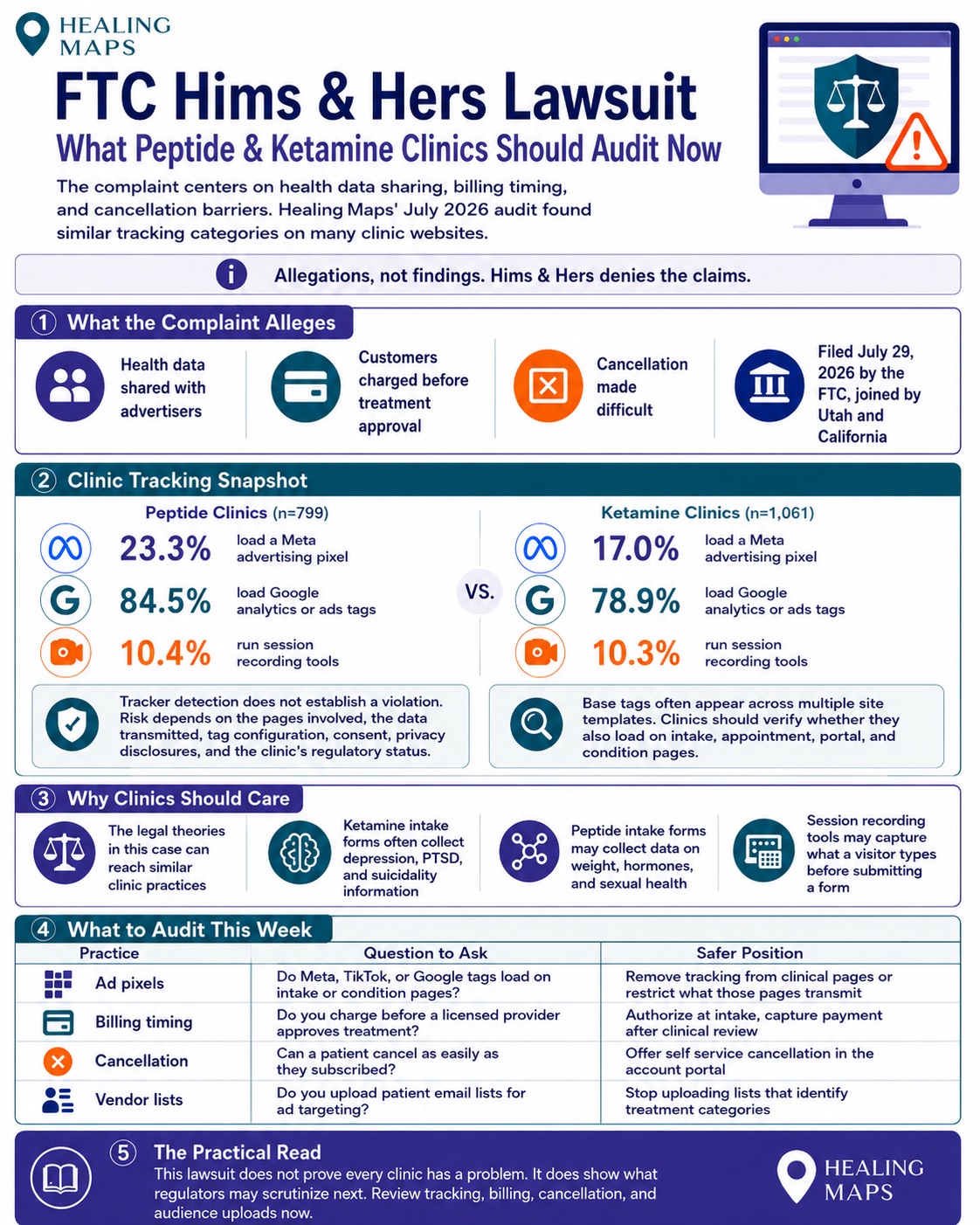
We checked. HealingMaps analyzed the public websites of 799 reachable peptide clinics and 1,061 reachable ketamine clinics in July 2026, looking for the same categories of tracking named in the complaint.
Nearly one peptide clinic in four, and one ketamine clinic in six, loads the same category of Meta advertising tracker named in the complaint. These tags were detected on public homepages. Base tags often appear across multiple website templates, so clinics should confirm whether they also load on intake, appointment, portal, and condition pages.
One important qualification: tracker detection does not establish a violation. Risk depends on the pages involved, the data transmitted, tag configuration, consent, privacy disclosures, and the clinic’s regulatory status. These numbers show exposure worth investigating, not a finding of unlawful sharing.
The session recording number deserves its own attention. Those tools can capture what a visitor types before they ever press submit. On a form asking about weight, hormones, sexual health, or depression symptoms, that is sensitive information moving to a third party.
For ketamine clinics the exposure is sharper.
The FTC’s BetterHelp order treated mental health data as the most sensitive category there is. Ketamine intake forms routinely screen for depression, PTSD and suicidality, so the information a misconfigured tracker could touch is far more sensitive.
HealingMaps Intelligence
This data comes from our new 2026 Peptide & GLP-1 Clinic Intelligence Report.
The full report benchmarks 846 verified clinic menus, 2,905 advertised prices, and the marketing, tracking, and compliance practices of 807 clinic websites. See exactly where your clinic stands on pricing, conversion, and regulatory exposure.
Get Lifetime Access for $299 →One time purchase · Access code emailed within 2 hours · All 50 states covered
Run a ketamine clinic? The 2026 Ketamine Clinic Intelligence Report covers your side of the market.
The Three Practices Worth Auditing This Week
Start with your own site rather than your lawyer. You can answer most of these questions in an afternoon.
| Practice | The Question to Ask | The Safer Position |
|---|---|---|
| Ad pixels | Do Meta, TikTok or Google tags load on intake forms and condition pages? | Remove tracking from clinical pages, or restrict what those pages transmit |
| Billing timing | Do you charge before a licensed provider approves treatment? | Authorize at intake, capture payment after clinical review |
| Cancellation | Can a patient cancel in the same number of clicks it took to subscribe? | Offer self service cancellation in the account portal |
| Vendor lists | Do you upload patient email lists to ad platforms for audience targeting? | Stop uploading lists that identify treatment categories |
Compliance attention on this category keeps rising. We covered the marketing language regulators flag in our breakdown of an FDA GLP-1 warning letter, and the certification most clinics still skip in our look at LegitScript certification.
The Practical Read
A lawsuit is not a verdict. The court has decided nothing, and the company is contesting every claim. But enforcement priorities are visible well before rulings arrive.
The agency chose a marquee defendant in exactly the business model many peptide and GLP-1 clinics now run. Cash pay, subscription based, marketed online, delivered by telehealth. Treat the filing as a published checklist of what regulators consider a problem, and work through it before anyone asks you to.