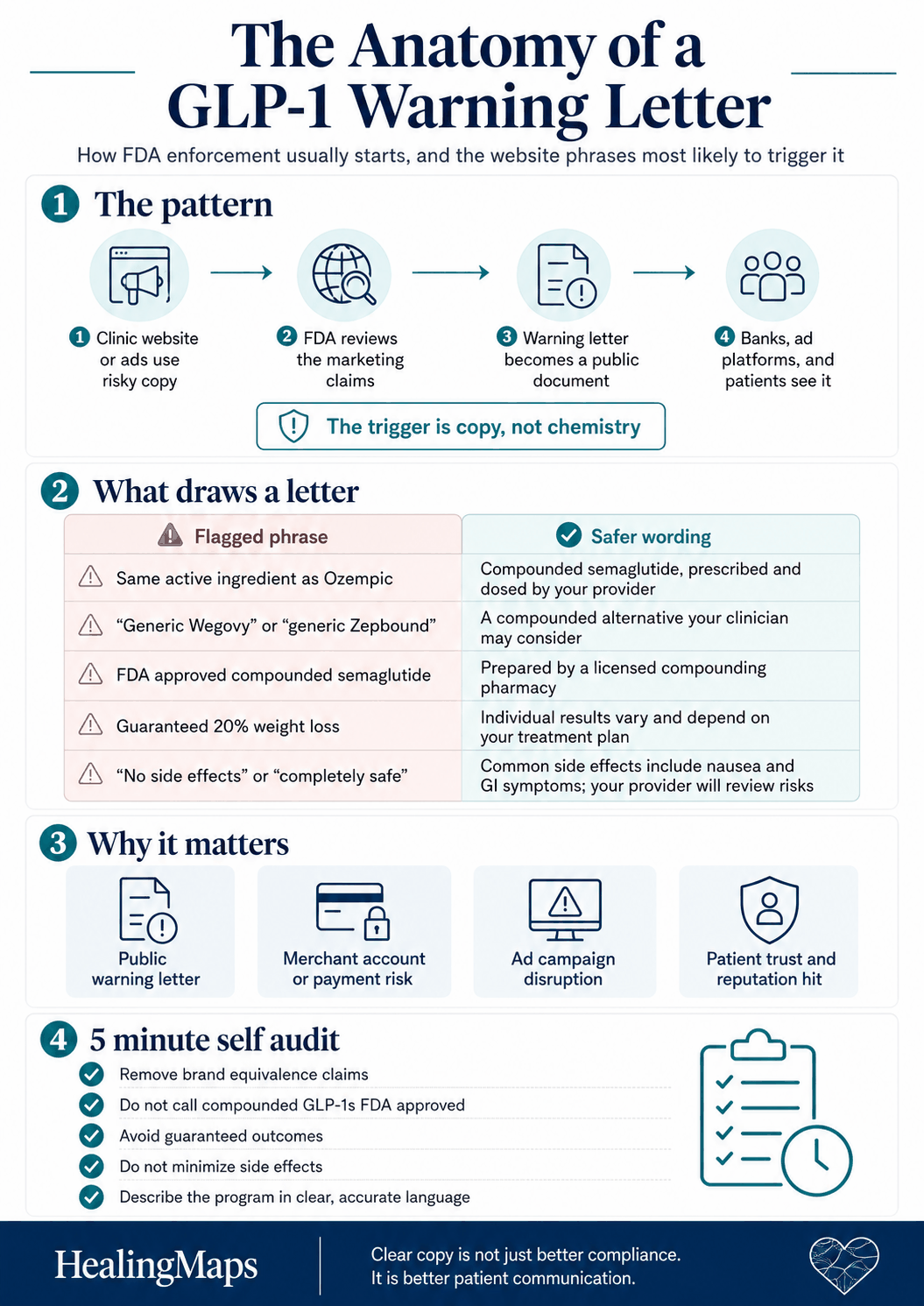
The Anatomy of an FDA GLP-1 Warning Letter
The FDA is not writing warning letters about the medicine in your GLP-1 program. It is writing them about the words on your website. In June 2026 the agency sent 25 warning letters to telehealth and compounding operations over false or misleading claims about compounded semaglutide, tirzepatide, and liraglutide. That followed more than 40 similar letters in late 2025 and over 50 in September 2025. The pattern is clear, and the trigger is copy, not chemistry. We traced how this enforcement pattern started, and why it points at ketamine marketing next, in our report on the FDA’s GLP-1 crackdown.
Key Takeaways
| Key Takeaway | What It Means |
|---|---|
| The trigger is marketing language | Letters cite website and ad claims, not the compounding itself. |
| Brand comparisons are the top offense | “Same as Ozempic” and “generic Zepbound” draw direct fire. |
| Enforcement is escalating | Three waves of letters in under a year signal a sustained campaign. |
| A letter is a public document | Warning letters are posted online and read by banks and ad platforms. |
| Compliant copy is fixable today | Most flagged phrases have a clean, honest replacement. |
Why the FDA Reads Your Website
Compounded GLP-1 drugs live in a narrow legal lane. They are permitted under specific conditions, but they are not FDA approved products, and they cannot be marketed as equivalent to the branded drugs. When a clinic website says its compounded product is the “same active ingredient as Ozempic,” it makes an equivalence claim the FDA treats as false or misleading. The medicine may be fine. The sentence is the violation.
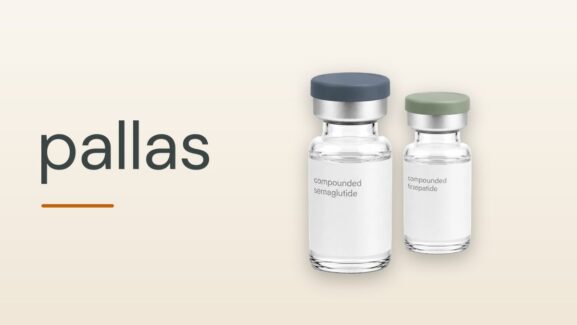
The agency laid out its position plainly in guidance on policies for compounders as GLP-1 supply stabilized. As the shortage that justified wide compounding eased, the enforcement focus shifted to the claims clinics use to sell it.
The Phrases That Draw Letters
Review the flagged language across the enforcement waves and a short list repeats. Brand name equivalence leads. Claims that a compounded product is “identical to” or “the generic version of” a branded drug appear again and again. Guaranteed outcome language follows, along with claims that minimize known risks or promise results no drug label supports.
The fix is not to hide your program. It is to describe it accurately. The table below pairs the most common flagged constructions with a compliant way to say the same thing.
| What Draws a Letter | What to Say Instead |
|---|---|
| “Same active ingredient as Ozempic” | “Compounded semaglutide, prescribed and dosed by your provider” |
| “Generic Wegovy” or “generic Zepbound” | “A compounded alternative your clinician may consider” |
| “FDA approved compounded semaglutide” | “Prepared by a licensed compounding pharmacy” (compounded drugs are not FDA approved) |
| “Guaranteed 20% weight loss” | “Individual results vary and depend on your treatment plan” |
| “No side effects” or “completely safe” | “Common side effects include nausea and GI symptoms; your provider will review risks” |
Why a Warning Letter Costs More Than a Fine
FDA warning letters are published on the agency website. That publication is the real cost. Acquiring banks, payment processors, and ad platforms monitor those lists. A letter can trigger a merchant account review, a held reserve, or a declined ad campaign long before any formal penalty arrives.
For a cash pay clinic, losing card processing is an operational emergency. The reputational hit compounds it, because prospective patients and referral partners can find the letter with one search. The medicine was never the problem, but the business consequences land on the whole practice.
The Compliance Layer Most Clinics Skip
There is a structural reason marketing compliance keeps tripping clinics up. Peptides, GLP-1 drugs, hormone therapy, and telemedicine are all flagged high risk by Visa, Mastercard, and the major ad platforms. To advertise or process payments in these categories, platforms increasingly expect LegitScript certification, an independent verification of clinician licensure and pharmacy compliance.
Certification does two things at once. It improves your odds of keeping a merchant account and running compliant ads, and the review process itself surfaces the exact marketing language that draws FDA attention. Clinics that treat certification as a checkbox miss its real value as a copy audit. The Healing Health Alliance helps member clinics reach LegitScript certification at a discount, precisely because it has become table stakes for staying online.
A Five Minute Self Audit
Open your website and read every line about your weight management program as if you were an FDA reviewer. Flag any sentence that compares a compounded product to a brand name drug. Flag any promise of a specific result. Flag any claim that a compounded product is FDA approved, because none are. Flag any language that minimizes risk.
Then rewrite each flagged line using the accurate construction. Describe what the drug is, who prescribes it, and what the patient can realistically expect. An honest version is almost always the compliant version, and it reads as more credible to patients anyway.
Why This Matters for Your Whole Peptide Menu
The warning letters have targeted GLP-1 drugs so far, but the principle behind them is not GLP-1 specific. It is the FDA enforcing on marketing language, and that standard applies to how you describe every compounded service you offer. The claims you make about BPC-157, TB-500, or a growth hormone peptide are read the same way as the claims you make about compounded semaglutide.
The reason GLP-1s came first is simple. They are the mass market, so they drew the first wave of attention. The rest of the peptide menu is now moving into a brighter spotlight of its own. The FDA advisory committee vote on July 23 and 24 puts BPC-157 and six other peptides under formal review, and regulatory scrutiny of the category is rising, not falling. Clean marketing copy is becoming more important across your entire service list, not less.
This is why the compliance layer is worth building once, for everything. LegitScript certification and accurate copy protect your peptide programs, your hormone optimization, and your weight management side all at the same time. Audit the language across your whole menu now, while the enforcement wave is still concentrated on GLP-1s, rather than after it reaches the compound you rely on most.
The Bottom Line
The GLP-1 crackdown is a language enforcement campaign, and it is still accelerating. The clinics getting letters are not necessarily practicing worse medicine. They are describing it in words the FDA treats as misleading. Audit your copy this week, replace brand comparisons with accurate descriptions, and treat certification as the compliance layer it is. For where compounded GLP-1 access stands now, see our guide to semaglutide clinics and current sourcing, and for the affiliate and telehealth landscape, our peptide telehealth guide.