In early 2026, the FDA began turning up the pressure on companies marketing compounded GLP-1 medications. By March, the agency had announced 30 warning letters to telehealth companies over false or misleading claims, after sending thousands of letters to pharmaceutical and telehealth firms since the prior fall. Novo Nordisk, the manufacturer behind Ozempic and Wegovy, dismissed a patent lawsuit against a telehealth company after that company agreed to sell Novo’s branded drugs and stop advertising compounded versions. The pattern has since jumped drug classes: in July the FDA went after online ketamine sellers directly.
The weight loss industry is now learning an expensive lesson about promoting unapproved compounded drugs. Ketamine clinic owners should study that lesson closely, because parts of the ketamine market, especially the compounded oral, sublingual, and intranasal models, rest on the same structure.
The first exposure a regulator will read is not your infusion protocol. It is your website.
Here’s A Breakdown
Key Takeaway
Detail
The GLP-1 playbook is public
Thousands of FDA warning letters targeted marketing claims, not the drugs themselves
The compounded segment mirrors the structure
Oral, sublingual, and intranasal ketamine models rest on unapproved compounded products marketed for conditions the FDA never cleared
The FDA has already warned twice
Risk alerts in 2022 and 2023 flagged compounded ketamine for psychiatric use
The market runs on compounding
A Rhode Island analysis found 98.7 percent of ketamine dispensed in 2023 was in powder form, the form compounding pharmacies use
Enforcement can extend beyond the FDA
Clinic advertising could also draw scrutiny from state consumer protection officials and private litigants
The fix is an audit
Review every claim on your site, your ads, and your intake materials
How the GLP-1 Crackdown Unfolded
The sequence matters more than the headlines. The FDA did not begin by shutting down compounding pharmacies. It began with marketing. Warning letters cited promotional materials that implied compounded versions were equivalent to approved drugs, or that the FDA had reviewed them for safety and effectiveness. The enforcement theory targeted how compounded drugs were promoted to consumers, not whether compounding itself was legal.
Then came the manufacturer. Novo Nordisk sued a telehealth company over an off brand version of its patented drug, then dismissed the case after that company agreed to sell Novo’s branded medications and stop advertising compounded GLP-1 drugs. The price of peace was the end of compounded marketing. Regulator pressure and manufacturer litigation arrived as a pair. That two front pattern is the playbook, and it transfers to any market built on compounded alternatives to an approved product.
Why Ketamine Fits the Same Pattern
Now hold that playbook against the ketamine industry. Ketamine is FDA approved as an anesthetic. It is not approved for the treatment of any psychiatric disorder. The only approved ketamine derived psychiatric treatment is Spravato, which carries strict REMS controls. Everything else is off label, compounded, or both. IV infusion clinics typically administer the FDA approved anesthetic off label. Sublingual lozenges and nasal sprays are usually compounded products.
The at home segment depends on that compounded supply. One Rhode Island analysis of statewide prescribing from 2017 to 2023 found that 98.7 percent of the ketamine dispensed in 2023 was in powder form, the form compounding pharmacies use. The FDA has already put the industry on notice twice. A 2022 risk alert flagged compounded ketamine nasal spray. A broader 2023 warning covered oral and sublingual formulations, specifically citing at home use through telehealth. Those alerts read differently now. In the GLP-1 sequence, warnings came first. Letters came next.
The Legal Line Most Clinic Websites Cross
Prescribing off label is legal and common in medicine. Marketing an unapproved use directly to consumers is a different act with different rules. That distinction is where clinic websites get into trouble.
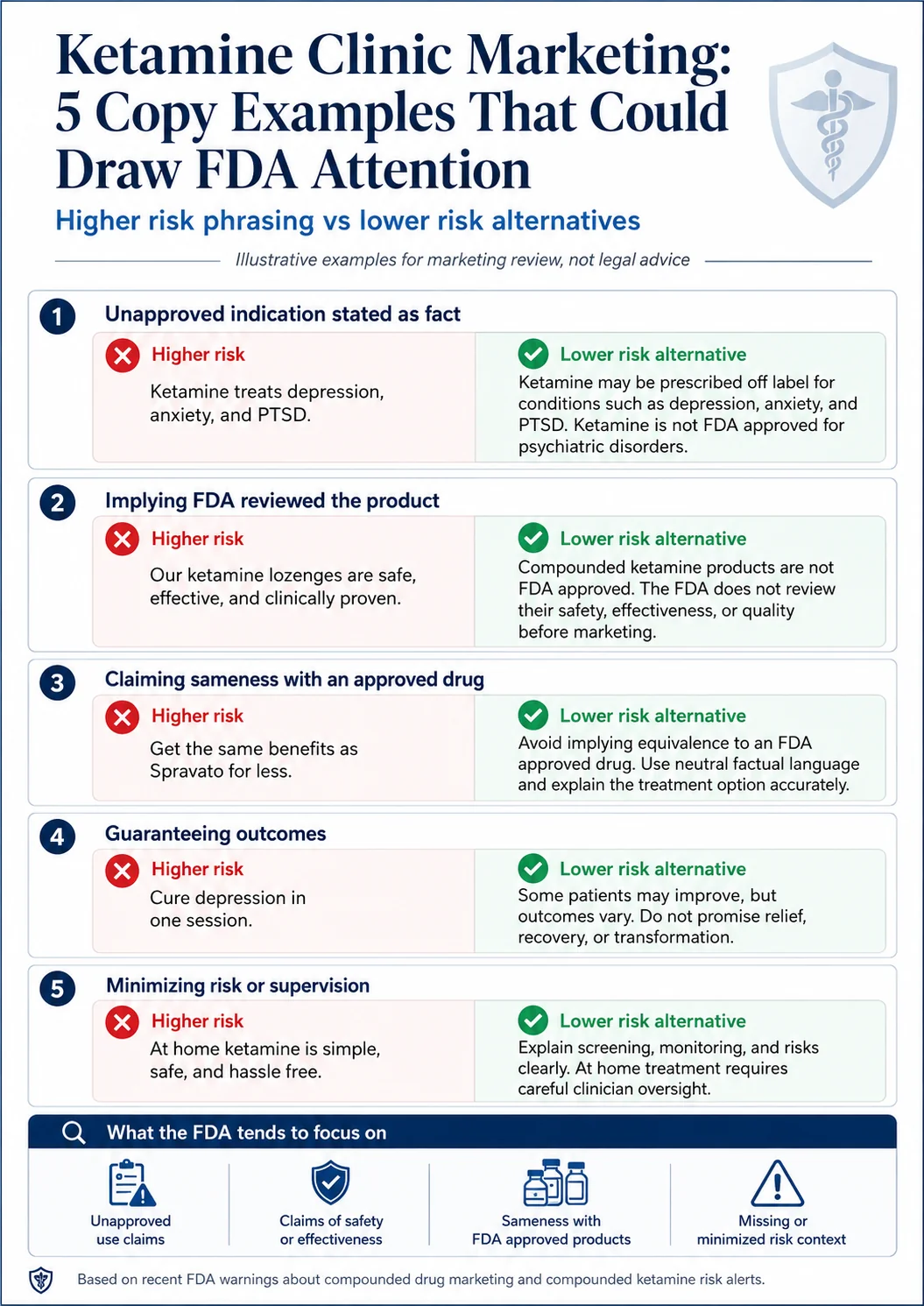
Read your own homepage as a regulator would. Does it say ketamine treats depression, anxiety, or PTSD as settled fact? Does it promise relief, recovery, or transformation? Does it feature patient testimonials describing cures? Each of those framings promotes an unapproved use of a compounded or off label drug. Health law analysts note that regulatory scrutiny in this space focuses on operational indicators, and accurate marketing sits near the top of the list alongside physician supervision and individualized treatment plans.
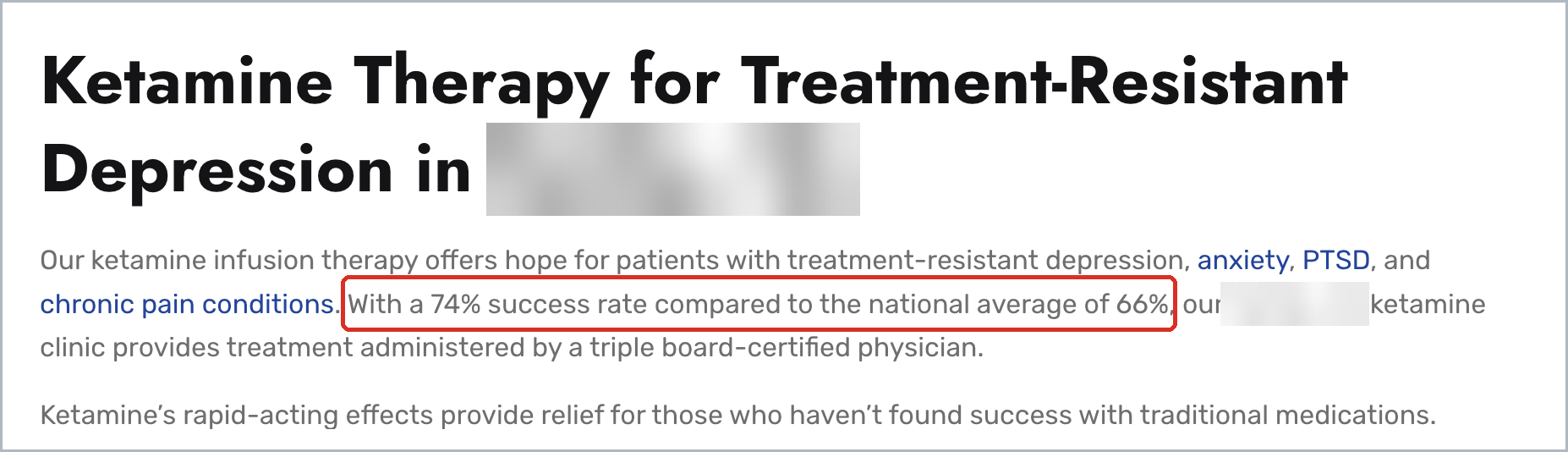
Here’s an Example From a Ketamine Clinic’s Website
Live on a U.S. ketamine clinic website today: an unsourced success rate claim, presented as marketing. This is the kind of language the three tests below are built to catch. Identifying details removed.
The Second Front: State Enforcement and Private Litigation
The FDA is not the only actor reading clinic websites. State attorneys general and consumer protection agencies could also scrutinize advertising and business practices in the ketamine space. Private litigants can follow the same trail. An aggressive marketing claim can become evidence in a malpractice suit, a consumer protection action, or a board complaint.
The manufacturer front deserves attention too. The GLP-1 episode showed that a drugmaker with an approved product will litigate against compounded competition. As approved psychedelic and ketamine derived products expand, the companies behind them inherit the same incentive. Clinics promoting compounded alternatives against an approved therapy should expect that dynamic to sharpen.
What a Marketing Audit Actually Looks Like
Set aside an afternoon this month and review every patient facing claim your practice makes. That means the website, Google and social ads, intake paperwork, email sequences, and printed materials in the waiting room.
Apply three tests to each claim. First, does it present an off label use as an approved indication? Second, does it promise or imply outcomes? Third, could you support the claim with evidence if a regulator asked tomorrow? Claims that fail get rewritten in conditional, accurate language. Describing ketamine as an off label treatment that some patients pursue for treatment resistant depression is defensible. Declaring that ketamine cures depression is not.
Five common phrasings that raise regulatory risk, and the lower risk alternative for each. Illustrative examples for marketing review, not legal advice.
Then document the audit itself. A dated record showing your practice reviewed its marketing for accuracy is exactly the artifact you want in the file if a letter ever arrives.
The Window Is the Point
The GLP-1 crackdown did not surprise anyone paying attention. The FDA telegraphed it through warnings for two years before acting. Compounded ketamine has received the same warnings on the same timeline. The clinics that treat this year’s enforcement wave as a preview will spend a few hours fixing their copy. The clinics that ignore it are betting their marketing against a playbook the government has already run once this year.
The Healing Maps Editorial Team has decades of experience across all facets of the psychedelic industry. From assessing studies and clinic research, to working with clinician's and clinics, we help provide data-backed information to psychedelic-curious individuals across the globe.
To provide the best experiences, we use technologies like cookies to store and/or access device information. Consenting to these technologies will allow us to process data such as browsing behavior or unique IDs on this site. Not consenting or withdrawing consent, may adversely affect certain features and functions.
Functional
Always active
The technical storage or access is strictly necessary for the legitimate purpose of enabling the use of a specific service explicitly requested by the subscriber or user, or for the sole purpose of carrying out the transmission of a communication over an electronic communications network.
Preferences
The technical storage or access is necessary for the legitimate purpose of storing preferences that are not requested by the subscriber or user.
Statistics
The technical storage or access that is used exclusively for statistical purposes.The technical storage or access that is used exclusively for anonymous statistical purposes. Without a subpoena, voluntary compliance on the part of your Internet Service Provider, or additional records from a third party, information stored or retrieved for this purpose alone cannot usually be used to identify you.
Marketing
The technical storage or access is required to create user profiles to send advertising, or to track the user on a website or across several websites for similar marketing purposes.