
Ketamine Patients and GLP-1 Patients Are Often the Same People
A woman books a ketamine series for depression that four antidepressants failed to touch. She weighs more than she wants to. She drinks more than she tells her physician. Six miles away, a different clinic starts her on semaglutide for weight loss. Nobody there asks about her mood. Nobody at the first clinic asks about her weight. One person, one tangled set of problems, treated as two.
| Key Takeaway | Detail |
|---|---|
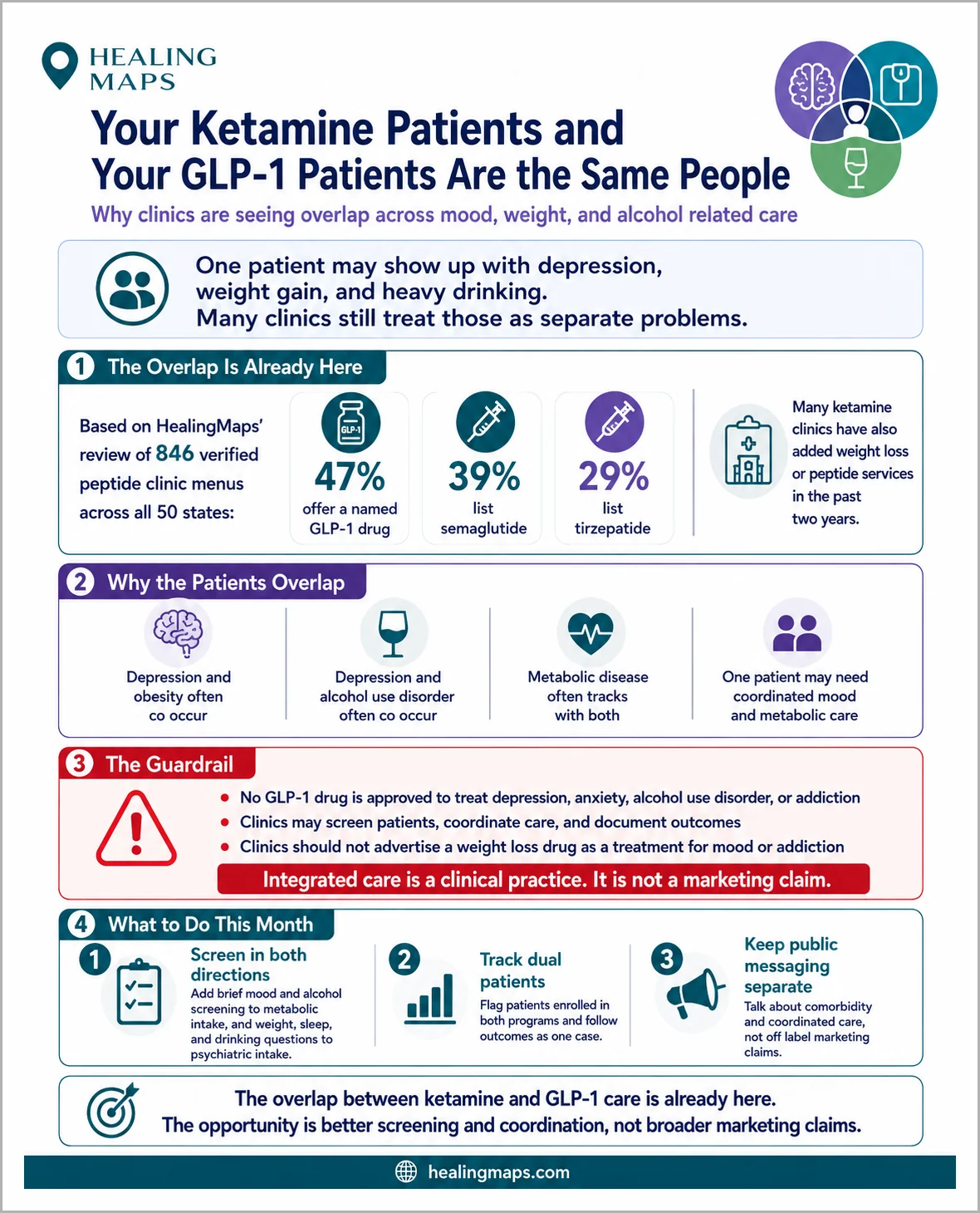
| The overlap is already built | 47 percent of peptide clinics offer a named GLP-1 drug, based on our review of 846 clinic menus |
| The patients overlap too | Depression, problem drinking and metabolic disease cluster in the same people |
| The evidence is early but real | A 2025 randomized trial in 48 adults found semaglutide reduced craving and heavy drinking |
| A larger test is running | The VA is testing semaglutide against placebo in more than 600 veterans |
| The gap is screening | Most clinics treat mood or metabolism, and few ask patients about the other |
| The wall is advertising | No GLP-1 is approved for mood or addiction. Claiming otherwise creates real regulatory risk |
The Overlap Is Not Hypothetical
Start with what clinics actually sell. We reviewed the published menus of 846 verified peptide clinics across all 50 states. Semaglutide appears on 39 percent of them. Tirzepatide appears on 29 percent. Counted together, 47 percent offer a named GLP-1 drug.
BPC-157 still leads the category at 55 percent. That surprises people who assume peptide medicine is a weight loss business. It is not. Nearly half these practices, though, now write GLP-1 prescriptions alongside recovery compounds.
Some ketamine practices have added weight loss or peptide services over the same period. Two very different clinic types are arriving at overlapping menus.
The Patients Were Always Shared
Clinicians have known the pattern for decades. Depression and obesity co-occur. Alcohol use disorder and depression co-occur. Metabolic disease tracks with both.
Nobody needs a study to see this in a waiting room. What has changed is that one drug class may act on both metabolism and reward related behaviors.
What the Research Actually Shows
GLP-1 receptors are not confined to the pancreas and gut. They also appear in brain regions that govern reward and motivation. The leading hypothesis is straightforward. A drug that dampens the pull of food may dampen other appetites too.
Early signals came from patient records. People taking GLP-1 medications showed lower rates of alcohol and substance use disorders than similar patients on other diabetes drugs. Correlations from records carry real limits.
Controlled evidence arrived in 2025. A phase 2 randomized trial published in JAMA Psychiatry assigned 48 adults with alcohol use disorder to low dose semaglutide or placebo over nine weeks. Semaglutide reduced craving, drinking quantity and heavy drinking days. It did not reduce the number of drinking days overall. The authors framed the result as justification for larger trials rather than proof.
That larger test is now running. The VA began recruiting in late July for a trial of semaglutide in more than 600 veterans with alcohol use disorder.
What Peptide Clinics Are Missing
Consider the weight loss patient who is not losing weight. She misses doses. She plateaus. She stops answering follow up calls.
Untreated depression explains a share of those cases. So does heavy drinking, which adds calories and erodes adherence. A GLP-1 program that never screens for either will keep losing patients and never learn why.
Our review of patient inquiries found that people ask by goal rather than by compound. They want to feel like themselves again. That sentence belongs as much to psychiatry as to metabolic medicine.
What Ketamine Clinics Are Missing
The blind spot mirrors it. Interventional psychiatry screens carefully for mood, suicidality and prior medication trials. Metabolic health rarely enters intake.
Weight, metabolic illness, sleep problems and alcohol use can influence depressive symptoms, physical health, medication decisions and treatment safety. Researchers have not settled how each one affects ketamine response specifically. Studies on body mass index point in conflicting directions, and one found metabolic syndrome rather than weight predicted a weaker initial response.
Identifying those conditions still matters. A practice already running a GLP-1 line has the tools on site.
The Wall You Cannot Cross
Here is the boundary. No GLP-1 drug is approved to treat depression, anxiety, alcohol use disorder or addiction.
Prescribing and advertising are different questions. Clinicians may generally prescribe an approved drug for an unapproved use when they judge it medically appropriate, though the FDA has made no safety or efficacy determination for that use. Advertising is where the exposure sits. A clinic promoting a GLP-1 as an effective treatment for mood or addiction could face regulatory or consumer protection risk unless the claim is properly supported.
Federal enforcement in this category has consistently focused on website language, a pattern we mapped in our anatomy of an FDA GLP-1 warning letter. Integrated care is a clinical practice. It is not a marketing claim.
What to Do This Month
Three steps work regardless of how the VA trial reads out.
Screen in both directions. Add a brief alcohol and mood screen to metabolic intake. Add weight, sleep and drinking questions to psychiatric intake. Both take minutes.
Track the dual patients. Flag anyone enrolled in both programs and follow their outcomes as one case. Large health record studies already exist, so treat your own data as a quality improvement tool rather than a research asset.
Keep the two conversations separate in public. Talk about comorbidity and coordinated care. Do not market a weight loss drug as a treatment for drinking or mood. Clinics weighing the combination for the first time can start with our guide to adding peptide services to a ketamine practice.