
Ketamine Clinics and GLP-1 Clinics Almost Never Overlap. We Think That Changes
Two kinds of clinic have grown quickly in the same years. One treats depression with ketamine, Spravato and TMS. The other treats weight with GLP-1s and peptides. The assumption is that they have been merging into each other. We counted all 2,721 clinics in our directory, and they have not. Fourteen businesses do both. We think that number is about to move, and the last section explains why.
Whatever you decide to add, the cost of running the building is negotiable. HealingMaps’ GPO, the first built for the ketamine industry, gets member clinics 40 percent or more off medical supplies, 15 to 20 percent off malpractice and liability premiums, discounted LegitScript certification, and 20 to 30 percent off HIPAA compliant payment processing. Joining is free with no obligation. See what your clinic qualifies for →
| Key Takeaway | Detail |
|---|---|
| What we counted | 2,721 distinct businesses across published HealingMaps listings |
| The two groups | 1,631 offer ketamine, Spravato or TMS. 863 offer peptides or GLP-1s |
| The overlap | 14 businesses carry something from both groups |
| What ketamine clinics added | Spravato at 29.6 percent, TMS at 16.8 percent, everything else under 1 percent |
| What most did | 62.5 percent of ketamine businesses offer ketamine and nothing else |
| The asymmetry | 95 percent of Spravato sites do ketamine. Only 30 percent of ketamine clinics do Spravato |
What We Counted
Every published listing in our directory carries one or more service tags. We pulled all of them and grouped the tags into families, so that peptide listings and BPC-157 listings count once rather than twice.
Then we collapsed duplicate listings of the same business into a single record. That left 2,721 distinct businesses.
This measures our directory. It is not a census of the industry, and a clinic that offers something we never tagged is invisible to the count. We come back to that at the end.
The Two Groups Barely Touch
Sort those businesses into a mental-health group and a metabolic group and the result is stark. There are 1,631 in the first and 863 in the second.
Fourteen are in both. That is 0.6 percent of the 2,480 businesses in either group.
Not fourteen percent. Fourteen businesses.
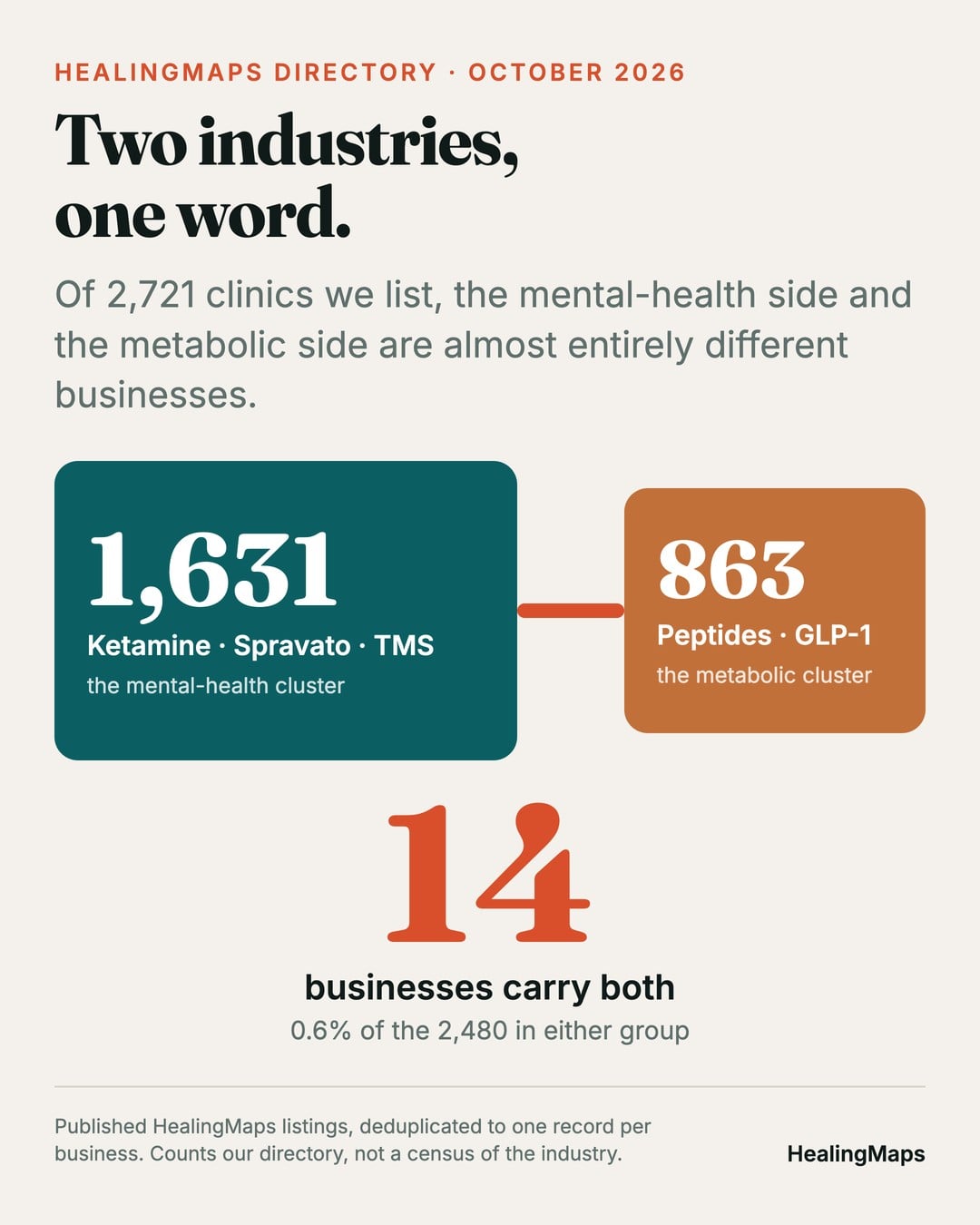
Three ketamine clinics in the whole directory offer peptides. Ten offer GLP-1s. No peptide clinic offers Spravato, and none offers TMS.
What They Added Instead
Ketamine businesses did add services. They added psychiatric ones.
Spravato appears at 473 of 1,599 ketamine businesses, or 29.6 percent. TMS appears at 268, or 16.8 percent.
After those two there is a cliff. Psychedelics sit at 0.9 percent, peptides and GLP-1s at 0.6 percent each, addiction treatment at 0.1 percent.
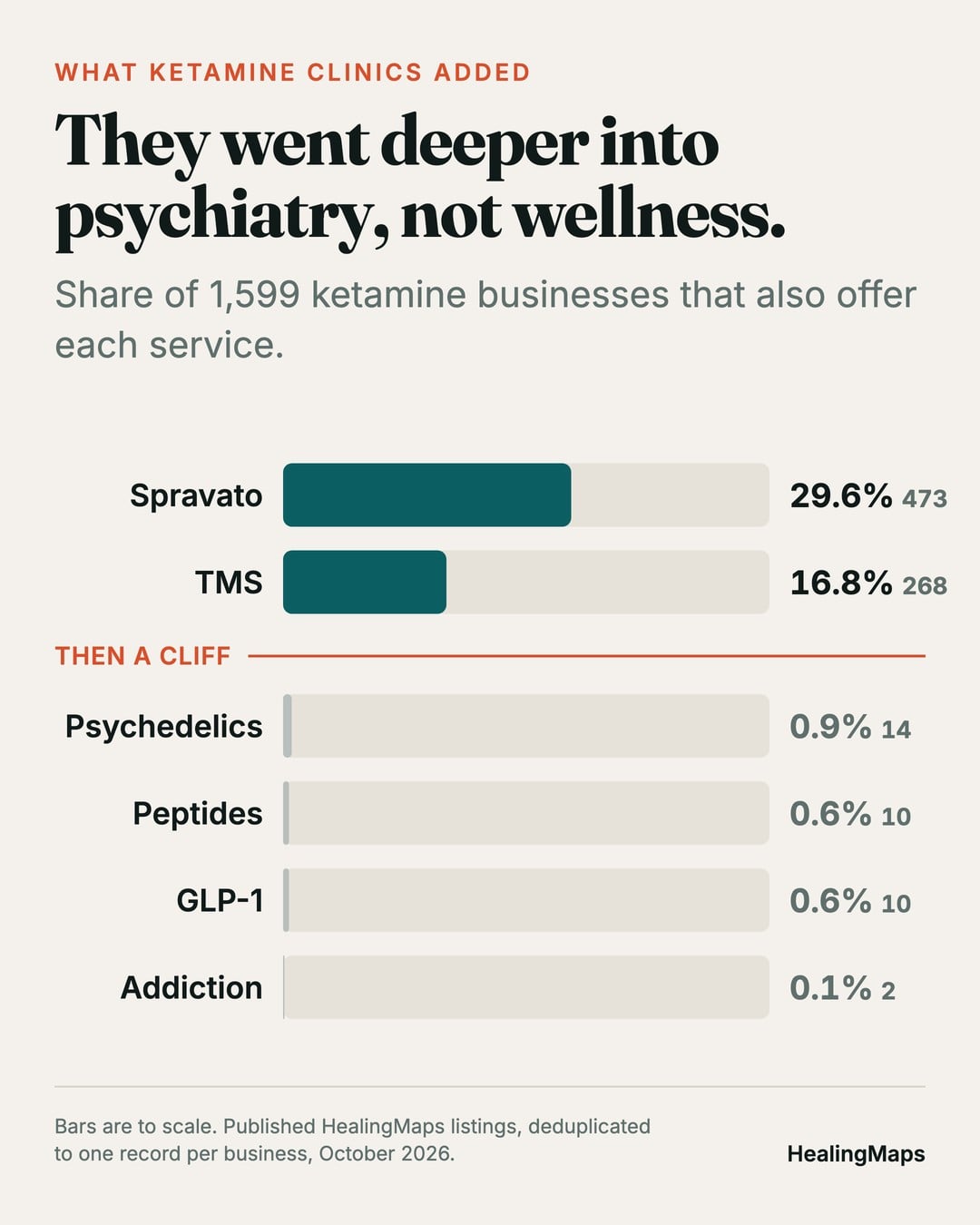
Both of the services that did get added are reimbursed psychiatric treatments with established payer paths. Neither is a cash-pay wellness product.
Most of Them Added Nothing
The larger finding is quieter. Exactly 1,000 of 1,599 ketamine businesses, or 62.5 percent, offer ketamine and nothing else.
Another 25.8 percent carry two services and 11.4 percent carry three. Three businesses in the entire directory carry four or more.
So the single-service ketamine clinic is not a relic. It is still the majority of the market.
The Spravato Asymmetry
The Spravato numbers run in one direction only, and that is the part worth sitting with.
Of 496 Spravato sites, 473 also offer ketamine. That is 95 percent. Adding Spravato is something ketamine clinics do, rather than something new entrants build around.
Run it the other way and the picture inverts. Of 1,599 ketamine businesses, 473 offer Spravato. The other 1,126 do not.
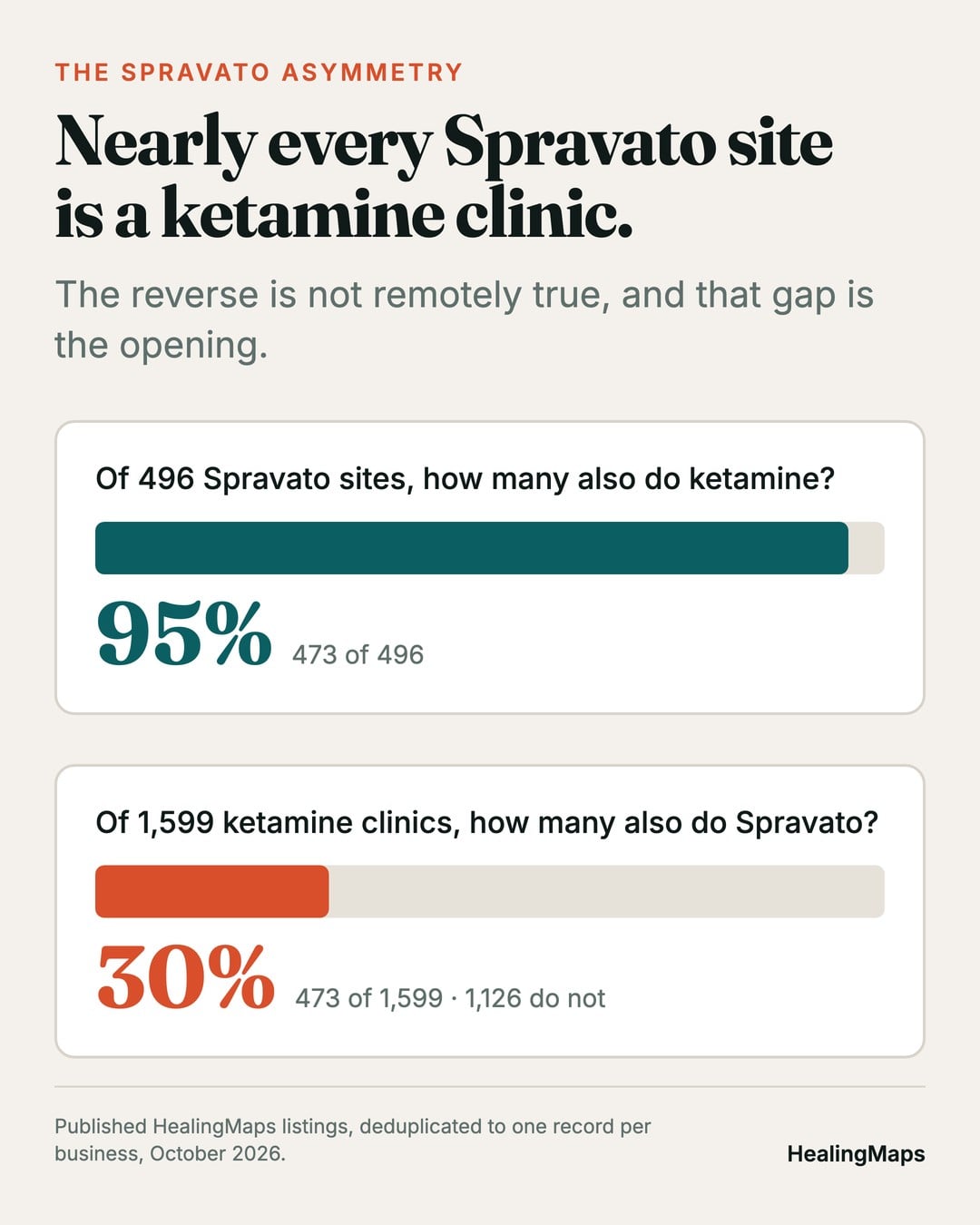
The clinical case was settled years ago. What separates those two groups is certification, observation space and payer enrollment, which we covered in our look at the second indication most clinics never market.
What This Changes If You Are Deciding
If you are weighing what to add, the directory is telling you what your peers concluded.
They did not go where the consumer demand headlines went. They went toward treatments that bill, share a patient population and reuse the room you already have.
A GLP-1 line means a different patient, a different marketing funnel and a different compliance surface. Ten clinics out of 1,599 found that trade worth making.
Spravato and TMS keep the same patient in the same chair. That is most of the explanation.
Why We Think the Gap Closes
Everything above is a snapshot. It describes how these businesses are organized today, not a rule about how they have to be.
Our read is that the separation is temporary, and the reason is the patient. The two groups are converging on the same person from opposite directions.
Metabolic clinics are discovering that weight is partly a behavioral problem. Adherence, disordered eating and mood all shape whether a patient stays on treatment, and a prescribing-only model is not staffed for any of it.
Behavioral health clinics have the opposite gap. They have the psychiatric capability and the monitored room, and almost none of the metabolic patient volume.
If that merge happens, we expect it runs from the metabolic side toward behavioral health rather than the reverse, because that is where the patient numbers are.
One caution on how that gets described. Spravato carries an approval for treatment-resistant depression, not for anything metabolic, and insurance follows the approval. A GLP-1 patient is not a Spravato candidate unless a clinician diagnoses treatment-resistant depression.
So the convergence we expect is behavioral health support arriving alongside metabolic care, not a drug moving outside its label.
Where This Count Is Soft
Our tags come from how we list clinics, not from an audit of what each one does. A practice quietly offering peptides without telling us will not show up here.
We also found 14 businesses listed twice, once under each group, which we merged. Treat the overlap as roughly 14 rather than exactly 14.
And this counts published listings only. Our taxonomy reports a higher ketamine figure that includes unpublished records.
None of which moves the shape of it. The gap between 1,631 and 863 is not a tagging artifact when the bridge between them is fourteen businesses wide. We will run this count again next year.
Clinics comparing their own market can start with our directory of verified ketamine clinics.