New Study Reveals What Happens to Your Brain on the World’s Most Powerful Psychedelic
Scientists at University College London have captured the first detailed look at how 5-MeO-DMT reshapes human brain activity. The findings challenge long held assumptions about consciousness and could reshape our understanding of psychedelic therapy.
New: Get Pre-Screened for a Psychedelic Clinical Trial
| Key Takeaways |
|---|
| 5-MeO-DMT is the first psychedelic shown to strip away sensory content while preserving awareness |
| Slow brain waves surged dramatically but fragmented into chaotic, unpredictable patterns |
| The brain settled into a simplified, stable state unlike any other known psychedelic |
| Participants remained conscious despite brain activity resembling deep sleep |
| Findings may help identify biomarkers for therapeutic “peak” experiences |
A Psychedelic That Deconstructs Reality
Most psychedelics build elaborate inner worlds. LSD and psilocybin fill the mind with vivid geometric patterns, intense emotions, and complex narratives. 5-MeO-DMT does the opposite.
Within seconds of inhalation, users report that space, time, and self dissolve completely. What remains is often described as a void or pure awareness. The experience lasts only minutes but leaves lasting impressions.
Despite its intensity, this compound has received far less scientific attention than its psychedelic cousins. That gap matters. Clinical trials are already testing 5-MeO-DMT for depression, bipolar disorder, and alcohol use disorder.
The Study: Mapping an Extreme Brain State
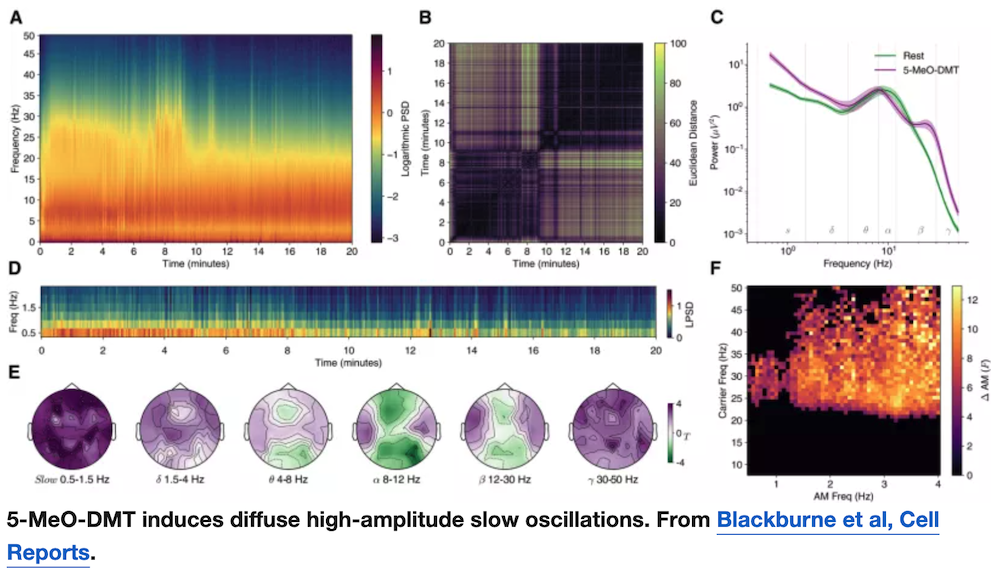
The UCL team recruited 29 participants who inhaled a high dose of synthetic 5-MeO-DMT. Researchers recorded brain activity using electroencephalography before, during, and after the experience.
The results surprised even the scientists. Slow brain waves, typically seen only during deep sleep or anesthesia, surged across the cortex. But these waves behaved strangely. Instead of traveling in smooth, coordinated sweeps, they broke apart into brief, chaotic bursts moving in unusual directions.
Even more striking: the brain settled into a simplified, stable pattern. This low dimensional state made complex mental activity difficult to achieve.
Challenging Old Assumptions
For decades, neuroscientists believed slow brain waves signaled unconsciousness. This study upends that idea.
“5-MeO-DMT radically reorganizes the human brain to create this unique state of deconstructed consciousness,” said lead author George Blackburne. “The brain appears unable to formulate the distinctions that usually structure our lived experience, yet it continues to produce the fundamental sensation that we are indeed experiencing something.”
This distinction matters for therapeutic applications. The compound does not simply alter perception. It appears to strip consciousness down to its most basic form.
Implications for Psychedelic Medicine
The findings open new doors for research and treatment. Brain patterns identified in this study could serve as biomarkers for the mystical experiences often linked to therapeutic breakthroughs.
Professor Christof Koch of the Allen Institute noted that the accumulated data could help identify markers for loss of consciousness and peak experiences that drive clinical outcomes.
For practitioners and patients in the psychedelic therapy space, this research validates what many have observed: 5-MeO-DMT offers something fundamentally different from other compounds. Understanding that difference at the neural level brings the field one step closer to optimizing treatment protocols.
The study represents the most detailed examination of this powerful compound to date. As clinical applications expand, this foundational research will likely guide how providers approach one of nature’s most profound consciousness altering substances.