Psilocybin Sessions for PTSD Are Mostly Silent. The Argument About What to Call Them Is Not
Picture a psilocybin session for PTSD. Most people imagine a patient talking through trauma while a therapist guides them. Researchers recorded what actually happens, and the room is mostly quiet. Across the dosing sessions they analyzed, roughly 78 percent of the time was silence.
| Key Takeaway | Detail |
|---|---|
| The finding | Dosing sessions were silent about 78 percent of the time, against 25 to 30 percent in preparation and follow up |
| The sample | 22 adults with PTSD, each given a single 25 milligram dose of synthetic psilocybin |
| The design | Open label, with session audio analyzed afterward. This was a post hoc analysis, not a study built to test the question |
| The bigger claim | The authors argue the treatment should not be called psychedelic assisted psychotherapy |
| The context to keep | The lead author is chief medical officer of the company that makes the drug, and that company promoted the paper to investors |
What They Measured
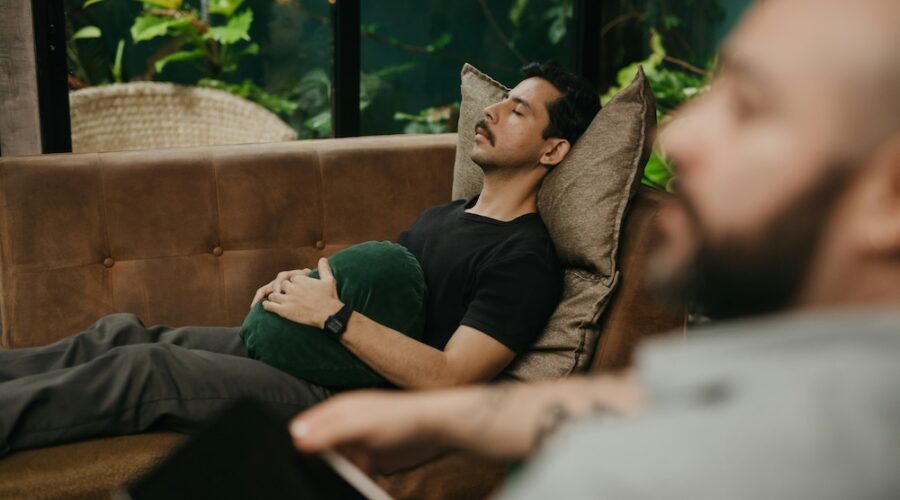
The analysis covered 22 adults with moderate to severe PTSD. Each received a single 25 milligram dose of synthetic psilocybin in a dimly lit room, with eyeshades and a standard music playlist.
Researchers transcribed session audio and counted words per minute. Dosing sessions ran six to eight hours. Nearly all the talking clustered at the very beginning and the very end.
Preparation and follow up sessions looked completely different, with silence occupying only 25 to 30 percent of the time. The contrast is the actual finding.
What Support Looked Like
Providers were not silent because they were passive. They offered brief reassurance, sometimes held a hand, and occasionally reminded the patient where they were.
Participants valued exactly that. They described the quiet presence as an anchor during stretches of emotional intensity.
One correlation makes intuitive sense. Patients reporting more intense ego dissolution spoke even less. When the experience goes deep enough, talking stops being possible.
The Claim That Travels Further Than the Data
The authors go beyond describing silence. They argue the field should stop saying psychedelic assisted psychotherapy and start saying psychedelic treatment, on the grounds that no psychotherapy is occurring.
That is a reasonable description of the dosing session. It is a much larger claim about the treatment as a whole.
Who Benefits From That Conclusion
Worth stating plainly, the same way we would for any industry funded finding. The lead author is Guy Goodwin, chief medical officer of Compass Pathways, the company that makes the psilocybin formulation used in the study. Compass also announced the paper through investor relations, under a headline about distinguishing its trial support from psychotherapy.
None of that makes the measurements wrong. Sessions almost certainly are mostly silent, and practitioners have said so for years. It does mean the interpretation carries commercial weight.
Compass’s most cited commercial weakness is that its model requires both a therapist and a medical provider for every session. We noted that when we looked at which psychedelic companies could be acquired next. A finding that reclassifies therapists as monitors goes straight at that weakness. Read the chemistry and the conclusion separately.
This Is Not an Argument Against Integration
Here is where careless coverage will go wrong. The study measured the dosing session only.
Preparation and follow up were the sessions full of talking. The paper does not show that the work before and after the dose is unnecessary. It shows the opposite, that the talking lives there.
That distinction matters for anyone running an interventional practice. We have argued before that integration is what makes or breaks ketamine outcomes, and nothing here contradicts it.
The Staffing Math Is the Real Story
Follow the money implication rather than the semantics. If a six to eight hour dosing session needs trained monitoring rather than continuous psychotherapy, the cost of delivering these treatments falls substantially.
A licensed therapist billing hourly for eight hours per patient is a different business than a trained monitor supervising a quiet room. Scalability, staffing and reimbursement all shift.
That model resembles something ketamine clinics already run. It is the same argument we made about intravenous psychedelics and existing infusion infrastructure. The delivery layer keeps looking familiar.
What to Hold Loosely
The limits are real. Twenty two people is a small sample. The trial was open label, so everyone knew what they received. Words per minute is a blunt instrument for measuring what passes between two people in a room.
Silence is also not evidence that presence does not matter. A monitor who says almost nothing may still be the reason a patient feels safe enough to go inward.
The honest summary is narrow and still useful. Psilocybin dosing sessions are mostly quiet, the talking happens on either side of them, and the argument about what to call the whole package is being made by people with a stake in the answer. Clinics watching this space should track the staffing question, because that is what will determine whether these treatments are deliverable at scale. Early outcome signals in PTSD, including a recent veterans pilot, are what make the question worth answering.