The Mushroom That Makes People See Tiny People Is Not Acting Like Psilocybin
A wild mushroom from Asia is forcing scientists to ask a strange but serious question. What happens when a fungus produces vivid hallucinations that do not appear to come from psilocybin, ibotenic acid, or any other familiar psychedelic compound?
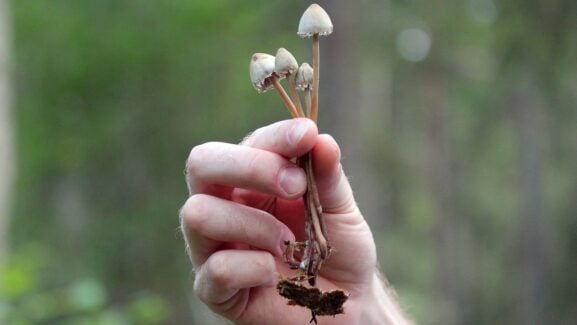
The mushroom, Lanmaoa asiatica, has been linked to unusually specific visions of miniature people. In Yunnan, China, where it is sold in local markets and valued for its flavor, people have reported seeing tiny humanlike figures after eating it undercooked. The story sounds folkloric. The science behind it may be more important than the punchline.
New: Interested in Being Part of a Psychedelics-Focused Clinical Trial? Sign Up Here
Key Takeaways
| Key takeaway | What it means |
|---|---|
| This is not a typical magic mushroom | Researchers have not found the genetic markers linked to psilocybin or ibotenic acid production. |
| The visions are unusually specific | Reports often describe tiny human or fantasy figures interacting with the real world. |
| Cooking appears to matter | The effects are most often linked to raw or undercooked mushrooms. |
| The active compound remains unknown | Scientists suspect a novel metabolite may be responsible. |
| The research could matter beyond mushrooms | It may offer new clues about hallucinations, perception, and brain chemistry. |
A Different Kind of Hallucination
Most people think of psychedelic mushrooms as psilocybin mushrooms. Those effects often include visual patterns, intensified colors, altered time perception, and emotional shifts. Lanmaoa asiatica appears to behave differently.
Reports describe what clinicians call Lilliputian hallucinations. The term refers to visions of tiny people or figures, named after the miniature inhabitants in Gulliver’s Travels. In some accounts, the figures seem detailed and three dimensional. They may appear to move through a person’s surroundings, rather than simply distort the visual field.
That distinction matters. It suggests the mushroom may not just be turning up ordinary psychedelic perception. It may be triggering a more specific visual phenomenon.
Why Scientists Are Paying Attention
University of Utah researchers Colin Domnauer and Bryn Dentinger have been studying the mushroom and its relatives. In a recent genomic analysis, researchers examined samples across the Lanmaoa genus and looked for known genes tied to mushroom psychoactive compounds.
They did not find the usual suspects.
That does not prove the mushroom has no psychoactive chemistry. It suggests the opposite. The effect may come from a compound that science has not yet identified. For a field already exploring psilocybin, ketamine, DMT, ibogaine, and other psychoactive substances, that possibility is striking.
It also shows how much remains unknown. Psychedelic research often focuses on compounds that already have names, pathways, and protocols. But nature is not limited to the molecules researchers already understand.
The Public Safety Piece
There is also a practical warning here. This mushroom is eaten as food in parts of China and the Philippines. It is not necessarily consumed for a trip. In fact, the reports often involve undercooking.
That makes this a food safety issue as much as a psychedelic story. Wild mushrooms can be difficult to identify. Some edible species resemble toxic ones. Even mushrooms considered safe in one context can cause illness when prepared incorrectly.
The reported symptoms are not limited to tiny people. Other accounts include dizziness, nausea, auditory hallucinations, and physical sickness. That range should keep the story grounded. The mystery may be fascinating, but it is not an invitation to experiment.
What This Could Teach Us
The most interesting part may be what Lanmaoa asiatica reveals about the brain. Hallucinations are not one thing. They can emerge through different biological routes, and they can look very different from person to person.
A mushroom that reliably produces a narrow and unusual type of visual experience could help scientists study perception in a new way. It may reveal how the brain builds figures, assigns scale, and places imagined objects into real space.
For now, the key word is “may.” Researchers still need to identify the active compound. They also need to understand how it acts in the body and brain.
Lanmaoa asiatica is not the next psilocybin. At least not yet. It is a reminder that the psychedelic frontier is wider, stranger, and less mapped than the current clinical conversation can sometimes make it seem.