Watch a Berkeley Neuroscientist Describe Your Brain on Psychedelics in 101 Seconds
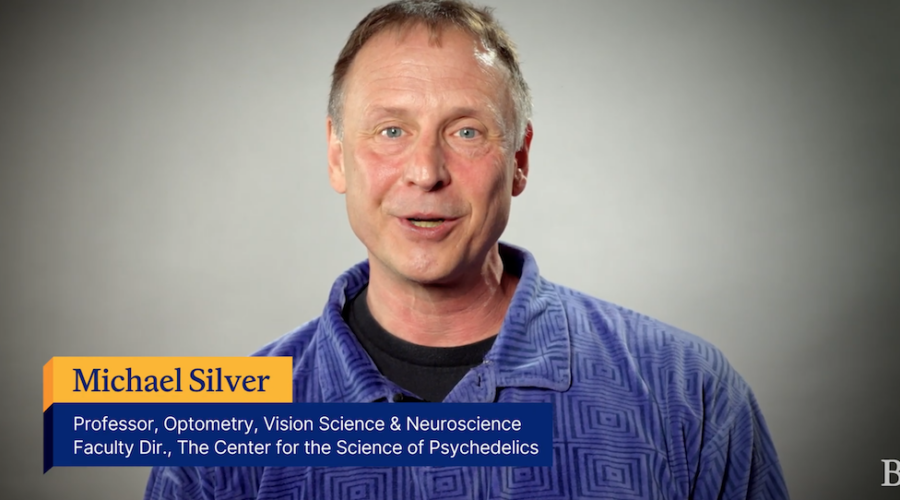
Psychedelic research is often discussed through the lens of treatment. But at UC Berkeley, neuroscientist Michael Silver is also asking a deeper scientific question. What can psychedelics teach us about the relationship between the brain, the mind, and consciousness?
Silver, a professor of optometry and vision science and neuroscience, directs the UC Berkeley Center for the Science of Psychedelics. In the video, he describes psychedelics as tools that may help researchers understand how physical brain activity connects to perception, emotion, thought, and subjective experience.
New: Get Pre-Screened for a Psychedelic Clinical Trial
Key Takeaways
| Key Takeaway | Why It Matters |
|---|---|
| Psychedelics may help explain consciousness | Researchers can study how changes in the brain alter subjective experience. |
| UC Berkeley is studying visual perception | The visual system gives scientists a strong model for understanding psychedelic effects. |
| Brain imaging is central to the research | FMRI allows researchers to watch brain activity during the psychedelic experience. |
| The long term goal is better mental health care | Mechanistic research may help improve treatment and reduce suffering. |
Looking for treatment? Find Spravato clinics (which is covered by insurance) and ketamine clinics closest to you as well as other psychedelic therapies in your area.
Why Vision Is A Useful Starting Point
Silver makes an important distinction. The brain is a physical organ made of neurons and other cell types. The mind refers to perception, cognition, emotion, and thought. Consciousness is the subjective experience of being aware.
Psychedelics may help researchers study how these layers connect.
At UC Berkeley, one focus is visual perception. That choice is not random. As Silver explains, a large portion of the brain is devoted to visual processing. Scientists also understand the visual system better than many other brain systems.
That gives researchers a strong foundation. They can ask detailed questions about how psychedelics affect vision, then connect those changes to brain activity.
Watching The Psychedelic Brain In Real Time
The Berkeley team uses functional magnetic resonance imaging, known as FMRI, to study the brain during a psychedelic experience. Silver describes it as a way to collect a movie of brain activity without invasive procedures.
In the study he describes, a participant receives pharmaceutical grade synthetic psilocybin in a capsule. While the experience unfolds, the person reports changes in visual perception by pressing buttons on a keypad.
This matters because the researchers can compare two things at the same time. They can observe changes in subjective experience and match them with changes in brain activity.
That link is critical. Scientists already know a lot about the chemical identity of psychedelics and the receptors they interact with. But they know far less about how receptor activity produces changes in consciousness.
What This Means For Mental Health
For HealingMaps readers, the clinical promise is clear. Silver says he would not be surprised if mental health care sees a major shift in the coming years.
The idea is not simply that psychedelics create unusual experiences. It is that, in the right therapeutic context, those experiences may lead to enduring change. Silver describes this as something closer to healing.
That phrase matters. Many treatments help manage symptoms. Psychedelic assisted therapy aims, in some cases, to help people change their relationship to distress, memory, fear, or behavior.
A Field Built On Better Questions
This research does not replace clinical care. It strengthens the foundation beneath it.
If psychedelic medicine is going to grow responsibly, researchers need to understand how these substances work. They need to know what happens in the brain, how that relates to experience, and why the right context matters.
Silver’s work points toward that future. It is careful, mechanistic, and ambitious. The goal is not just to explain psychedelics. It is to use that knowledge to improve wellbeing and reduce suffering.