What a Mindbloom Affiliated Study Can and Cannot Tell Us About At-Home Ketamine Injections
A peer reviewed study reports symptom improvement among patients in Mindbloom’s at-home ketamine injection program. However, this was not an independent test of the company’s treatment model. Researchers analyzed Mindbloom patient records, and six of seven authors had financial ties to the company.
Key Takeaways
| Key takeaway | What the study shows |
|---|---|
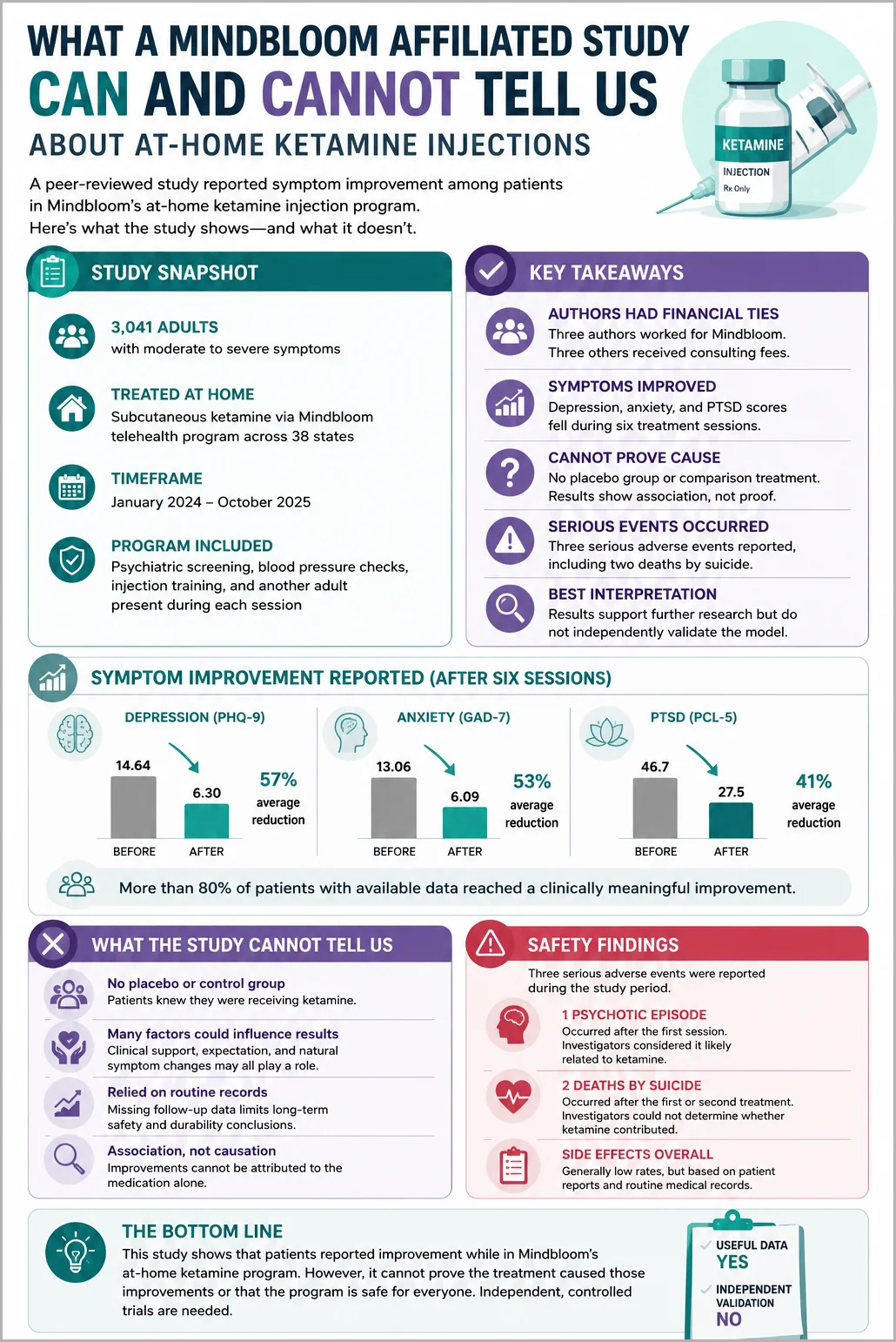
| Who conducted it | Three authors worked for Mindbloom, while three others received consulting fees from the company. |
| What researchers analyzed | The team reviewed clinical records from patients treated through Mindbloom across 38 states. |
| Reported outcomes | Average depression, anxiety, and PTSD scores fell during six treatment sessions. |
| What it cannot prove | The study had no placebo group or comparison treatment. |
| Safety findings | Three serious events occurred, including one psychotic episode and two deaths by suicide. |
| Best interpretation | The results support further research but do not independently validate the treatment model. |
Looking for treatment? Find Spravato clinics (which is covered by insurance) and ketamine clinics closest to you as well as other psychedelic therapies in your area.
The Study Used Mindbloom’s Own Records
Researchers reviewed records from 3,041 adults with moderate to severe symptoms. Patients received subcutaneous ketamine through Mindbloom’s telehealth program between January 2024 and October 2025.
The program included psychiatric screening, blood pressure checks, injection training, and clinician guided dosing. Patients also needed another adult present during each session.
That structure matters because the treatment involved more than mailed medication. Still, the study evaluated one company’s protocol using data collected during normal clinical operations.
Three authors worked for Mindbloom. Three others received consulting fees from the company. Company employees and contractors contributed to the methods, analysis, and writing. One author reported no financial relationship with Mindbloom.
Symptoms Improved, but Cause Remains Unclear
Average symptom scores fell after six sessions. Depression scores declined from 14.64 to 6.30. Anxiety scores dropped from 13.06 to 6.09. PTSD scores fell from 46.7 to 27.5.
More than 80 percent of patients with available data reached a clinically meaningful improvement. Those numbers appear notable, but they require careful interpretation.
Researchers did not compare the program with placebo, usual care, or another ketamine treatment. Patients knew they were receiving ketamine. They also received coaching, monitoring, and regular clinical contact.
Those factors may have influenced the results. Symptoms may also change naturally over time. The study therefore shows an association, not proof that injections caused the improvements.
Safety Claims Need Similar Caution
The authors reported low overall rates of side effects. However, the study recorded three serious adverse events during the reporting period.
One patient developed a psychotic episode after the first session. Investigators considered it likely related to ketamine. Two patients died by suicide after their first or second treatment. Researchers could not determine whether ketamine contributed.
The analysis also relied on patient reports and routine medical records. Missing follow up data make it harder to assess patients who left early.
These details do not establish that the program is unsafe. They do show why broad safety claims would be premature.
What Ketamine Providers Should Take From It
The paper offers useful information about how one supervised telehealth program operated. It may help researchers design stronger trials of subcutaneous ketamine outside clinics.
It should not serve as independent validation of Mindbloom’s model. Controlled trials led by researchers without financial ties should come next.
The most accurate conclusion remains limited. Patients reported improvement during treatment, and serious events appeared uncommon. Independent trials must determine how much benefit came from ketamine and which patients can use this model safely.