
Big Pharma’s Psychedelic Drug Race Enters Its Next Phase
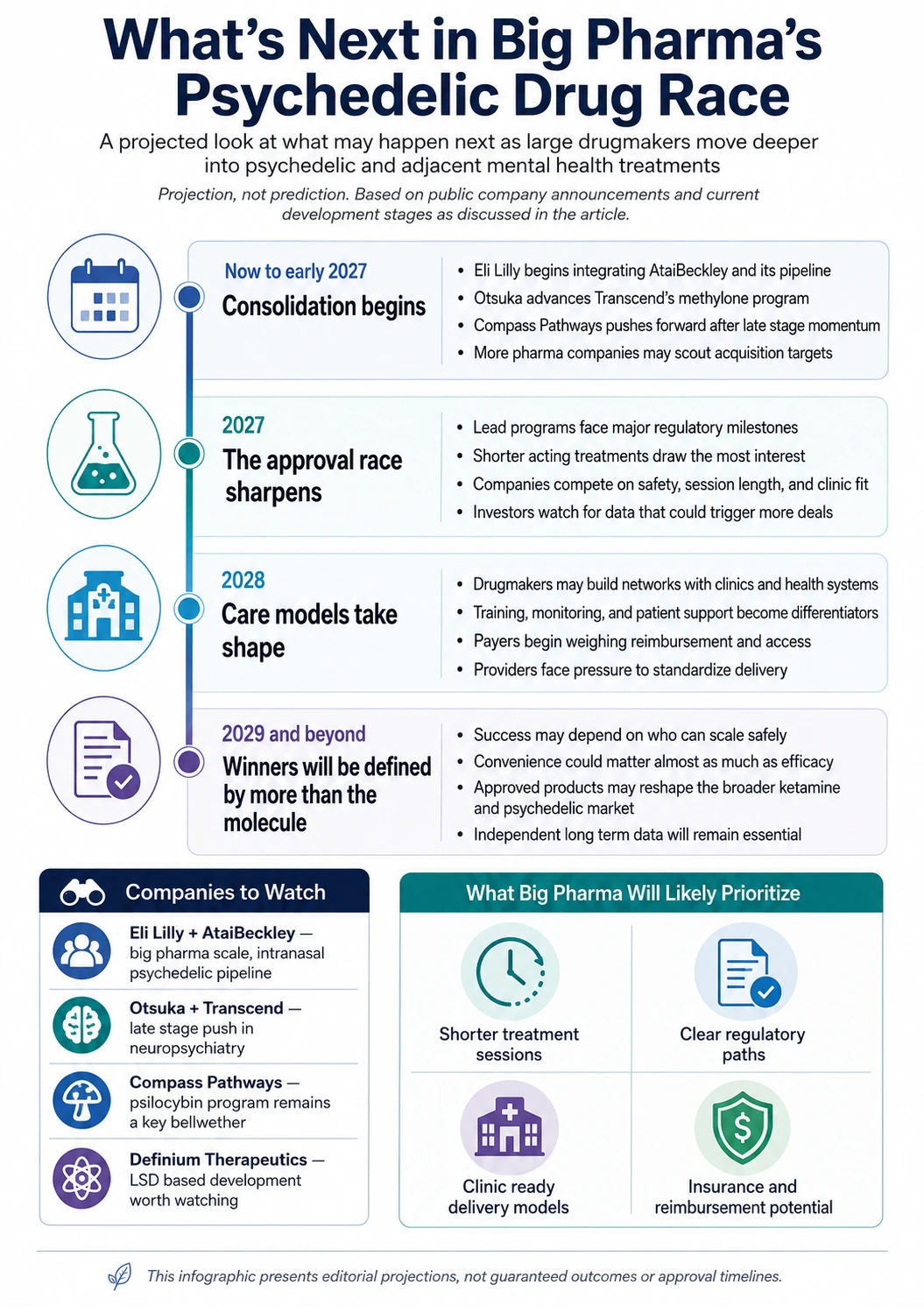
Eli Lilly’s planned acquisition of AtaiBeckley made headlines because of its price. Yet the larger story starts after the deal closes. Psychedelic drug development is moving from small biotechnology companies into global pharmaceutical systems. The next phase will focus on approvals, delivery, insurance, and scale.
Looking for treatment? Find Spravato clinics (which is covered by insurance) and ketamine clinics closest to you as well as other psychedelic therapies in your area.
Key Takeaways
| What comes next | Why it matters |
|---|---|
| More acquisitions | Large drugmakers may buy promising programs instead of building psychedelic pipelines from the beginning. |
| A race for approval | Psilocybin, LSD, methylone, and DMT treatments are advancing through late stage development. |
| Shorter treatment visits | Companies will favor drugs that fit clinic schedules and reduce staffing costs. |
| New delivery networks | Approved treatments may require trained staff, monitoring, and standardized patient support. |
| Pressure on reimbursement | Insurers will decide whether intensive sessions can become widely accessible. |
Do you work in the ketamine industry? Save thousands on overhead and other fees by joining the first GPO for ketamine clinics and practitioners. There’s no cost to join and zero obligations. Sign up here!
The Next Deals May Target Late Stage Winners
Lilly agreed to pay about $2.8 billion upfront for AtaiBeckley. Another $1 billion depends on development and regulatory milestones. Otsuka also completed its acquisition of Transcend Therapeutics in June. Forecasts back the spending: the psychedelic drug market could reach roughly $14 billion.
These deals suggest established companies may buy programs after smaller firms absorb early development risk. Strong late stage data could now trigger another acquisition wave.
Compass Pathways has reported positive results from two Phase 3 studies of COMP360 psilocybin for treatment resistant depression. Definium Therapeutics recently announced positive Phase 3 results for its LSD based treatment, DT120. Transcend has moved its methylone treatment for posttraumatic stress disorder into Phase 3.
Not every program will attract a buyer. However, promising data can bring access to deeper funding and larger regulatory teams.
Convenience Will Become a Competitive Advantage
Clinical results will not decide the market alone. Treatment duration may become nearly as important.
A psilocybin or LSD session can require several hours of supervision. That creates staffing, scheduling, and facility costs. AtaiBeckley designed BPL 003 around an average clinic visit of about two hours. That figure has since become the industry’s organizing principle, and session length now separates these programs more than efficacy does.
This points toward a wider industry priority. Companies will compete to create shorter and more predictable experiences with consistent dosing. Developers are also testing new delivery methods, including nasal sprays, dissolving tablets, and films placed inside the cheek.
The leading product may not create the most dramatic experience. It may offer the best balance of benefit, safety, duration, and efficiency.
Big Pharma Must Build More Than a Drug
Traditional pills move through pharmacies with limited clinical infrastructure. Many psychedelic treatment models require controlled settings, trained monitors, and follow up care.
Large drugmakers know how to navigate regulators, educate clinicians, and negotiate with insurers. They can also build treatment networks or partner with established clinics.
That could create opportunities for ketamine clinics and mental health practices with suitable facilities. It could also bring stricter standards and greater corporate control.
Providers should watch how companies define psychological support. They should also track who can administer treatment and how outcomes must be documented.
Approval Will Start the Hardest Test
Compass has received rolling review for its planned COMP360 application. Definium and Transcend are still completing late stage programs. Lilly’s agreement ties some payments to FDA approval and federal rescheduling.
The race is no longer limited to showing that psychedelic compounds can produce clinical effects.
Companies must show that treatment models can work safely across many sites. They must persuade insurers that limited sessions justify their cost. They must also identify patients who face unacceptable risks.
Big Pharma’s arrival will accelerate the field. It may also favor products that fit existing medical systems. The next major story will be whether these companies can turn complex treatments into care patients can actually receive.