Does California’s Medi-Cal Cover Ketamine Therapy? (2026)
Last reviewed and updated: May 11, 2026. Medically reviewed by Dr. Carlene MacMillan, MD.
The short answer: Medi-Cal — California’s Medicaid program — covers Spravato (esketamine) for treatment-resistant depression under most managed-care plans, subject to prior authorization and step-therapy requirements. It does not cover off-label IV or IM ketamine for depression, anxiety, or PTSD. About 14.5 million Californians are enrolled in Medi-Cal, and for most, Spravato is the only state-funded path to ketamine therapy. This guide walks through eligibility, the prior-auth process, plan-by-plan variation, and what to do if you’re denied.
Key Takeaways
| What Medi-Cal covers | Spravato for treatment-resistant depression (with prior authorization). Step-therapy of 2+ SSRI/SNRI typically required first. |
| What Medi-Cal does NOT cover | Off-label IV ketamine, IM ketamine, or at-home sublingual ketamine for depression. No California Medi-Cal plan reimburses these as of 2026. |
| Plan variation matters | Medi-Cal is administered through 25+ managed-care plans (LA Care, Anthem Blue Cross Medi-Cal, Health Net, Kaiser, Molina, etc.). Coverage policies, prior-auth speed, and step-therapy requirements vary by plan. |
| Where to receive treatment | Spravato must be administered in a REMS-certified clinic. Most major California cities have at least one Medi-Cal-accepting REMS clinic. |
| Out-of-pocket realities | Even with Medi-Cal coverage, transportation, time off work, and 8 weeks of 2× weekly treatment create practical barriers that Medi-Cal does not address. |
| If you’re denied | File an Independent Medical Review (IMR) through the California Department of Managed Health Care. Roughly 60% of psychiatric-medication appeals are overturned in patient favor. |
How Medi-Cal Coverage Compares to the Out-of-Pocket Pathways
For Medi-Cal members, the practical choice is Spravato (covered) vs IV ketamine (not covered, full out-of-pocket). The comparison below shows the broader cost-and-coverage landscape across all three main ketamine pathways — useful context for decisions where step-therapy or denials make Spravato access uncertain.
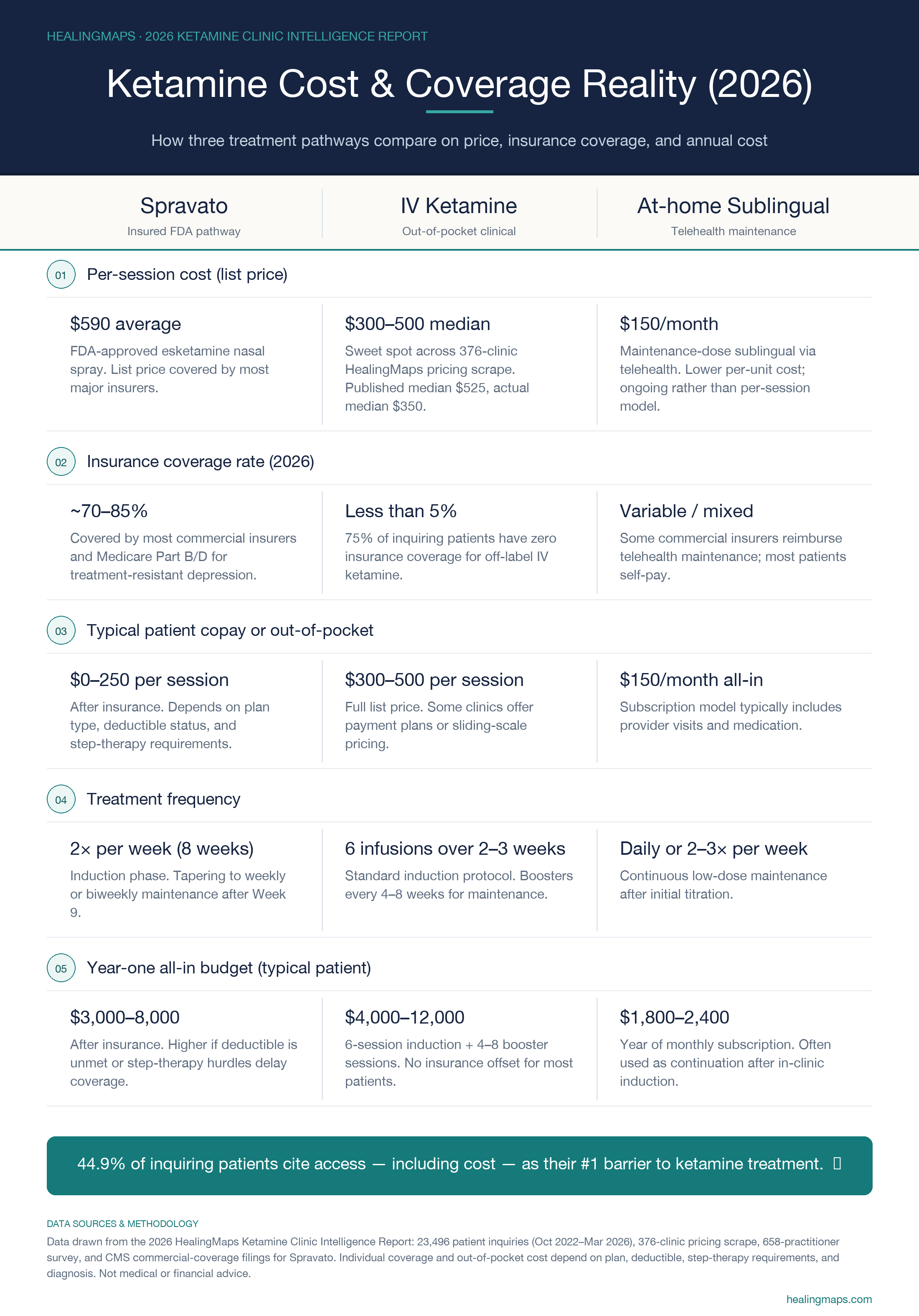
The guide below walks through Medi-Cal eligibility, plan-specific coverage policies, the prior-auth process, and the appeals pathway when initial requests are denied.
Ketamine, a medication initially developed as an anesthetic, has recently gained attention for its potential in treating various mental health conditions, including depression, anxiety, and PTSD. As its use in therapeutic settings grows, a significant question arises for residents of California: Does Medi-Cal, the state’s Medicaid program, cover ketamine therapy services, either in-clinic or through telehealth? We’re going to some provide clarity on this matter for those who rely on Medi-Cal for their healthcare needs.
| 77% of Ketamine Clinics’ Liability Insurance Falls Short |
| Insurance companies have not kept up with the needs of the emerging ketamine industry. And many practitioners are not as covered as they think they are. Our partner is changing that by offering a 10% discount to the only policy that is tailored for ketamine clinics to all KIW subscribers. See if you qualify here. |
Interested in Ketamine Therapy? Find Ketamine Clinics in California
National Ketamine Cost & Access Snapshot
Sources: HealingMaps Clinic Intelligence Report 2026 · CDC PLACES 2023 · r/TherapeuticKetamine patient pricing corpus · 132 clinic website pricing reviews · 658 practitioner survey responses.
- Median per-session cost (patient reported): $350, typical range $150 to $500
- IV Ketamine median: $450 per session (range $300 to $800)
- IM Ketamine median: $350 per session (range $200 to $500)
- Spravato (esketamine) cash-pay median: $750 per session (range $590 to $885 pre-insurance)
- KAP (ketamine-assisted psychotherapy) median: $650 per session (range $400 to $1,200)
- Patients with zero insurance coverage for ketamine: 75%
- Patients citing access as the #1 barrier to treatment: 44.9%
- Patients reporting at-home ketamine is “a bad idea”: 64.8%
Behind this data: HealingMaps has analyzed 23,496 patient inquiries (Oct 2022 – Mar 2026), mapped 1,800 verified clinics across 3,142 counties, scraped 132 clinic pricing pages, and collected 658 practitioner survey responses. This snapshot reflects our multi-source methodology.
Medi-Cal Ketamine Cost Calculator
How Much Will Ketamine Therapy Cost?
Does Medi-Cal Cover Ketamine Therapy in California?
For Californians struggling with treatment-resistant depression, anxiety, or other mental health conditions, ketamine therapy has emerged as a promising treatment option. However, navigating the complexities of insurance coverage, especially with Medi-Cal, can be confusing. Let’s dig in and break down how Medi-Cal covers ketamine therapy, both in-clinic and through telehealth, in California?
The Short Answer: Currently, Medi-Cal generally does not cover ketamine therapy for mental health conditions. This applies to both in-clinic and telehealth services. There are, however, a few exceptions and potential avenues for coverage that we’ll explore in detail.
Just What Is “Medi-Cal” And What Does It Cover
Medi-Cal, California’s Medicaid program, provides health coverage to low-income individuals and families. The coverage includes a range of services, from primary care to specialized treatments. However, coverage for emerging therapies like ketamine can vary, depending on factors like FDA approval, clinical evidence, and cost-effectiveness.
New: Interested in Being Part of a Psychedelics-Focused Clinical Trial? Sign Up Here
Ketamine Therapy and FDA Approval
The FDA has approved a nasal spray form of esketamine (a ketamine derivative) for treatment-resistant depression, under the brand name Spravato. This approval is crucial because Medi-Cal is more likely to cover FDA-approved treatments. However, the broader use of ketamine, especially in an off-label capacity for other mental health conditions, falls into a gray area regarding insurance coverage.
RELATED: Does Medicare Cover Ketamine Therapy?
Medi-Cal and Off-Label Prescriptions
While Medi-Cal does cover some off-label prescriptions, this is typically contingent on the medication being considered safe and effective for the specific condition, and often requires prior authorization. Since traditional ketamine infusions for mental health are not FDA-approved, coverage under Medi-Cal might be limited or require additional steps for approval.
RELATED: In-Clinic vs Ketamine Telehealth Services. Here’s How They’re Different
In-Clinic vs. Telehealth Services
When it comes to the mode of delivery, in-clinic ketamine infusions are the most common form of treatment. However, with the rise of telehealth, some services offer remote monitoring for orally administered ketamine. Medi-Cal has expanded coverage for telehealth services, especially post-pandemic, but it’s important to confirm whether this extends to ketamine therapy.
Navigating Medi-Cal Coverage for Ketamine Therapy
- Consult with a Healthcare Provider: The first step is to consult with a healthcare provider who is knowledgeable about ketamine therapy. They can offer guidance on whether this treatment is appropriate for your condition and discuss potential coverage options.
- Check for Prior Authorization: If considering ketamine therapy, check if it requires prior authorization under Medi-Cal. This process involves your healthcare provider submitting documentation to demonstrate the medical necessity of the treatment.
- Treatment-Resistant Depression: If you’ve tried and failed multiple standard treatments for depression, your doctor might be able to submit a prior authorization request to Medi-Cal for ketamine therapy. This request needs to demonstrate the medical necessity of the treatment and lack of effectiveness of other options.
- Explore Spravato (Esketamine) Options: Given that Spravato is FDA-approved, it’s more likely to be covered. Inquire about this specific treatment and any requirements for coverage, such as trying other treatments first.
- Understand the Limits of Coverage: Be aware that even if Medi-Cal covers ketamine therapy, there might be limitations, such as a cap on the number of sessions or specific eligibility criteria.
- Consider Telehealth Services: If interested in telehealth options, verify with Medi-Cal if they cover remote ketamine therapy and under what conditions.
The Good and Bad News
In summary, Medi-Cal may cover ketamine therapy, particularly FDA-approved Spravato. Navigating this coverage requires care. Off-label ketamine uses present more complexity. They might need prior authorization or may lack coverage. Interested individuals should consult healthcare providers and Medi-Cal representatives. This ensures understanding of options and alignment with their coverage needs.
Disclaimer
This article is for informational purposes only and does not constitute medical advice. Coverage details may change, and it’s important to consult directly with Medi-Cal or a healthcare professional for the most current information.
More on Ketamine Cost & Coverage from HealingMaps
- Is Ketamine Infusion Covered by Insurance? (Full Guide)
- Solving the Insurance Puzzle: How to Get Your Ketamine Treatments Covered
- Ketamine Infusion Therapy Treatment Cost (2026 Pricing)
- Spravato Cost & Insurance Coverage
- Does California’s Medi-Cal Cover Ketamine?
- Does TRICARE Insurance Cover Ketamine Therapy?
- Does New York’s United Health Insurance Cover Ketamine?
- At-Home Ketamine vs In-Clinic (Comparison Guide)
- Find a Verified Ketamine Clinic Near You
Frequently Asked Questions
Why isn’t off-label IV ketamine covered when Spravato is?
Spravato (esketamine) received FDA approval in 2019 specifically for treatment-resistant depression — which gives insurers a clear, FDA-backed indication to cover. Generic IV ketamine is FDA-approved only as an anesthetic. When used for depression, anxiety, or PTSD, it’s prescribed off-label, which most insurers categorize as not medically necessary and refuse to cover. The pharmacology is similar; the regulatory and coverage landscape is not.
Can I submit a superbill for off-label IV ketamine?
Yes — and it sometimes works. If your insurance plan has out-of-network mental-health benefits, you can pay the clinic up front, request a superbill (an itemized receipt with procedure codes), and submit it to your insurer for partial reimbursement. Recovery rates are unpredictable but can run 40–70% in some plans. The process takes 4–12 weeks and may require appealing initial denials. Most ketamine clinics will provide a superbill on request.
What’s the step-therapy requirement for Spravato?
Most insurers — commercial and government — require documented failure of at least two FDA-approved antidepressants from different drug classes before authorizing Spravato. Typical sequence: SSRI (sertraline, escitalopram, fluoxetine) → SNRI (venlafaxine, duloxetine) → Spravato. Failure must be documented in clinical notes, with adequate trial duration (usually 6–8 weeks at therapeutic dose) and either lack of response or intolerable side effects. Your prescriber will manage this documentation.
Can I use HSA or FSA funds for ketamine therapy?
Yes, with a Letter of Medical Necessity (LMN) from your prescribing clinician. The LMN documents that ketamine therapy is being used to treat a specific medical condition (typically major depression, treatment-resistant depression, or PTSD). HSA and FSA reimbursements are generally easier to secure than insurance reimbursements because the rules are clearer and there’s no third-party adjudication. Off-label use does not disqualify ketamine from HSA/FSA eligibility.
How do I appeal an insurance denial?
Three levels typically: (1) Internal appeal to the insurer within 60 days of denial, including supporting clinical documentation and a clinician’s letter of medical necessity. (2) External review by an independent reviewer — required by federal law for all qualified plans. (3) State insurance commissioner complaint if external review fails. Roughly 40–60% of psychiatric-medication appeals are overturned at the external review stage, particularly when documentation is thorough.
Is at-home sublingual ketamine cheaper than IV?
Substantially — typically $150/month all-in via telehealth subscription, versus $300–500 per IV session. The trade-off is intensity and protocol: at-home sublingual delivers a lower bioavailable dose and is typically used for maintenance rather than acute induction. Many patients do IV ketamine for the 6-session induction (highest acute response rate) and then transition to at-home sublingual for ongoing maintenance — combining clinical-grade onset with sustainable long-term cost.