Shrooms Feel Great…and Taste Like Dirt. Make Mushroom Chocolates. Here’s How.
Last reviewed and updated: June 19, 2026.
Key Takeaways
| Why chocolate? | Masks bitter mushroom taste; convenient pre-portioned dosing; fat content may slightly smooth onset for some people |
| Heat & potency | Psilocybin degrades above ~190°F; standard chocolate melting is safe; add mushroom powder after chocolate cools to 100–110°F |
| Legal status (U.S.) | Illegal in most states; legal for personal home use in Colorado (Prop 122); Oregon allows only licensed service centers (not home use) |
| Dosing accuracy challenge | Mushroom potency varies between strains, flushes, and caps vs stems; grind uniformly + mix thoroughly; expect ±20–30% variation per piece |
If you’re interested in “deep ceremonial work,” just eat mushrooms raw. Don’t lemon-tek them or turn them into honey. Eating shrooms fresh or dried lets you taste their earthy, dirty nature, and connect with the fungus. Gets you closer to their essence.
So says Travis Tyler Fluck (pronounced flook), a deep appreciator of psilocybin mushrooms. Fluck was a driving force behind the world’s first psychedelic decriminalization vote, in Denver in 2019. He’s a two-time winner of the Psilocybin Cup, and a co-founder of the Denver Mushroom Cooperative, a community education organization.
If you add sugar or lemon to your mushrooms, it’s almost like turning Grey Goose into Jell-O shots, or dousing your caviar in ketchup.
Still, Fluck admits, mushrooms don’t taste great to most people. And not everyone’s trying to do deep ceremonial work all the time. And a lot of people aren’t ready for the yuck of raw mushrooms.
So sometimes he makes chocolates–a sweeter, tastier way to eat mushrooms.
“A spoonful of sugar makes the medicine go down,” Fluck says.
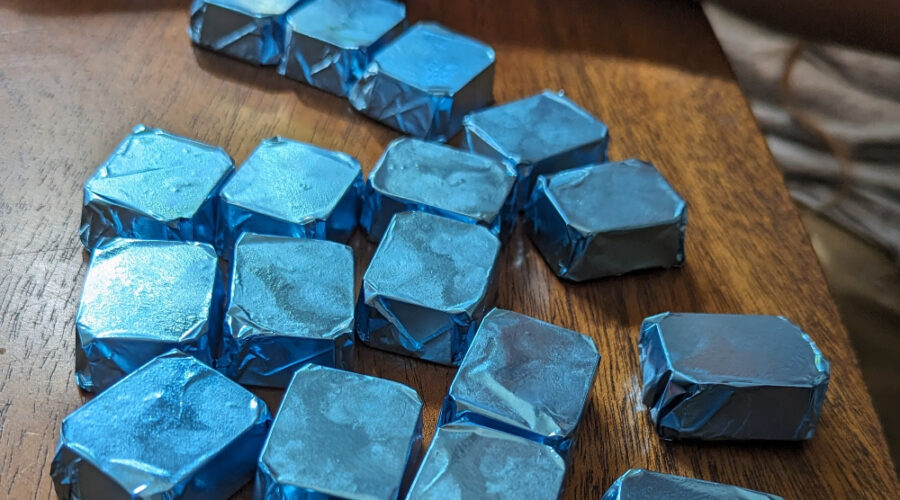
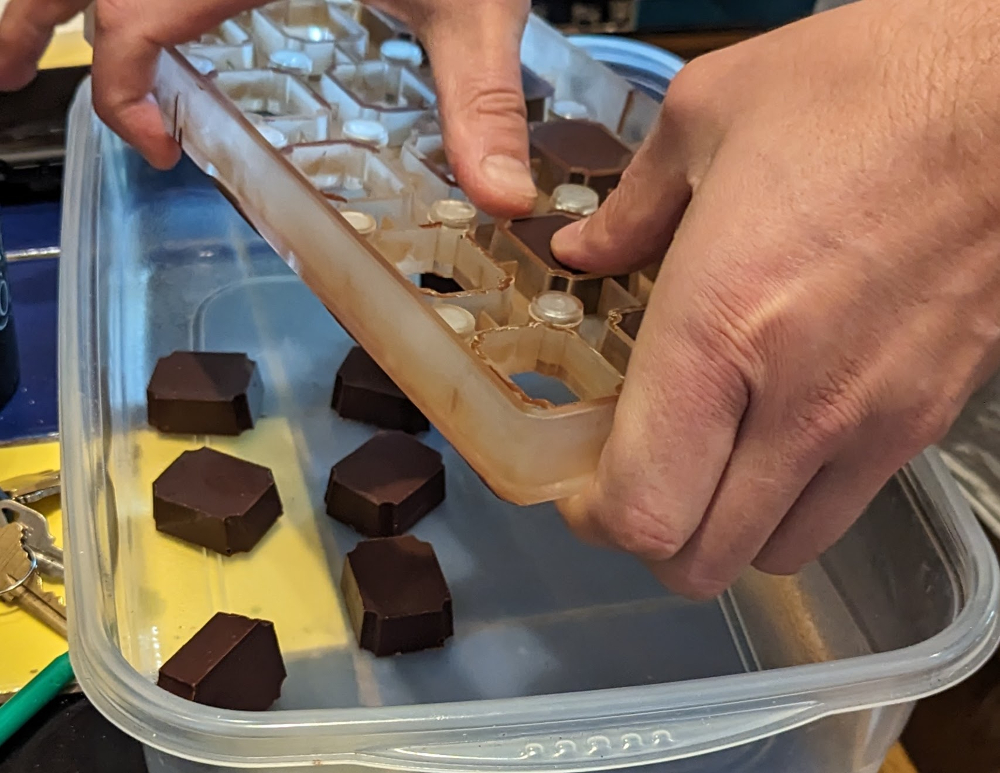
And it’s not hard to make mushroom chocolates, either. “Just heat the chocolate up and stir in the mushroom powder and put it in a mold,” Fluck says. He pops mushroom-infused chocolates out of an ice cube tray, places them on shiny paper, and wraps them up like gifts.
You can, too.
The Basics of Mushroom Chocolates
There are many ways to consume mushrooms, including eating them whole (either wet or dried), lemon tekking, powdering them and putting them into capsules, making magic mushroom tea, or incorporating them into food. In terms of this last option, one popular way to do this is to make mushroom chocolates.
This guide explains how to make mushroom chocolates, starting with how to obtain a batch of psilocybin mushrooms and then describing the process of adding them to chocolate.
Ingredients For Mushroom Chocolates
The essential ingredients you’ll need to make mushroom chocolates are:
- Magic mushrooms, dried and ready to be chopped up or powdered
- Store-bought chocolate (bars or chips)
- Two saucepans, or a saucepan and a glass bowl
- Sharp knife or coffee grinder
- Chocolate mold
- Digital scale
Exciting news: Oregon is legalizing Psilocybin therapy in early 2023. Click here to get on the waiting list for the first state-approved psilocybin therapy in the United States now!
Sourcing Magic Mushrooms
People get psilocybin mushrooms by:
- Growing at home.
- Buying From A Dealer. Know that some strains, like penis Envy and Liberty Caps are more potent than others.
- Picking Them. Psilocybin-containing mushrooms grow around the world, from Florida to Oregon. Be super careful; a lot of mushrooms look the same.
FROM OUR PARTNER: Want to Save Money in the Long Run? Get Your Own Mushroom Grow Kit Here
Determining Your Dosage
When making mushroom chocolates, you don’t want to guess your shrooms dosage. Doing so could either land you with an underwhelming, overwhelming, or difficult trip.
Consider how potent you want each piece of chocolate to be. We would recommend that you make each piece of chocolate contain a low dose so that you can always eat another piece, or half a piece, if you want the trip to be stronger. We also recommend you use a mid-strength Psilocybe cubensis strain such as “Golden Teachers”.
Using scales, you can measure out 1g of mushrooms for each piece of chocolate. This is an easily divisible low dose. One piece would give you a mild trip, two pieces a moderate strength trip, and more than that would be a strong trip.
Of course, if you’re a beginner when it comes to shrooms, you can always put less in. If you’re a seasoned tripper, you can add more than a gram.
Make a note of the dose that is going into your chocolate, so you can tell others confidently that one piece of chocolate contains, for instance, 1g of magic mushrooms – being sure to also tell them the strain or species.
RELATED: How Much Do Shrooms Cost, And Can You Buy Them Legally?
How To Make Mushroom Chocolates
Here is a step-by-step process for making mushroom chocolates.
- Chop your mushrooms into small, easily manageable pieces. Or powder your shrooms using a spice/coffee grinder.
- Put your chocolate of choice in a glass bowl. If you have bought chocolate bars, cut them into small pieces. And if you have chocolate chips, pour them in until you have the amount you want.
- Fill the saucepan with water about halfway. Place the chocolate-filled bowl in the middle of the pan. (You don’t want to put the chocolate itself in the pan, as it shouldn’t be getting wet.)
- Place the pan on a stovetop and bring the water to a boil. The heat from the water will melt the chocolate inside the bowl. It is possible to melt the chocolate inside the microwave, however, this risks burning the chocolate.
- Remove the bowl from the pan once all the chocolate has melted and let it cool for a minute.
- Once the chocolate has cooled a bit, mix in your mushrooms (the total dose of which will be divided by the number of molds you have) and stir until they seem evenly distributed. Make sure to mix very well!
- Pour the mushroom-chocolate mix into molds. If the mixture is too thick to pour, spoon it into the molds and smooth out the tops.
- Cool the magic mushroom chocolates, either in the fridge or freezer or by leaving them on the counter at room temperature.
Interested in joining a Psychedelics Clinical Trial? Sign up here now and we will connect you with a clinical trial in your area when one becomes available.
How To Store Mushroom Chocolates
Store mushroom chocolates in an airtight container in the fridge or freezer. A glass Snap-Ware container, which you would normally use for storing weekday leftovers, will be perfect for the fridge. Make sure to line the container with waxed baking paper to prevent sticking. You can also place each individual chocolate in miniature waxed muffin paper.
Place in zip-lock bags to store in the freezer.
Keeping mushroom chocolates cool will slow the rate of oxidation, as well as prevent them from melting on a hot day. You can expect these chocolates to last in the fridge for up to a month but perhaps longer than that, up to six months — up to a year in the freezer.
RELATED: These Magic Mushroom Chocolate Bars Made 12 People Sick And Now The FDA Is Investigating
Mushroom Chocolates Are Discreet
In most countries around the world, magic mushrooms are a highly prohibited drug. In the United States, they remain, federally, a Schedule I drug. This classification entails the harshest punishments for selling or possession. Having dried mushrooms in a clear jar or plastic bag will look suspicious.
It’s true that people do use dried edible mushrooms for cooking, but don’t expect law enforcement to assume this if they catch you with your shrooms.
Mushroom-infused chocolates, on the other hand, look the same as any other chocolate, so there’s no reason they’ll raise suspicion (unless they’re explicitly labeled as containing magic mushrooms). Some dealers and darknet vendors sell magic mushroom bars but they’re often labeled as such, which obviously isn’t as discreet as making your own, without such labeling.
Once you have your mushroom chocolates, you can take them anywhere. Just make sure that they don’t end up in the wrong hands, with someone eating them and assuming they’re just normal chocolates.
Psilocybin Chocolates and the Legal Landscape in 2025
This article was written as a culinary and practical guide to making psilocybin mushroom chocolates. Since then, the legal and regulatory landscape for psilocybin has changed in meaningful ways — and the chocolate preparation method remains one of the most commonly used formats in both personal use and, more recently, commercially relevant contexts as legal markets develop.
Oregon’s licensed psilocybin service centers. Oregon legalized supervised psilocybin services through Measure 109 in 2020, and licensed service centers began operating in 2023. In the licensed framework, psilocybin is served directly (not as chocolate products), and service center operators work with state-approved preparation formats. However, the mainstream conversation about psilocybin chocolate has helped normalize the idea of psilocybin in palatable, precise-dose formats — which is relevant context for where formal markets are heading. If and when retail psilocybin becomes available, chocolate products are the format most likely to appear first.
Colorado’s natural medicine framework. Colorado passed Proposition 122 (Natural Medicine Health Act) in 2022, legalizing personal use and possession of psilocybin mushrooms for adults 21+ (not for sale), and creating a licensed healing center framework that is developing as of 2025. The personal possession provisions mean Coloradans can legally possess and use psilocybin mushrooms — and by extension, could make mushroom chocolates at home without the legal risk that applies in most other states. This doesn’t change the safety or dosing guidance, but it changes the legal context for residents.
Dosing accuracy with homemade preparations. One thing the article touches on but deserves additional emphasis: dosing accuracy is one of the primary challenges with homemade mushroom chocolates. Psilocybin content in mushrooms varies significantly between strains, flushes, and even different parts of the same mushroom (the caps are generally more potent than the stems). When mushrooms are ground and mixed into chocolate, that variability gets distributed unevenly through the batch — meaning each piece can have meaningfully different potency. Consistent grinding (fine powder from a coffee grinder, then thorough mixing) reduces but does not eliminate this variation. If dose precision matters to you, weigh each mushroom serving before incorporation rather than relying on piece count after the chocolate is set.
Frequently Asked Questions
Why use chocolate for psilocybin mushrooms instead of eating them plain?
The main reasons are palatability and convenience. Dried psilocybin mushrooms have a distinctive earthy, sometimes bitter taste that many people find unpleasant — particularly in larger doses. Chocolate masks the flavor effectively. Chocolate also makes portioning more convenient: a standard chocolate bar format allows you to pre-set approximate doses and carry them easily. There’s also an absorption question: some people find that the fats in chocolate — combined with the way chocolate melts — may slightly affect onset timing and smoothness of the experience, though this effect is modest and individual.
Does making mushroom chocolate reduce the potency of psilocybin?
Heat is the primary concern. Psilocybin starts to degrade at temperatures above approximately 190°F (88°C), and the conversion to psilocin (the active form in the body) is accelerated at high temperatures but psilocin is even more heat-sensitive. Most chocolate tempering processes peak around 120–130°F — well below the degradation threshold. Standard double-boiler or microwave chocolate melting methods operate safely if you keep temperatures below 160°F. The key is not to overheat: burning chocolate not only ruins the flavor, it risks meaningful potency degradation. Let melted chocolate cool to 100–110°F before adding finely ground mushroom material, then mix thoroughly.
Is making mushroom chocolate legal?
In most U.S. states, psilocybin mushrooms remain illegal under state law, making mushroom chocolate equally illegal. Colorado passed Proposition 122 in 2022, which legalized personal possession and use of psilocybin mushrooms for adults 21+, meaning home preparation (including chocolate) is legal for personal use in Colorado. Oregon’s Measure 109 legalized supervised psilocybin services in licensed facilities — not home use. Several cities have passed decriminalization ordinances (Ann Arbor, Denver, Oakland, Seattle, Washington D.C., and others) that deprioritize enforcement for personal possession, but decriminalization is not legalization. Always check your specific jurisdiction.
How do you dose psilocybin mushroom chocolate accurately?
Dosing accuracy is one of the primary challenges. Psilocybin content varies between mushroom strains, flushes, and parts of the mushroom (caps typically more potent than stems). When ground mushrooms are mixed into chocolate, this potency variation distributes unevenly. Best practices: use a precision scale to weigh your total mushroom material; grind to a very fine, uniform powder; mix extremely thoroughly before pouring into molds; portion by weight after the chocolate sets, not by piece count alone. A common approach: target 0.5–3.5 grams per serving based on desired experience, then back-calculate how much mushroom material to incorporate in the total batch to hit that ratio per piece. Still expect ±20–30% variation between pieces even with careful preparation.