
How Ketamine Clinics Can Improve Google Maps Visibility in 2026
Most “rank your clinic on Google Maps” advice circulating in 2026 is recycled home-services SEO with the word “plumber” swapped for “clinic.” It’s mostly correct on the fundamentals, mostly wrong on the specifics, and in two or three places it’s genuinely risky if you apply it to a regulated medical practice.
At HealingMaps, we’ve spent the last three years indexing, verifying, and ranking 1,600+ ketamine clinics across the United States. We see what gets clinics into the Map Pack — and we see what gets them suspended from Google Business Profile, flagged by state medical boards, or sued by past patients. The two playbooks are not the same. The paid side of that surface is getting more expensive, now that pharmaceutical advertisers are bidding on psychedelic keywords.
Here’s what actually works for ranking a ketamine clinic in Google Maps, and what the generic playbook gets dangerously wrong.
Save 40%+ on Your Medical Supplies
GPO-level pricing negotiated through Pipeline Medical, exclusively for Healing Health Alliance members. One member practice is projected to save $38,000+ a year. Find out how much we can save your clinic — no obligation, no contracts.
(43% reduction on supply spend)
Key Takeaways
| What drives rankings | Google bases local rankings on relevance, distance, and prominence — and there’s no way to request or pay for a better local ranking. The practical work happens on relevance and prominence. |
| GBP fundamentals | An accurate medical primary category, a complete services section, real clinic photos, and a verified physical address are the foundation. Most ketamine clinics leave several of these empty. |
| Reviews | Steady review velocity matters more than total count. Requests must be neutral, consistent, and never incentivized — the FTC’s Consumer Reviews and Testimonials Rule and Google’s own policy both apply. |
| HIPAA in public | Never confirm a reviewer is a patient or reference treatment details in any reply. OCR fined a practice $50,000 for a single review response. |
| Citations | 12-15 healthcare-specific listings (Psychology Today, Healthgrades, Zocdoc, HealingMaps, the REMS Spravato locator) outweigh 80 generic directories. |
| What to skip | DBA keyword stuffing, paid reviews, Facebook group seeding, and press-release spam — home-services tactics that carry regulatory and suspension risk for a medical practice. |
| Clinical legitimacy | Visible prescriber credentials, protocol transparency, honest off-label disclosure, and MedicalClinic schema are what separate clinics that surface in the Map Pack from vague wellness brands. |
The Map Pack is still where the calls come from
A large share of the inbound calls a ketamine clinic gets from Google tend to come through the Map Pack — the three local results that sit above the organic listings. Patients searching “ketamine clinic near me,” “ketamine therapy [city],” or “Spravato provider [city]” make a decision in the Map Pack first and only scroll into organic results if none of the top three feel right.
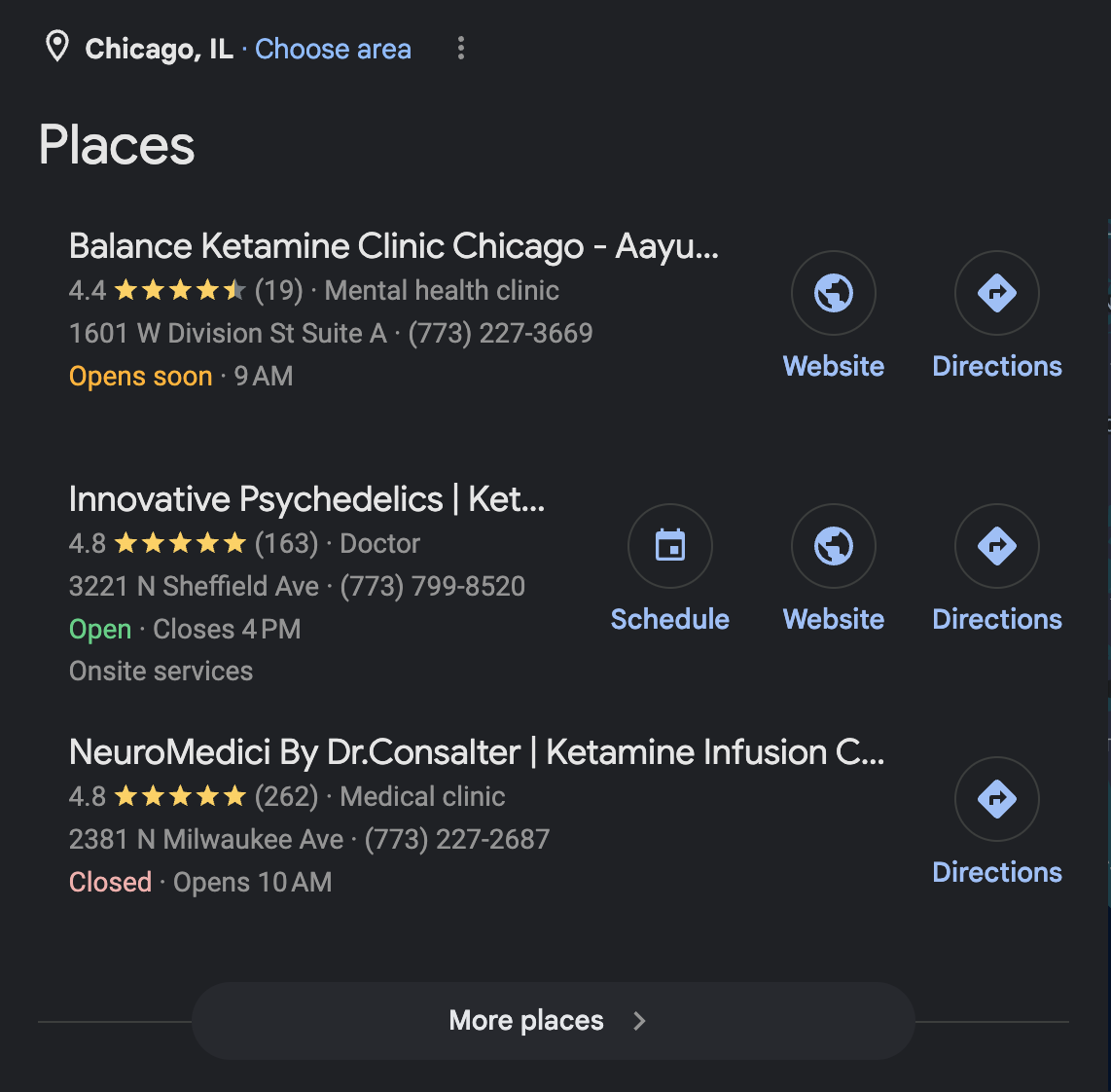
Position one in the Map Pack tends to pull several times the call volume of position three, and the falloff from the third result to the fourth — the first listing below the pack — is steeper still. Everything else in this article is in service of getting and holding one of those three slots.
Google says local rankings are based primarily on three factors:
- Relevance (how well your GBP matches the search query)
- Distance (how close the searcher is to your business)
- Prominence (how authoritative your business looks to Google)
Google is also explicit that there’s no way to request or pay for a better local ranking. Distance is largely controlled by where the searcher happens to be standing, so the practical work for clinics happens around relevance and prominence — which is what the rest of this article is about.
What transfers from the home-services playbook (with healthcare adjustments)
A handful of the boring fundamentals are universal. Skip these and nothing else matters.
Google Business Profile completeness
Same principles as any other local business — but the category and content choices are healthcare-specific.
Your primary GBP category should reflect your actual medical model and the way patients search for care. Depending on the clinic, that may be “Mental health clinic,” “Psychiatrist,” “Pain management physician,” or another accurate medical category — avoid choosing a vague category like “Doctor” simply because it sounds broad. Secondary categories should include “Pain management physician” if you treat chronic pain, “Addiction treatment center” if you serve SUD patients, and “Telehealth service” if you offer virtual integration sessions. Most ketamine clinics we audit have one or two categories filled. The rest sit empty as free ranking signals.
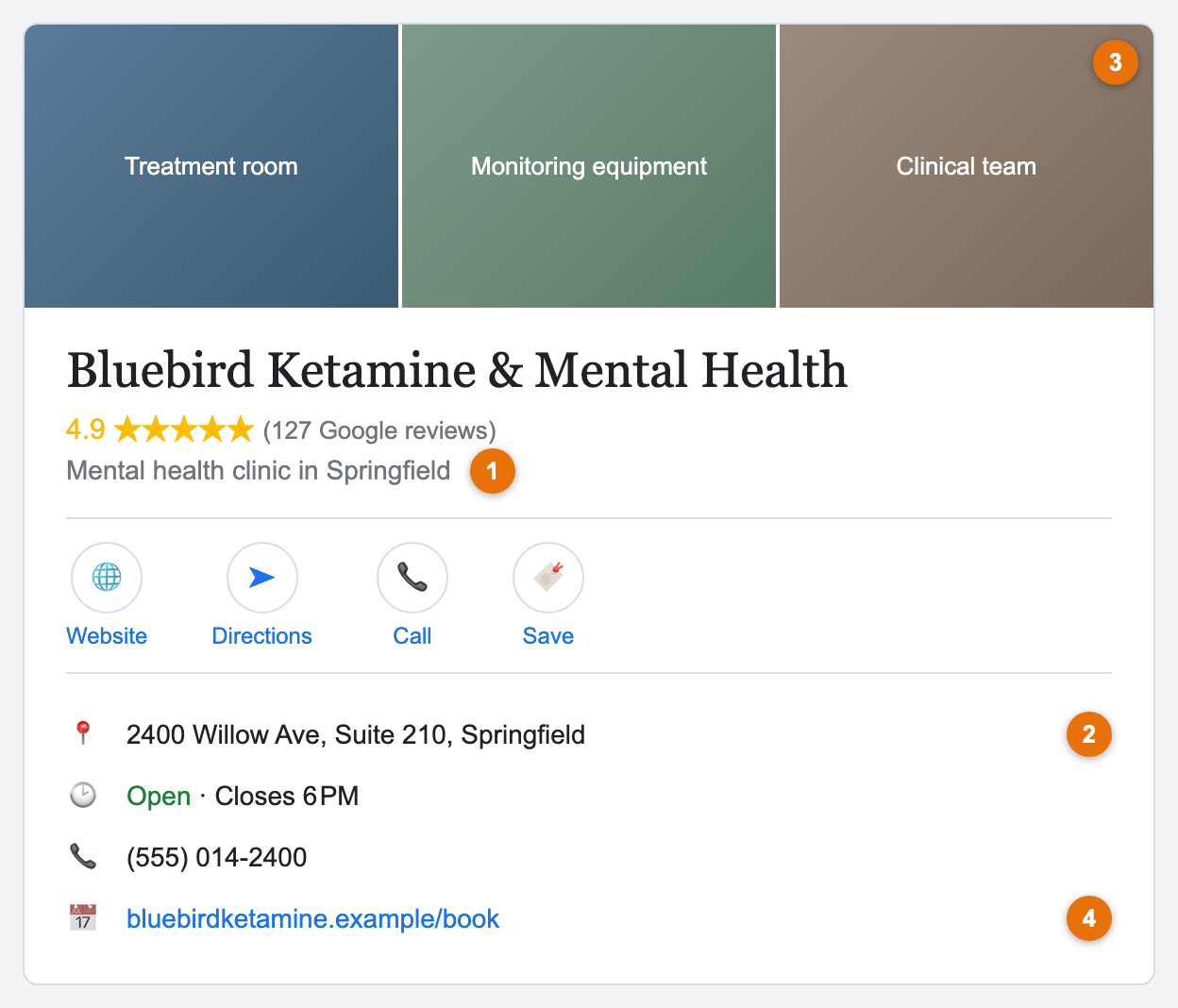
- Primary category matches the medical model — “Mental health clinic,” not “Doctor” or a vague wellness category. Secondary categories cover pain management, addiction treatment, or telehealth where accurate.
- NAP is exact — the name, address, and phone match every directory listing character-for-character.
- Real photos — treatment rooms, monitoring equipment, and the clinical team. No stock photos of smiling patients.
- A working booking link — one tap from the profile to an appointment.
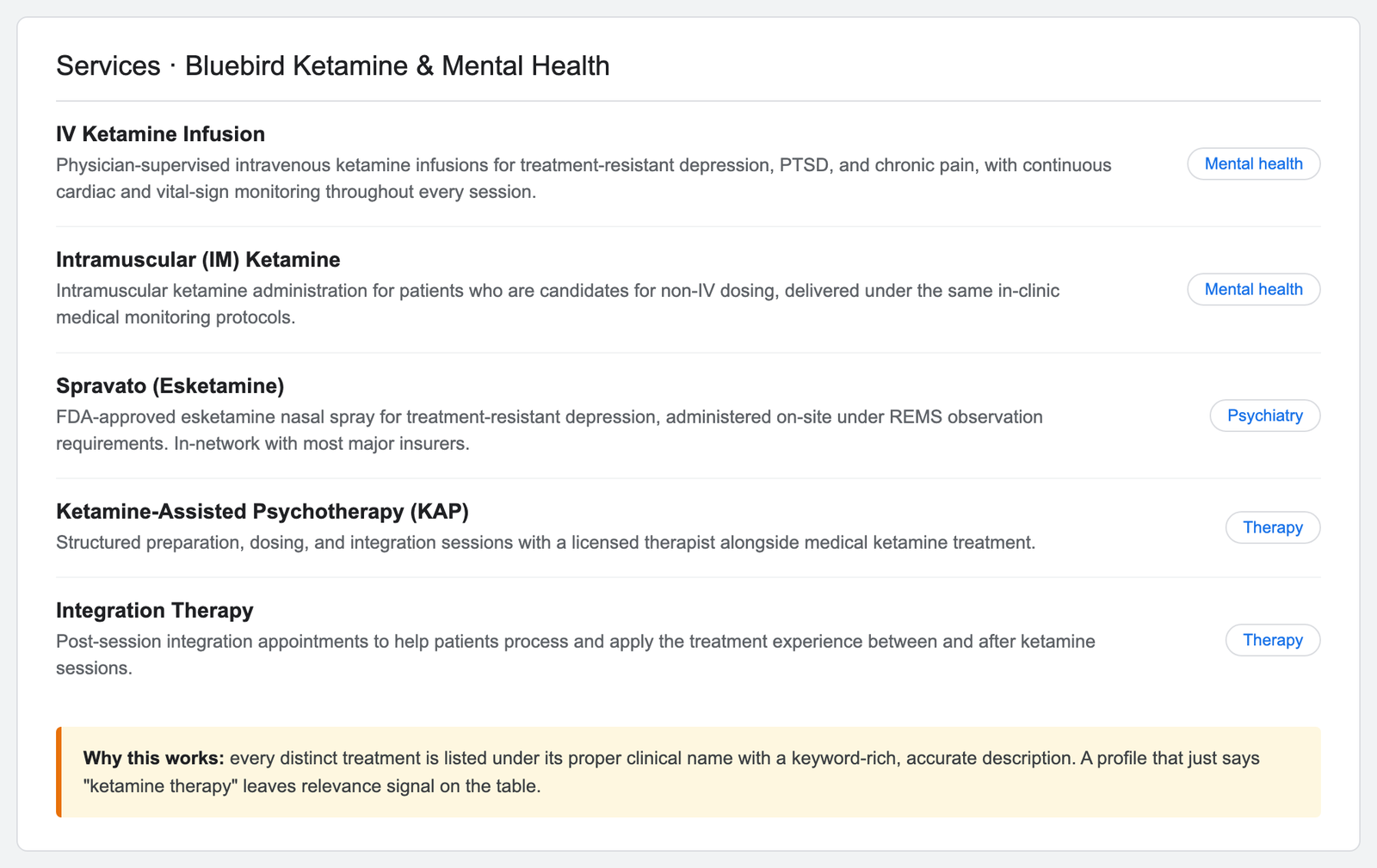
Your services section should list every distinct treatment with proper clinical names: IV ketamine infusion, intramuscular ketamine, ketamine-assisted psychotherapy (KAP), Spravato (esketamine), oral ketamine lozenges, integration therapy. Each service should have a keyword-rich description. Generic descriptions like “ketamine therapy” leave ranking signal on the table.
The products section is optional, and worth a cautious look if it’s available on your profile. Some clinics use it to describe treatment programs or consultation types, but the services section is usually the cleaner place for medical treatments. If you include pricing anywhere on your profile, make sure it’s accurate, current, and consistent with your state’s advertising rules.
Photos matter, but the rules are different for healthcare. Skip the stock photos of smiling patients — they read as inauthentic to prospective patients and do nothing to establish that a real clinic exists at a real address. Use real photos of your treatment rooms, IV setup, monitoring equipment, exterior signage, waiting area, and clinical team. Make sure the photos accurately represent the clinic, and refresh them periodically — forty to fifty real photos refreshed quarterly is a good benchmark.
Service area settings exist mostly for businesses that travel to their customers. If patients receive care at your clinic, your verified physical address is the signal that matters. Only use service-area settings if they accurately reflect how the clinic delivers care, and don’t inflate the area to cover cities you don’t realistically serve.
Physical address beats service-area-only profiles every time. If you’re operating out of a leased medical suite, make sure that address is on your GBP and matches every other listing.
Google Posts (the underused weekly signal)
Google Posts on your GBP function as a freshness signal that almost no ketamine clinic uses. A weekly post — a treatment-protocol explainer, an insurance update, a new provider introduction, a research summary — keeps your profile active in Google’s eyes. Google has said Posts are not a direct ranking factor, but in our internal Map Pack monitoring across major metros, profiles that post consistently tend to hold their positions better than otherwise-identical profiles that go dormant — most likely through the engagement and freshness that activity signals.
Keep posts factual and clinical. Avoid promotional language (“limited time offer”) — it sits poorly with both Google’s content policies and a clinical brand.
The Q&A section
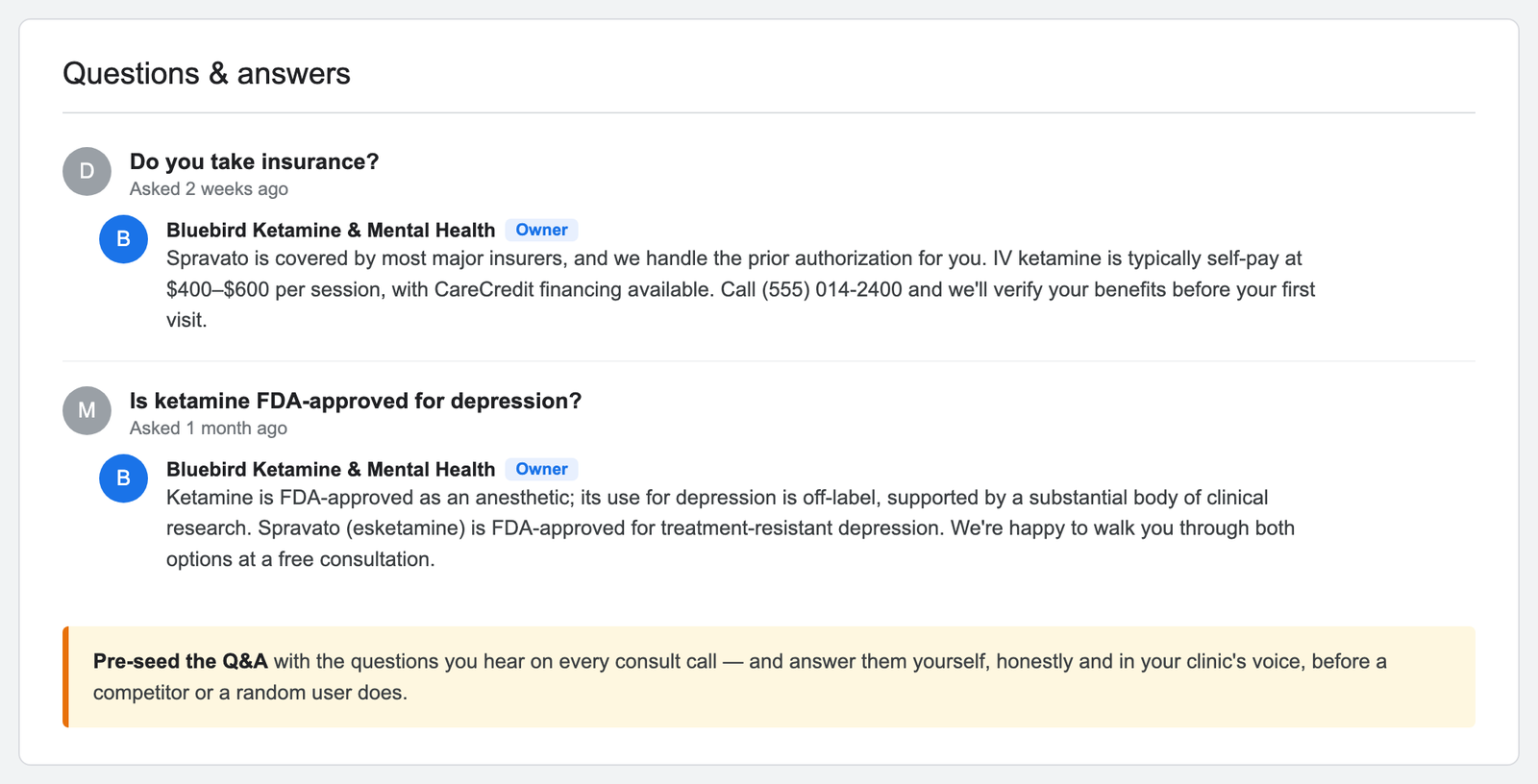
Every GBP has a public Q&A section that almost no clinic owner monitors. Patients ask questions. Anyone can answer them. If you don’t answer first, a competitor or a random user will, and that answer ranks in your profile permanently.
Pre-seed the Q&A with the questions you get on every consult call: “Do you take insurance?” “How many sessions does treatment require?” “Do you offer Spravato?” “Is ketamine FDA-approved for depression?” Answer them yourself, in your clinic’s voice, with your phone number for follow-up. This is a 30-minute project that almost nobody does.
Reviews — but the HIPAA-safe way
Reviews are among the strongest prominence signals in Map Pack ranking. Review velocity (how many you generate per month) matters more than total count. A clinic with 80 reviews and 8 in the last 90 days outranks a clinic with 600 reviews and zero recent ones, in most metros we monitor.
The home-services playbook says: pay your techs $25 per review, ask in person right after the job. That tactic will get a ketamine clinic in serious trouble.
You cannot pay anyone — staff or patient — for a review. The FTC’s Consumer Reviews and Testimonials Rule (16 CFR Part 465), which took effect on October 21, 2024, gives the agency clearer authority to seek civil penalties for fake, purchased, insider, or otherwise deceptive reviews and testimonials — and it applies to every business regardless of how patients pay. Google separately prohibits offering incentives in exchange for reviews. Where a federal program such as Medicare covers the service (for example, some Spravato), the federal Anti-Kickback Statute can apply as well, and several states have all-payer anti-kickback laws that reach cash-pay and privately insured care. State medical boards may also scrutinize review, testimonial, and advertising practices, depending on the state.
HIPAA does permit a neutral review request — patients are free to disclose their own treatment, and a generic “we’d value your feedback” ask is compliant. Where clinics get into trouble is on their own side of the conversation: a clinic cannot disclose that a specific person is a patient, or reveal any treatment detail, without explicit written HIPAA authorization. Keep the ask neutral, and never tie a named individual to mental health treatment in anything the clinic publishes.
What does work for ketamine review velocity:
- A neutral review request built into the post-treatment or follow-up workflow. The request should go to patients consistently, shouldn’t ask for a positive review, shouldn’t suggest what to say, and shouldn’t offer anything of value. (Reusing a patient’s story in your marketing is a separate process entirely — that one does require written HIPAA authorization.)
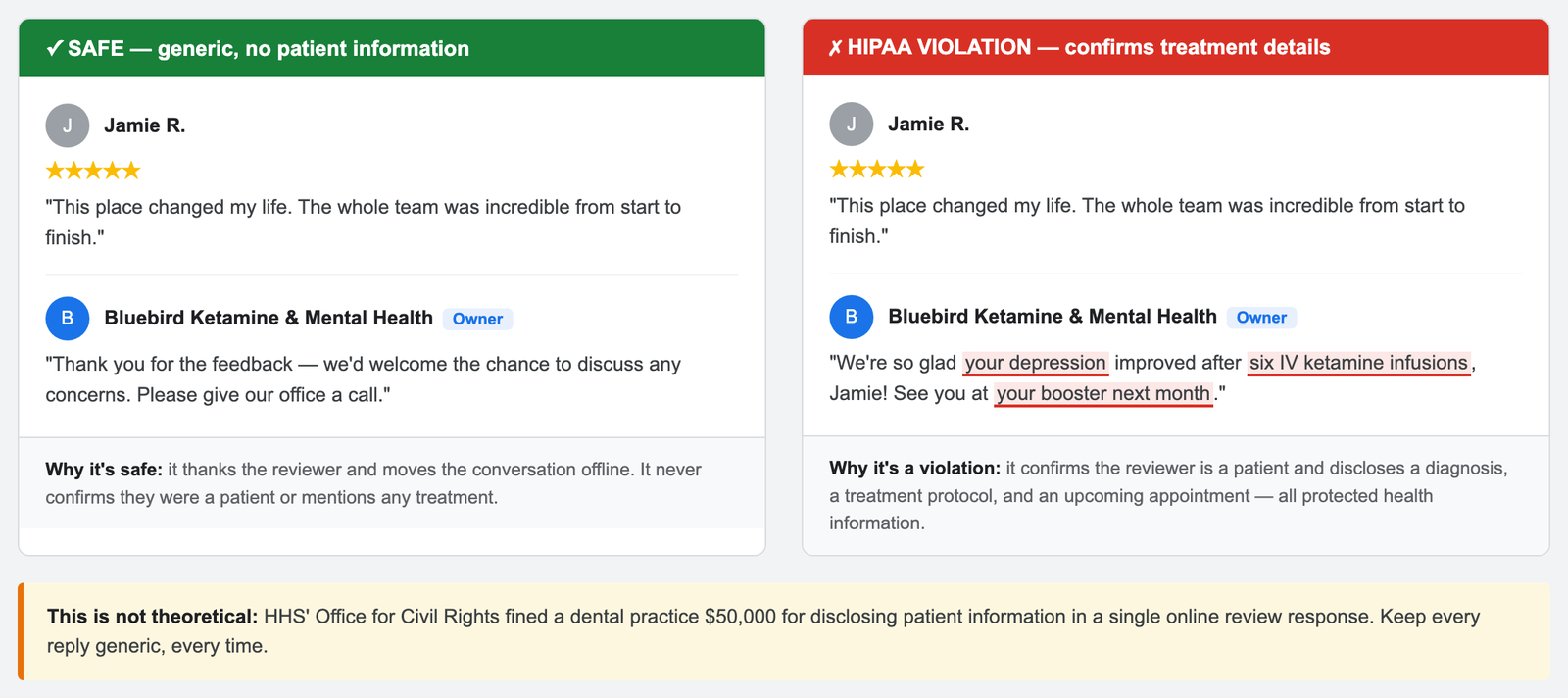
- Owner-signed responses to every review within 48 hours, including critical ones — but keep every reply generic and never confirm the reviewer is a patient or reference any treatment detail. (OCR fined a dental practice $50,000 for disclosing patient information in a review response.) A safe template: “Thank you for the feedback — we’d welcome the chance to discuss any concerns. Please give us a call.” Never write anything like “We’re so glad your depression improved after six infusions” — that confirms a treatment relationship and reveals health information. Responding consistently supports trust and engagement; it just has to be done within these lines.
- Quarterly outreach to your highest-NPS patients with a written invitation to share their experience publicly if they’re comfortable. Optional, never compensated.
Small site details compound the same way; this simple website detail makes your ketamine clinic look more trustworthy.
You will generate fewer reviews per month than an HVAC company. That’s fine. Healthcare reviews are weighted differently — a clinic with consistent recent velocity at a high rating outperforms a clinic with a larger but stale review set.
NAP consistency across healthcare-specific citations
Pick one exact format for your business name, address, and phone number. Use it everywhere. “ABC Ketamine Clinic” on Healthgrades and “ABC Ketamine Clinic LLC” on Psychology Today confuses Google’s entity matching and weakens your prominence signal. “(303) 555-1234” on one site and “303-555-1234” on another can have the same effect.
The home-services playbook tells you to build out 80+ generic citation directories — Yelp, BBB, Angi, HomeAdvisor, Thumbtack, Yellow Pages, Foursquare. A few of those matter for healthcare. Most don’t.
The citations that actually move the needle for a ketamine clinic’s Map Pack ranking, ranked by impact:
- Psychology Today directory listing
- Healthgrades provider profile
- Vitals provider profile
- Zocdoc (especially if you offer Spravato and accept insurance)
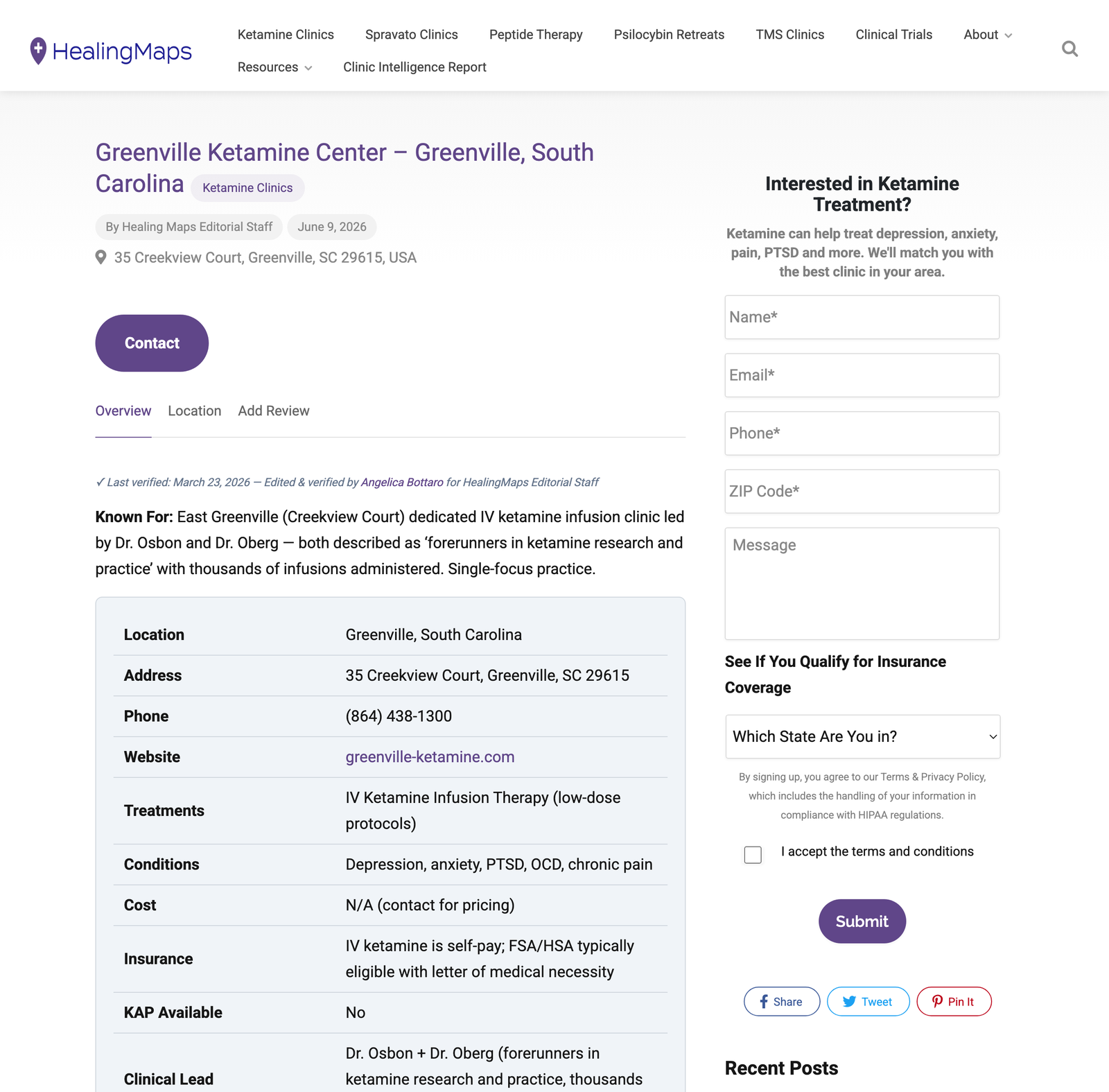
- HealingMaps clinic listing
- The REMS Spravato locator (if you offer Spravato)
- WebMD Care provider listing
- Your state medical society directory
- Your local chamber of commerce
- Apple Business Connect (Apple Maps — separate from Google but often forgotten)
- Bing Places
- Yelp (still matters for general consumer trust signals, even if it’s not a top driver)
Anything beyond this list is diminishing returns. You don’t need 80 citations. You need 12-15 high-trust healthcare-specific ones, all carrying the exact same NAP.
Conversion fundamentals (with ketamine-specific twists)
Map Pack ranking gets the call to ring. The website has to convert it.
Most home-services conversion advice transfers cleanly: phone number top right, sticky call button, three-second above-the-fold pitch, mobile PageSpeed above 70, real photos throughout, three-field forms.
Three ketamine-specific additions matter more than anything else:
Insurance answer above the fold. A large share of ketamine inquiry calls open with “do you take insurance?” If your homepage doesn’t answer this in the first scroll, you lose the call before it happens. Spravato is generally covered. IV ketamine generally isn’t. Be explicit. Clinics that say “we’ll discuss financing on your consult” lose to clinics that say “Spravato covered by Aetna, Anthem, BCBS, Cigna, United. IV ketamine $400-$600 per session, financing available via CareCredit.”
Treatment plan transparency. Patients researching ketamine want to know: how many sessions, over what timeframe, what does maintenance look like, do you offer integration. Clinics that publish this — six infusions over two to three weeks, then booster every four to eight weeks, integration sessions available — consistently outconvert clinics that hide it behind a consultation.
Provider credentials prominent. A photo and short bio of your prescriber, with board certification, years of practice, and ketamine-specific training (KRIYA Institute, Polaris, Fluence, etc.) belongs above the fold or in the first scroll. This is the single highest-trust signal you can put on the page.
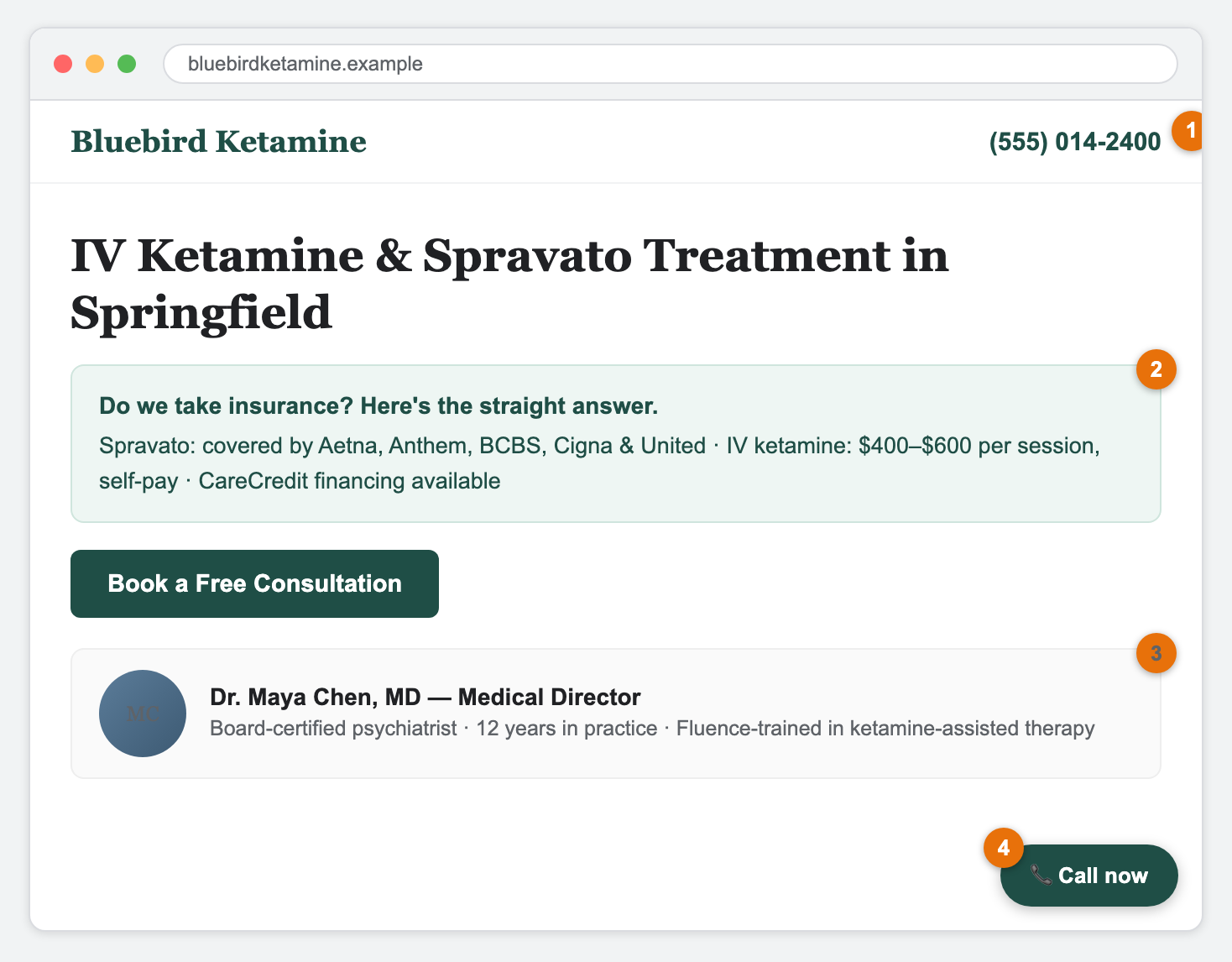
- Phone number top right — visible without scrolling, tappable on mobile.
- The insurance answer, immediately — most inquiry calls open with “do you take insurance?” Clinics that answer it on the first scroll win the call.
- Prescriber credentials in plain text — board certification, years in practice, ketamine-specific training. The single highest-trust signal on the page.
- Sticky call button — follows the visitor down the page.
The five tactics from the home-services playbook that will hurt you
These are the moves that get repeated in every “rank your business in the Map Pack” thread, and every one of them carries real regulatory or reputational risk in a healthcare context.
1. DBA keyword stuffing into your business name
The home-services tactic: file a DBA so “Smith Plumbing LLC” becomes “Smith Plumbing, Drains & Sewer Repair,” update GBP, watch your rank jump.
Why this breaks for ketamine: Google’s healthcare GBP review process is much stricter than the home-services queue. Adding “Ketamine Therapy & Depression Treatment” to your clinic’s legal name will trigger a manual review, and in the majority of cases we’ve seen, suspension or forced rollback. Some state medical boards also restrict how a medical practice can advertise services in its registered name. The downside risk — a 30 to 90 day GBP suspension during peak season — vastly outweighs the upside.
2. Paying staff or patients for reviews
Covered above. Anti-Kickback Statute exposure, HIPAA exposure, state medical board exposure, FTC exposure, Google policy exposure. Five regulatory regimes. Don’t do it.
3. Asking patients to mention you in local Facebook groups
The home-services tactic: after every job, ask happy customers to drop your name in a neighborhood Facebook group when someone asks for a recommendation.
Why this breaks for ketamine: a patient publicly identifying themselves as a ketamine recipient on Facebook is disclosing a mental health treatment in a public forum. Even if a patient freely chooses to discuss their own care, the social and professional consequences for them can be severe — and a clinic should be very cautious about building a systematic marketing tactic around patients disclosing mental health treatment in public. The better approach is simply not to ask patients to post about treatment in neighborhood Facebook groups.
There’s a narrow exception: patients who have already publicly disclosed their treatment journey on their own initiative (mental health advocates, certain creators) and explicitly want to recommend you. That’s fine. Soliciting it as a tactic is not.
4. Treating Thumbtack, Angi, HomeAdvisor, and Yelp as your primary citation stack
These are home-services marketplaces. They contribute essentially zero Map Pack ranking signal for ketamine queries. Yelp still has some general trust value, but the rest are noise for healthcare. The healthcare-specific citation stack above is where your time goes.
5. Press release spam to EIN Presswire and PRWeb
The home-services advice: monthly press releases, $50-400 each, syndication picks them up across dozens of low-tier sites, signal compounds.
Why this is mostly noise for ketamine: Google has steadily devalued low-trust syndication networks since the helpful content updates, and medical queries are held to a higher trust standard than most. Press releases on EIN/PRWeb get picked up by the same 30-40 low-quality news aggregators every time, and Google deduplicates and downweights these aggressively. The actual high-trust press placements — local news features, mental health trade publications, peer-reviewed coverage — require real journalism outreach, not paid syndication.
A press release once or twice a year for a genuine milestone (new location, new medical director, FDA-related news) is fine. A monthly schedule of low-grade releases is wasted budget.
The healthcare-specific signals that actually drive the Map Pack
This is where ketamine clinic rankings diverge most sharply from generic local SEO, and where almost nobody has the right playbook.
Medical and mental health businesses appear to be judged through a higher trust lens than ordinary local businesses. Whether or not Google describes this internally as a formal healthcare filter, the pattern across the clinics we monitor is consistent: clinics that present clear clinical legitimacy tend to perform better in the Map Pack than clinics that look like vague wellness brands, regardless of how much GBP optimization the wellness brands are doing.
The signals that communicate clinical legitimacy:
- Board-certified prescriber visible on the homepage with credentials in plain text (not just an image)
- MD, DO, NP, or PA listed for every prescriber with NPI cross-verifiable in the public registry
- Medical clinic schema markup (
MedicalClinic+Physician+MedicalProcedure) in your site’s JSON-LD, not genericLocalBusinessschema - Protocol transparency — explicit treatment plans with session counts, monitoring procedures, contraindications
- Integration support documentation — even a one-paragraph description of how you handle post-session integration weighs as a clinical seriousness signal
- Crisis resources visible — a 988 link or emergency information in the footer signals clinical responsibility
- Honest disclosure of off-label status — ketamine is FDA-approved as an anesthetic, not for any psychiatric disorder. When it’s used for depression, PTSD, anxiety, or other psychiatric conditions, that use is off-label, as the FDA has stated publicly. (Spravato — the esketamine nasal spray — is the exception, with its own FDA-approved psychiatric indications and REMS requirements.) Clinics that say this plainly read as more legitimate than clinics that imply FDA approval
- REMS certification displayed if you offer Spravato
Each signal individually is small. Together, they’re the difference between a profile that reads as a legitimate medical operation and one that reads as a wellness brand — and in our monitoring, that difference shows up in Map Pack visibility.
Local link building for ketamine clinics
The other underused prominence signal is local backlinks. The home-services playbook is right that a $300-500 sponsorship of a local nonprofit gets you a backlink from a .org domain, and that signal feeds local rankings.
For a ketamine clinic, the highest-leverage local backlink targets are:
- Local mental health nonprofits (NAMI affiliates, suicide prevention groups, veterans organizations)
- Local medical society websites
- Local addiction recovery organizations if you treat SUD
- Local pain support groups if you treat chronic pain
- University medical centers in your metro (often link to community providers)
- Local journalism — interviews with local mental health reporters or contribution to local health publications
A handful of these — five to ten genuine local backlinks from healthcare-relevant local sites — outweighs hundreds of generic citation listings.
The actual operator checklist
If you want one consolidated punch list:
Week 1
- Audit your GBP: primary category, secondary categories, services section
- Verify your NPI record and taxonomy codes
- Replace generic
LocalBusinessschema withMedicalClinic+Physician - Add insurance, pricing, and treatment plan transparency above the fold on your website
- Pre-seed your GBP Q&A section with the questions you get on every consult call
Month 1
- Build out the 12-15 healthcare-specific citation listings (Psychology Today, Healthgrades, Vitals, Zocdoc, HealingMaps, REMS Spravato locator, WebMD Care, state medical society, chamber, Apple Business Connect, Bing Places, Yelp)
- Lock NAP consistency across all of them
- Replace any stock photography on your site and GBP with real treatment-environment photos
- Build a neutral, consistent review request into your post-treatment follow-up workflow
Quarter 1
- Establish a weekly Google Posts cadence
- Earn 5-10 local healthcare-relevant backlinks (nonprofits, medical society, local press)
- Build out provider bios with credentials, training, and any publications
- Refresh GBP photos quarterly
Ongoing
- Owner-signed response to every review within 48 hours
- Monitor and answer new GBP questions weekly
- Quarterly content refresh on your highest-traffic pages
- Annual review of NPI, REMS, board certification, and directory listings
That’s the playbook. None of it is exotic. Almost all of it is the boring discipline of running a real medical practice and making the clinical legitimacy of that practice machine-readable.
The shortcut
Here’s the honest version: most independent ketamine clinics don’t have the in-house resources to manage all of this — and shouldn’t have to. You’re running a clinic, not a local SEO agency.
The Healing Health Alliance — HealingMaps’ GPO for the ketamine industry — was built partly to solve this. Member clinics get their HealingMaps listings continuously optimized as a high-trust citation source, with NAP consistency, schema markup, provider verification, and protocol transparency handled across the directory. Combined with group purchasing power on supplies, pharmaceuticals, and platform tools, member clinics see value through a mix of directory visibility, purchasing support, and operational savings — how much depends on the market and the clinic’s current setup.
The shortcut tactics — the DBA stuffing, the paid reviews, the press release spam, the Facebook group seeding — work for plumbers because plumbers operate in an unregulated category where the downside is just a slap from Google. They fail for ketamine clinics because the downside isn’t a ranking penalty. It’s a state medical board complaint, a HIPAA enforcement action, or a patient lawsuit.
Build the medical practice the way patients and regulators expect it to be built. Then make that legitimacy clear, consistent, and easy for Google to understand. That’s the whole playbook.