An Oral LSD Tablet Has Now Cleared Phase 3 Twice This Year. Here Is What Comes Next
Editor’s note (September 16, 2026): DT120 has since cleared a third Phase 3 trial. We covered the Panorama results and the low-dose arm designed to address unblinding.
An oral LSD tablet has now cleared phase 3 twice in a single year. Definium Therapeutics reported that DT120 ODT met its primary endpoint in generalized anxiety disorder, following a positive depression readout in June. Shares rose about 20 percent premarket. The share move will be forgotten in a week. The trial record is what changes the picture.
| Key Takeaway | Detail |
|---|---|
| The milestone | An oral LSD tablet met its primary endpoint in a phase 3 generalized anxiety trial |
| The pattern | This is the second positive phase 3 for the same drug this year, after a depression readout in June |
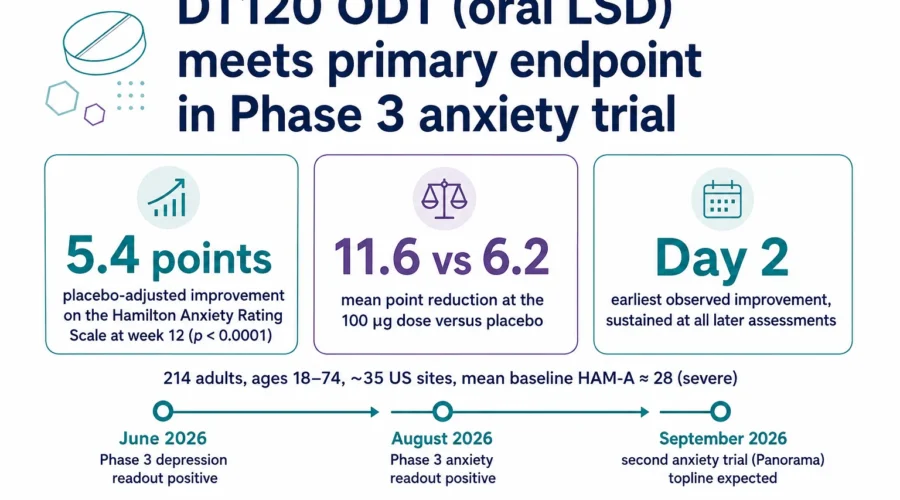
| The numbers | A 5.4 point placebo adjusted gain on the Hamilton Anxiety Rating Scale at week 12, p below 0.0001 |
| The speed | Improvement appeared as early as day 2 and held at every later assessment |
| Next checkpoint | A second phase 3 anxiety study reads out in September |
| The caveat | This is company topline data, not peer reviewed, and nothing is approved or scheduled for approval yet |
What the Trial Showed
The Voyage study enrolled 214 adults aged 18 to 74 across roughly 35 US sites. All had a DSM-5 confirmed generalized anxiety diagnosis. All scored at least 20 on the Hamilton Anxiety Rating Scale at baseline, with mean scores near 28. That is firmly severe.
At week 12 the drug beat placebo by 5.4 points on that scale, with a p value below 0.0001. At the 100 microgram dose, participants improved by a mean of 11.6 points against 6.2 for placebo.
Speed stood out. Improvement appeared as early as day 2 and held across every later assessment. Adverse events were mostly mild to moderate and concentrated on dosing days. The company reported no new safety signals and no suicidality concerns.
Why Two Readouts Matter More Than One
A single positive trial can be a fortunate draw. Two, in different indications, in the same year, is harder to dismiss.
The June result covered major depressive disorder, which we reported when that readout cleared. This one covers anxiety. Same compound, same delivery format, two distinct patient populations.
That combination is what moves a program from interesting to credible. It is also what makes regulators and acquirers pay attention at the same time.
The Timeline From Here
The next checkpoint arrives in September. A second phase 3 anxiety study, Panorama, reports topline results then.
Replication matters because regulators generally want more than one adequate and well controlled trial. If Panorama confirms Voyage, the anxiety package looks complete. If it misses, the story resets.
After that comes a filing, then a review period, then a decision. The company has not published a confirmed submission date, so anyone quoting an approval year right now is guessing. The realistic frame is years, not months.
One thing has changed in the background. The FDA published final guidance on psychedelic clinical investigations in July, which we covered when the rulebook landed. Programs now have written expectations to design against rather than standards inferred after the fact.
The Indication Is the Part Clinics Should Notice
Depression gets the headlines. Anxiety is the bigger operational story.
Based on our own aggregated demand data, anxiety has overtaken depression as the number one condition patients cite when searching for ketamine treatment. A rapid onset oral option aimed at that population would not be a niche product.
The delivery profile is worth studying too. It is a tablet rather than an infusion. In the company’s trials, participants left after roughly six hours, and no psychotherapy component was required. That means long chair time, light staffing and no vascular access.
The molecules keep changing. The room does not. Every late stage psychedelic in development still assumes a supervised setting.
What Is Not Settled
This is company issued topline data. Full results have not been published or peer reviewed, and topline announcements present trials at their best.
Nothing here is approved. An oral LSD product would also face scheduling questions that an approved indication does not resolve by itself, a distinction we worked through in our look at what changes when a psychedelic stops being off label.
The Acquisition Angle Got Sharper
Definium already appeared on analyst lists of likely takeover targets, which we covered in our piece on which psychedelic companies could be acquired next.
Two positive phase 3 readouts in one year strengthens that position. Buyers have been paying up for late stage psychedelic assets, and a company with data in both depression and anxiety is a different proposition than one with neither.
What to Do With This
Watch September first. Panorama is the checkpoint that determines whether this program is on a real path or a stalled one.
Think in positioning terms rather than threat terms. A six hour supervised oral dose is not a substitute for a 40 minute infusion series. It is a different product for an overlapping population.
Keep the monitoring capacity you already have. It is the scarce asset in every version of this future, and your practice already owns it.