

Microdosing Apps Analyze Your Sub-Perceptual Trip
Last reviewed and updated: June 16, 2026.
Key Takeaways
| Why track | Consistent logging lets you distinguish dose-related effects from natural mood variation or placebo — the only way to know if your protocol is actually working |
| Top dedicated apps | Deliqs (AI check-in chatbot, mood tracking), Houston (iOS only, intention-setting, regimen calendar), Mātū (iOS, integration journal + trend visualization) |
| What to track | Dose, time, mood, energy, focus — on both dosing AND non-dosing days |
| Most common protocol | Fadiman (dose Day 1, rest Days 2–3, repeat) — most tracking apps are built around this schedule |
| Legal note | Tracking apps are legal; psilocybin and LSD remain Schedule I federally — possession carries legal risk in most U.S. jurisdictions |
Are you doing non-psychedelic psychedelics? A dose so low you don’t know if you dosed yourself? A sliver of mushrooms or LSD so miniscule you see no breathing walls, hear no sweet musical enhancements, and gain no ability to talk to trees and rocks?
Well, if you are, we have an idea for you: a useful way to discover your ideal dosage for microdosing is to use a drug dose tracking app. With these apps, you can track your microdosing days and the effects that follow.
Here are some worth checking out:
Deliqs
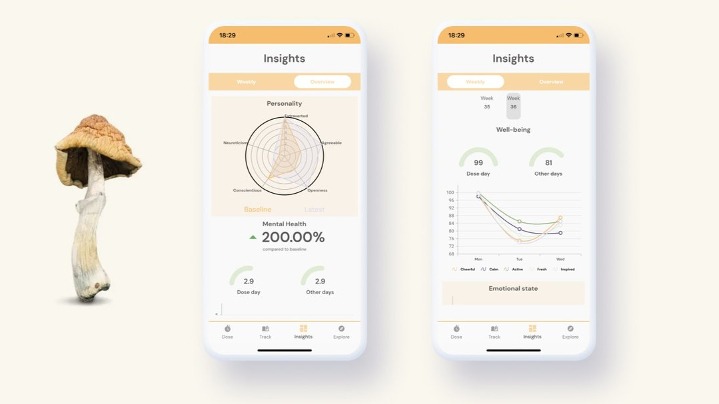
Deliqs is a straightforward, easy-to-use tracking app. Unlike any other app we’ve seen, an AI chatbot lets you vent or share, and then it responds. You can tell the app that you feel tired, and it responds with a caring computer-generated response like, “take a moment to do some deep breathing exercises,” before coaching you through box breathing. Like other apps, you set your dose and regimen. The app asks you to check in on your ratings on whether you’re “calm,” “active,” or “inspired.” You can watch your mood change over time. If your mood doesn’t change for the better, you can curse out the AI chatbot.
RELATED: The Conundrum Of Microdosing
Houston
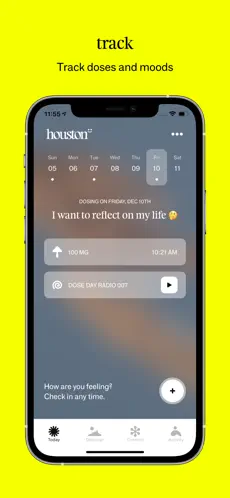
Why is this app called Houston? We can’t say. Does it work? We’re not sure. We can’t use it. The app is only available on iOS, and we have a Google phone. (We know, we know–lame.) Nevertheless, the app clearly has plenty of features. First, it lets you set your intention. You can choose your own intention, or pick from one of their pre-made intentions. Examples are: tap into creativity, spend time in nature, and be more present. You can set a calendar to track your dosing and rest days. You can track your dose. And the app prompts you to check in on your mood. Reviewers say it’s a super-simple, effective app. “Great way to dose with intention,” says a review on the app store. “The prompts to reflect on the experience are perfectly timed,” says another review. You might use your new focus and calm to figure out why a psychedelic app would be called Houston, and why the iPhone gets all the cool stuff.
RELATED: Macrodosing vs. Microdosing: Understanding What Makes Them Different
Other Dosage Tracking Apps
There are also drug dose tracking apps designed for prescription medications. Much of the time, these can equally be used for a microdosing regimen. They can provide alerts, reminding you when to take your microdose. These apps include:
Whichever app you choose, a drug dose tracking app is a crucial part of your microdosing routine. It will help you figure out your optimal dosage and track how your regimen is impacting your mood and thoughts.
RELATED: Is Ibogaine Legal In The United States?
Background on Microdosing: You Won’t Feel a Thing
Microdosing is now a popular way of using psychedelics. This practice involves taking sub-perceptual doses of a psychedelic like psilocybin mushrooms or LSD. Microdosages are doses so low that no changes in perception occur. The effects that do occur from microdosing can include improvements in focus, creativity, mood, motivation, energy, and productivity. However, it is difficult to draw conclusions about these effects based on existing evidence. This includes to what extent the benefits depend on the placebo effect.
Despite the limited research we have on microdosing, many psychedelic users find it helpful to regularly take tiny doses of psychedelics. But there are those who have never microdosed before who are interested in trying it out. Perhaps microdosing can be an alternative way to treat their mental health.
Whether you’re experienced or not, we help you understand how to microdose the right way. This means having a microdosing regimen and sticking to it. This article will describe what a microdosing regimen might look like. It will also describe how you can keep track of your dosage using a drug dose tracking app. There are different drug dose tracking apps to choose from, so we’ll highlight the best ones available.
FROM OUR PARTNER: Get Your “How To Microdose” Course Here
Not Every Day: Microdosing Regimens
A microdosing regimen involves choosing a drug dosage, firstly. Secondly, you need to choose what days to take your microdose on. A microdosing regimen allows you to microdose in a structured way. Many people believe they get the most out of the practice by microdosing in this way. After all, finding the proper shrooms dosage, or any other psychedelic dose, varies by person. This course from our partner Double Blind is helpful for finding the right dose, the right protocol, and to track your results and optimize your routine.
James Fadiman, a psychedelic researcher and pioneer of microdosing, has developed a regimen that is quite standard now among microdosers. The Fadiman approach involves microdosing once every three days. Patients follow a ‘one day on, two days off’ regime for about a month. Patients maintain this two-day gap between microdosing days for two reasons:
- Many people report feeling benefits of the microdose in the following two days after the dosing day.
- Psychedelics can cause a tolerance to build. If you took them every day, you would need to take a higher dose each time to achieve the same effects. A two-day break gives you enough time for your tolerance to disappear. It’s important to note that just because you can build a tolerance to psychedelics doesn’t mean they’re addictive. You won’t experience cravings for them or withdrawals upon cessation of use.
Fadiman also recommends taking your microdose before 10 a.m. This avoids the issue of the microdose making it hard to sleep at night. He also says you should go about your normal day after your microdose. After the month is up, Fadiman found most people only microdosed occasionally. Many people also like to take a break and return to their microdosing regimen at a later date.
You may find it better to have just a one-day break between microdosing days. Or you might benefit from even longer ones. Whatever regimen you choose, it can be helpful to keep track of it (and your dosage) with a drug dose tracking app.
RELATED: How To Start Microdosing Psychedelics: A Beginner’s Guide
Finding The Right Microdosage
To make use of these apps, ensure you can accurately measure your dose. For compounds such as psilocybin mushrooms, DMT, ibogaine, ketamine, MDMA, and cannabis, you should invest in high-quality scales that can make very small measurements.
For microdosing LSD, however, the most accurate way to track your dosage is to use volumetric dosing. This involves putting a 100mcg tab of LSD into a small bottle containing 100ml of solution. This could be distilled water and/or distilled alcohol, but never tap water. Chlorine will degrade your LSD. You can then take out your preferred dosage from the solution using a syringe. For example, 1ml will equal roughly 1mcg.
A microdose is generally considered to be one-tenth or one-twentieth of a normal, recreational dose. For LSD, if the normal dose is 100 micrograms (mcg), then a microdose will fall between 5mcg and 10mcg. And if a recreational dose of psilocybin mushrooms is 2g, then a microdose would be between 0.1g and 0.2g.
However, many users take less than the low end and higher than the high end of dosages. People differ in what they feel their ideal dosage is. In microdosing studies, the microdose of LSD has been as high as 13mg, 20mg, and even 26mcg. Many users might feel 20+ mcg to no longer be suitable, with perceptual effects occurring.
The Microdosing App Landscape in 2025
Since this article was first published, the microdosing app category has grown considerably — and some of the earlier apps have changed, been discontinued, or been superseded by more feature-rich alternatives. Before choosing a tracking app, verify it is still actively maintained and available on your device. The core features to look for haven’t changed: dose logging, mood and symptom check-ins at defined intervals, regimen scheduling (most microdosers follow Fadiman’s every-other-day protocol or Stamets’ 4 days on/3 days off), and trend visualization over time.
Newer Options Worth Knowing
Mātū is a well-regarded iOS app specifically designed for psychedelic tracking. It allows users to log doses, track set and setting, rate experiences across multiple dimensions (mood, energy, focus, creativity), and review trends over a customizable period. It also includes a guided integration journal with prompt-based reflection questions designed for both microdosing and full-dose sessions. Users report it as one of the most thoughtful purpose-built options in the category.
Insight Timer — primarily a meditation app — is used by many microdosers for the integration side of their practice (guided meditations, journaling, breathwork) rather than dose tracking specifically. Pairing a dedicated dose-tracker with Insight Timer covers both the quantitative and qualitative sides of a microdosing practice. For users who want a single app, Mātū and purpose-built microdosing trackers generally offer a more integrated experience.
What Matters Most In A Tracking App
Regardless of which app you use, the most important function is consistent check-in timing. The goal is to capture mood and functioning data at comparable points relative to each dose — researchers who study microdosing recommend checking in at a defined window (e.g., 4 hours post-dose) each dosing day, and at the same time on non-dosing days, to create a meaningful baseline comparison. Apps that prompt you at customizable intervals serve this function better than apps that only log when you remember to open them.
Frequently Asked Questions
Do you need an app to track microdosing?
No — a simple paper journal or spreadsheet works fine. The core data you want to capture: date, substance, dose (in milligrams or grams), time taken, mood/energy/focus ratings at defined check-in points, and any notable observations. The advantage of a dedicated app is automated reminders, trend visualization, and structured prompts that keep your check-ins consistent. Consistency matters more than the tool: a paper journal you actually complete every dosing day beats an app you forget to open. The most common tracking mistake is only logging when something notable happens — this creates skewed data that overstates the effect of dosing days relative to non-dosing days.
What should you track while microdosing?
At minimum: dose and time, overall mood (1–10 scale), energy level, and focus quality. More granular tracking might include creativity, social ease, anxiety level, sleep quality the following night, and any physical symptoms (headaches, nausea). Many experienced microdosers also track non-dosing days — this is important for identifying whether improvements are actually dose-related or simply carry-over effect from the previous day. The most useful metric over time is the trend across both dosing and non-dosing days, which helps distinguish a genuine benefit from the placebo effect or natural mood variation.
What is the Fadiman microdosing protocol?
The Fadiman protocol — developed by researcher James Fadiman and the most widely studied microdosing schedule — involves dosing on Day 1, resting on Days 2 and 3, then dosing again on Day 4, repeating the cycle. The two rest days between doses help prevent tolerance buildup and allow the cognitive effects of each dose to be observed in a non-dosed state. Most microdosing tracking apps are designed around this protocol, but many also support the Stamets Stack (4 days on / 3 days off, often including lion’s mane mushroom and niacin) and custom schedules. Fadiman himself has noted that individual variation in ideal protocol is significant — what works best for one person may not suit another.
Is microdosing legal?
The substances most commonly used for microdosing — psilocybin mushrooms and LSD — remain Schedule I federally in the United States. Psilocybin possession has been decriminalized (not legalized) in several U.S. cities including Denver, Oakland, Seattle, Ann Arbor, Washington D.C., and others. Oregon and Colorado have launched legal psilocybin service programs, but these administer full supervised doses — not microdoses — in licensed settings. LSD has not been decriminalized in any U.S. city. Apps that help you track microdosing doses are legal to download and use; the legal risk lies in obtaining and possessing the substances themselves.




Faith Mitchell
September 25, 2021 at 1:44 pmGreat article