The FDA Just Approved a Preservative-Free Ketamine. The Same Company Wants the Other 11 Labels Pulled
The FDA has approved a preservative-free ketamine from NRx Pharmaceuticals. The company announced it Friday morning, and Psychedelic Alpha reported it the same day. The clearance arrived ahead of a November 10 goal date. It does not resolve the company’s separate petition asking FDA to ban most of the ketamine now on the market.
The drug is one line on your cost sheet. The rest of it is negotiable today. HealingMaps’ GPO, the first built for the ketamine industry, gets member clinics 40 percent or more off medical supplies, 15 to 20 percent off malpractice and liability premiums, discounted LegitScript certification, and 20 to 30 percent off HIPAA compliant payment processing. Joining is free with no obligation. See what your clinic qualifies for →
| Key Takeaway | Detail |
|---|---|
| What was approved | An abbreviated new drug application for preservative-free ketamine injection, announced by NRx on October 30, 2026 |
| The label it carries | A generic carries its reference product’s labeling. Ketalar is approved for anesthesia, so this is not a psychiatric indication |
| Who manufactures it | Nephron Pharmaceuticals, West Columbia, South Carolina, using blow-fill-seal |
| Timing | Cleared ahead of a November 10 goal date |
| The separate petition | Docket FDA-2025-P-3577 asks FDA to ban all ketamine products containing benzethonium chloride. Still open |
| How far it reaches | 11 of the 12 ketamine hydrochloride labels in FDA’s directory contain the preservative |
| FDA’s position | An interim response posted March 4, 2026 said the agency could not decide, citing complex issues |
| The opposition | One substantive comment, filed by counsel for PH Health, which holds the Ketalar application |
What the FDA Actually Approved
An abbreviated new drug application is the generic pathway. A generic carries the labeling of the product it copies. The reference product here is Ketalar, approved in 1970 and indicated for anesthesia.
So this adds a preservative-free anesthetic to the market. It does not create a psychiatric indication. Clinics treating depression with IV ketamine prescribe off label today, and that is unchanged.
We walked through the distinction when the application was still pending, in our piece on what an FDA approval would and would not change. The generic filing and the depression program are separate applications.
What Preservative-Free Ketamine Buys You
Benzethonium chloride, or BZT, is an antimicrobial preservative. It is in the vial to keep the contents sterile when a clinician draws from it more than once.
Take it out and the multi-dose vial gets harder to justify. NRx’s product is made by Nephron Pharmaceuticals in West Columbia, South Carolina, using blow-fill-seal.
For a clinic the practical question is waste. A single-dose presentation changes cost per infusion and how you handle inventory. It does not change what you are permitted to treat.
The Petition Would Clear the Shelf
The petition is the part with teeth. Docket FDA-2025-P-3577 asks FDA to ban all products containing ketamine combined with BZT. A supplement went further. It asked the agency to withdraw approval of any ketamine product that uses the preservative.
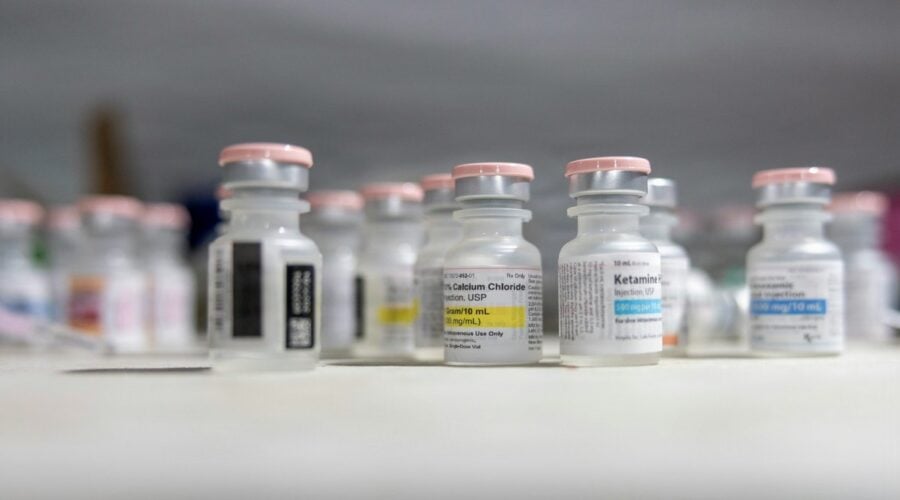
We counted the reach in FDA’s own label directory. Of the 12 ketamine hydrochloride injection labels listed there, 11 contain BZT. The lone exception is a Baxter single-dose pre-filled syringe.
Granting the request would pull nearly every competing product. The company that filed it would then hold one of the few approved alternatives. We covered that conflict when the petition surfaced, in a company asked the FDA to ban most ketamine.
FDA Has Already Said in Writing That It Cannot Decide
This is the part the coverage has skipped. FDA answered the petition on paper eight months ago. The answer was that there is no answer yet.
Carol J. Bennett, deputy director of the Office of Regulatory Policy at CDER, signed an interim response on February 27, 2026. It was posted to the docket on March 4.
The letter says FDA “has been unable to reach a decision on your petition because it raises complex issues requiring extensive review and analysis by Agency officials.”
Agency rules give FDA 180 days to respond to a citizen petition. The letter puts receipt at September 5, 2025, which set the deadline at March 4, 2026. FDA used the window to the day and reported no decision.
Nearly fourteen months after filing, the docket is still open. It is marked as allowing late comments.
The Only Opposition Came From Ketalar’s Owner
Two comments have been published on the docket in that entire span. One is anonymous. The other is an eight-page opposition from the firm Axinn, Veltrop & Harkrider, filed for PH Health Limited.
PH Health holds NDA 016812, the Ketalar application. It is the company whose product the petition would take off the market.
Its lead argument in September 2025 was that the petition was premature. The filing stated there was “currently no FDA-approved injectable ketamine formulation that does not use BZT.”
Friday’s approval retires that sentence. One exists now.
The firm’s second argument survives intact. It wrote that no postmarketing history exists for a preservative-free injectable ketamine, so the risk cannot be weighed. An approval does not create a safety record.
Where the Two Sides Disagree on the Math
The dispute is about exposure, and the gap is large. NRx commissioned a toxicology report modeling a 24-hour infusion. It put total BZT exposure at 28.8 mg.
PH Health says that assumes a dose four times the Ketalar label’s ceiling. The label caps maintenance infusion at 0.1 to 0.5 mg per minute. The report modeled 120 mg an hour in a 60-kilogram patient.
It also says the model uses the lowest strength, which carries the most preservative per milligram of drug. Ketalar’s label puts BZT at no more than 0.1 mg per milliliter.
Run the same patient on labeled use at the highest strength, PH Health argues, and exposure is about 0.72 mg. That is roughly 40 times lower than the modeled figure.
NRx’s own report calls its number a theoretical upper bound. It does not account for clearance, protein binding or distribution.
Neither side has produced human data showing harm from the preservative in ketamine. PH Health also points to a 2023 FDA order finding 0.1 to 0.2 percent BZT safe and effective in topical antiseptics.
What This Changes for Your Clinic
Nothing on Friday touches your protocols or your consent forms. The approved product is an anesthetic generic. Treating depression with it remains an off-label decision.
Supply is the thing worth tracking. If FDA ever grants the petition, 11 of 12 labels leave the market and purchasing changes quickly.
That outcome is nowhere near certain. The agency has held the request for fourteen months and called the issues complex. The only substantive comment against it came from the incumbent.
On its own terms a preservative-free option is good news. More approved supply means more leverage on price.
What to Watch Next
Three things. Whether FDA turns the interim response into a decision. Whether the product shows up in Drugs@FDA and the Orange Book, which it had not done as of Friday.
And whether NRx’s separate application for NRX-100 advances. That filing, not this one, is the one that would put a racemic IV ketamine on label for depression.
Clinics and patients tracking the market can start with our directory of verified ketamine clinics.