
Ketamine Clinics Promote Transformation. Patients Who Write In Ask Us About Money
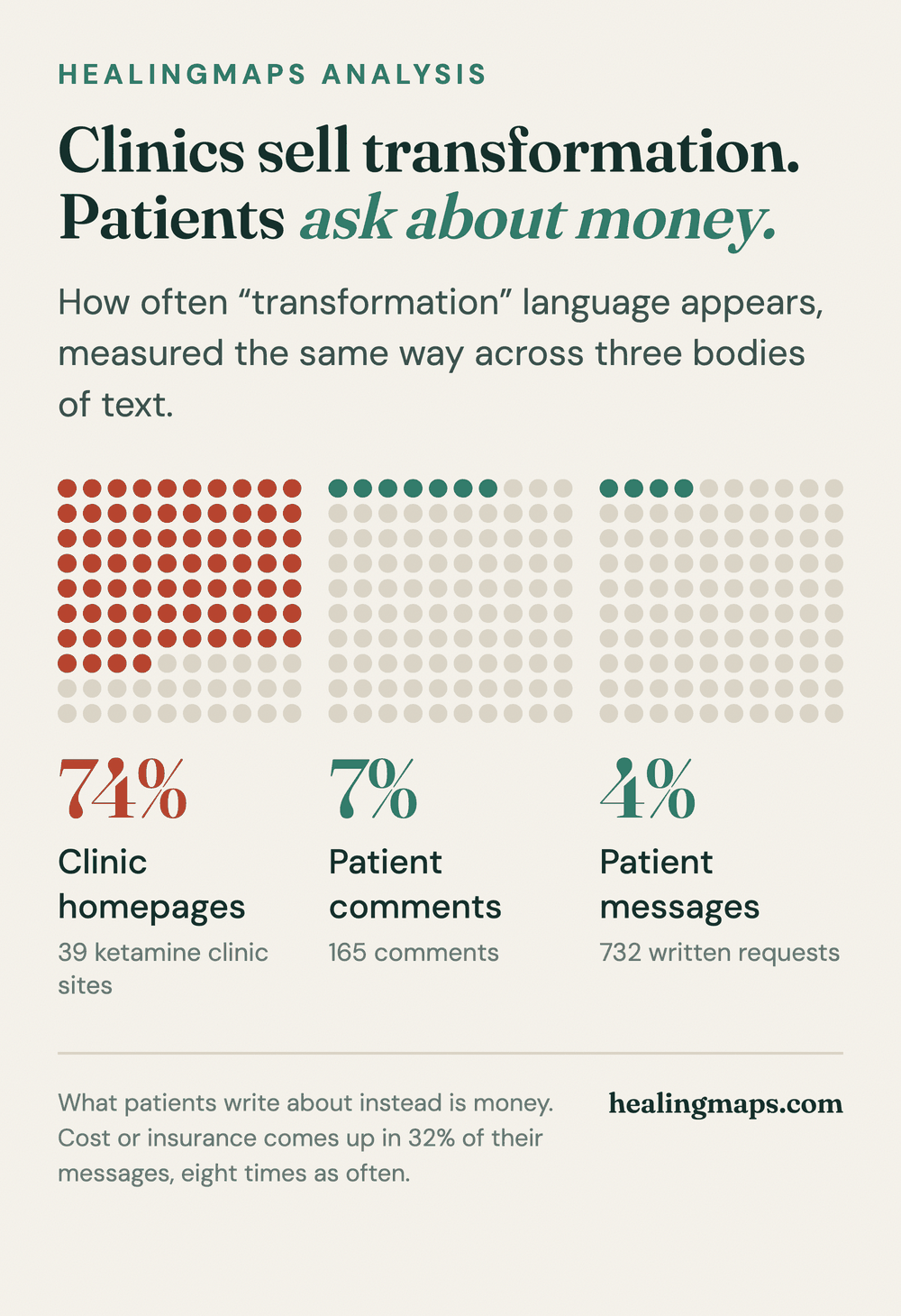
Three in four ketamine clinic homepages talk about transformation. About one in twenty people writing to us for a ketamine clinic do.
We measured both sides with one keyword list. Thirty nine clinic homepages, 165 reader comments and 732 messages sent through our ketamine clinic request forms. What people write about instead is money.
That does not mean the experience is unimportant to them. People seldom write about it while they are choosing a clinic. Afterward is different. We found 705 support line calls from people who had already finished a ketamine session.
HealingMaps GPO members save 40 percent or more on medical supplies and 15 to 20 percent on malpractice insurance. Joining is free. It is the first GPO built for the ketamine industry. Members also get 20 to 30 percent off HIPAA compliant payment processing and discounted LegitScript certification, with no obligation. See how much your clinic can save →
| Key Takeaway | Detail |
|---|---|
| The gap | 74% of clinic homepages use experience or transformation language. 4% of patient messages and 7% of comments do |
| What patients write about instead | Money. Cost or insurance comes up in 32% of messages, eight times as often as the experience |
| After treatment | In comments, staff and care (27%) and money (24%) lead. The experience is last of six themes |
| Clinics are not ignoring price | 64% of homepages mention cost or insurance |
| Also in the inbox | 17% mention current medication, 9% say other treatments failed, 5% are writing for someone else |
| What this is | Our own inbound messages and comments, not a survey. The samples are small on every side |
| Period | Messages August 2023 to March 2026. Comments September 2021 to October 2026. Homepages read November 2026 |
The gap, measured the same way three times
We ran one keyword list across three bodies of text. Clinic homepages, taken from websites listed in our directory. Reader comments that mention ketamine. And the messages people write when they ask us to find them a ketamine clinic.
| Theme | Clinic homepages | Patient comments | Patient messages |
|---|---|---|---|
| The experience or transformation | 74% | 7% | 4% |
| Compassionate staff and care | 87% | 27% | 2% |
| Cost or insurance | 64% | 24% | 32% |
| Protocol and dosing | 46% | 8% | 5% |
| Comfort and setting | 38% | 12% | 1% |
Read the two patient columns as before and after. Messages are written before a first visit, so staff and setting barely appear there. Comments often come from people who have been treated, and that is where staff shows up.
The experience is low on both sides of the visit. It is 4 percent before and 7 percent after, and it is the least mentioned of these themes in the comments.
Clinics do not lead with it alone. Compassionate care is on even more homepages, at 87 percent. But care language is something patients echo once they have been treated. Transformation language is not.
What people write about instead
Money. Of the 732 messages, 235 mention cost or insurance. That is 32 percent, against 4 percent for the experience.
Insurance comes up in 19 percent of messages and cost in 17 percent. Some people raise both.
It would be easy to read this as clinics ignoring price. The data does not say that. Sixty four percent of homepages mention cost or insurance somewhere.
The split is the useful part. Just under half of homepages mention cost, and just under half mention insurance. A reader with a money question has roughly even odds of finding an answer on the first page.
What else is in the inbox
The same 732 messages show what people want settled before they book.
| What the message mentions | Share of messages |
|---|---|
| Cost or insurance | 32% |
| Medication they currently take | 17% |
| A relative or friend | 11% |
| Other treatments that did not work | 9% |
| Crisis or desperation language | 6% |
| Clearly written on someone else’s behalf | 5% |
| Distance or travel | 5% |
| Veteran status or the VA | 4% |
One in six writers brings up a medication they are already on. That is a question about interactions and eligibility, and it arrives before any conversation about the experience.
About one in twenty messages is clearly written for somebody else. A son, a daughter, a husband, a wife, a parent or a friend. The person reading an intake page is sometimes not the person who would be treated.
What a clinic can do with this
Three things, in order of effort.
Put the money answer on the first page. State what a session costs and whether insurance is accepted. It is the most common thing people write to ask.
Answer the medication question in writing. A short section on common medications and who to call about them speaks to one in six of these writers.
Write one paragraph for the relative. Someone researching for a family member has different questions than a patient does.
None of this says the experience does not matter to patients. It says the experience is not what they write about when they are deciding, or when they review a clinic afterward.
How we counted, and what this is not
The clinic sample is 39 homepages that returned readable copy, out of 45 attempted. They came from the website links in our own ketamine directory listings. It is a sample, not a census.
The comments are the 165 that mention ketamine, out of 593 substantive reader comments. The messages are the 732 of 150 characters or more, from 2,127 entries on our ketamine clinic request forms.
We left out our other forms, including clinical trial signups, because those writers are not asking for a clinic. Across every form combined, experience language appears in about 6 percent of 2,441 messages.
All three were matched on the same keyword patterns. A page or a message can count toward more than one theme, so percentages do not sum to 100. Keyword matching misses paraphrase and catches some stray uses.
The counts behind the headline numbers are small. Twenty nine of 39 homepages, 11 of 165 comments and 29 of 732 messages. Treat them as a direction, not a precise measurement.
None of this is a survey. People comment when they want to review a provider, and they write to us when they want help finding care. We removed names and contact details. We are not quoting any message or naming any clinic.
Patients comparing supervised options can start with our directory of verified ketamine clinics. We looked at the aftercare side of the same question in our analysis of 25,419 support line interactions.
This article is for informational purposes and is not medical or business advice. Figures are counts from HealingMaps directory listings, reader comments and inbound requests, and are not a representative sample of ketamine patients, or of clinics.