Why Aaron Rodgers’ Ayahuasca Admission Is Significant, And What We Can Learn From It
Last reviewed and updated: June 26, 2026.
Key Takeaways
| Aaron Rodgers disclosure | Publicly credited ayahuasca with transformative mental health and performance benefits — one of the earliest high-profile athlete disclosures; helped normalize the conversation |
| Cultural impact | Part of a shift from “psychedelics = drugs” to “psychedelics = therapy” in mainstream media; 28% of Americans report lifetime psychedelic use (PLOS One 2023) |
| What’s changed since | Bryan Johnson’s public psilocybin protocol, NFL conversations broadening, Silicon Valley disclosure normalization, dozens of prominent figures on record |
| Legal access now | Oregon (2023) + Colorado (2024) licensed psilocybin facilitation services, ~$500–$2,000/session, no prescription needed; Spravato + IV ketamine available nationwide |
| Celebrity vs. evidence | Disclosures reduce stigma and build political will; clinical trials (Compass 2 Phase 3s, MindMed June 2026) are what advance regulatory access — both matter, neither is sufficient alone |
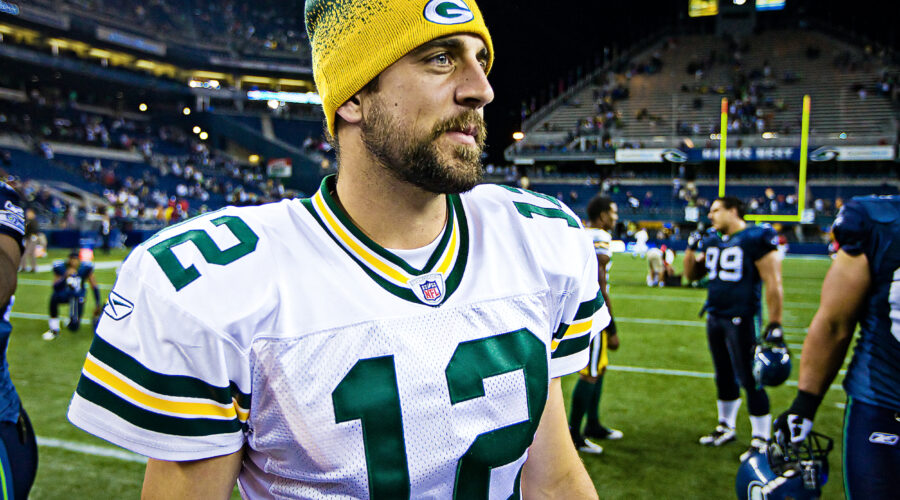
NFL quarterback Aaron Rodgers’ ayahuasca experience sent shockwaves through the sports world. As the latest professional athlete to open up about his use of psychedelic drugs, Rodgers’ admission comes at a time when he’s still on top of his sport. You might find yourself rolling your eyes at yet another athlete publicly discussing their use of psychedelics, but there are a few reasons Aaron Rodgers’ ayahuasca story stands out.
While Rodgers, 38, is certainly not the first pro-athlete to talk about using ayahuasca or psilocybin, it’s rare to see such an admission from an active professional athlete. That’s because most athletes speak up following retirement, not at the height of their careers.
Not just an active player but a wildly successful one, Rodgers’ choice to speak openly about his use of hallucinogenic plant medicines shows that the stigma around both psychedelics and mental health in professional sports is improving — though as some coverage of the news illustrates, not everyone is ready to accept that one of the league’s most impressive players credits psychedelic drugs for his latest professional wins.
Aaron Rodgers has effectively taken the conversation about psychedelics to millions of football fans (in 2021, the regular NFL season averaged 17.1 million viewers), raising some important points along the way about what these powerful drugs are capable of—and what they aren’t.
RELATED: Mike Wilson: Gaming’s Medicinal Madman
Aaron Rodgers’ Ayahuasca Experience Teaches Him About Unconditional Love
The Green Bay Packers quarterback isn’t your average football player. In 2021, Rodgers won the league’s most valuable player award for the second time in two years, and the fourth time overall since his NFL debut in 2008. Earlier this year, he signed a three-year, $150-million contract with the Packers, making him the highest-paid quarterback in the league.
During a recent Aubrey Marcus Podcast episode, Rodgers said he’d taken ayahuasca prior to the 2020 and 2021 seasons, and believes it was no coincidence he would go on to be named MVP. Ayahuasca, he said, improved his mental health dramatically by showing him how to love himself, and in turn, it enabled him to be a better teammate.
“The greatest gift I can give my teammates, in my opinion, is to be able to show up and to be someone who can model unconditional love to them,” he explained on the show.”
Obviously it’s important I play well and show up and lead… but they won’t care about what you say until they know how much you care.”
RELATED: Modernized vs. Traditional Ayahuasca Ceremonies: Which is Right For You?
Not Everyone Understands Psychedelics
Not all major-league commentators want to praise Rodgers’ newfound views on unconditional love.
As NBC Sports’ Peter King pointed out, “Rodgers used the word ‘love’ 20 times in a 1,597-word conversation… Of all the things I never thought I’d be writing about covering the NFL, the reigning MVP having a three-day experience with the Quechuan natives in South America ingesting psychedelics would be high on the list.”
While an NFL spokesperson revealed on Monday that Rodgers’ use of ayahuasca doesn’t violate the NFL’s substance use policy (though a controlled substance in the U.S., the active drug in ayahuasca, DMT, is not on the leagues’ list of banned substances and would not trigger positive drug test results), it’s not necessarily the brew’s illegal status that has some people turned off.
Aaron Rodgers’ ayahuasca admission shows that, although psychedelics may have returned to the mainstream, there are plenty of people who still disagree with (and fail to understand) their use.
Colin Cowherd, host of The Herd on Fox Sports Radio, dismissed Rodgers’ claim that ayahuasca led to a better experience on the field, and likened the quarterback’s trip to Peru to a rum-fueled bender.
“It happened to me too — it’s called college. I had six rum drinks in 90 minutes… I saw weird things too,” he said. “Aaron, lots of people have tried this psychedelic tea. They’re called hippies, burnouts, and affluent white people with too much time on their hands, and nobody in their life to call out their crap.”
READ NEXT: 3 Ways Mushroom Therapy Can Help You Excel In Your Career
Ayahuasca Not A One-Time Fix
While Aaron Rodgers’ ayahuasca experience may have set his success in motion, Rodgers didn’t credit the brew alone, and highlighted the importance of integration and healthy habits.
“It hasn’t all been just the ayahuasca journey. It’s been therapy, and it’s been meditation,” he told Marcus. “It’s been changing habits that weren’t giving me any type of joy. Eating better. Taking care of myself a little bit better. Being more gentle with myself.”
In the follow-up interview with King, Rodgers admits that not all areas of his life saw improvement by the experience. One of his intentions — to reconcile with estranged members of his family — is still a work in progress.
While it’s clear more education about psychedelics is necessary, Aaron Rodgers’ ayahuasca story also illustrates a bigger picture. No matter what the Colin Cowherd’s of the world have to say, these powerful drugs no longer only have links to hippies and burnouts. Yes, even professional quarterbacks can take part, too.
The Aaron Rodgers Story in Broader Context: What’s Changed Since
When Aaron Rodgers discussed his ayahuasca experiences publicly — crediting them with transformative effects on his mental health, self-awareness, and performance — it was notable partly because of who he was: a high-profile professional athlete in a culture that had long treated any discussion of psychedelics as career suicide. That cultural calculation has shifted substantially since his disclosure, and Rodgers was part of the reason why. He was not, it turned out, uniquely unusual — he was an early public voice in a conversation that has since become significantly more mainstream.
He’s far from alone now. The wave of public figures discussing psychedelics for mental health and performance has broadened considerably since Rodgers’ disclosure. Bryan Johnson — the tech entrepreneur known for his “Blueprint” longevity protocol and its aggressive transparency — has publicly documented using psilocybin as part of his optimization regimen. Multiple NFL players have discussed ketamine for pain management and mental health recovery in both on-record and background conversations with reporters. Silicon Valley’s relationship with psychedelics has gone from a quiet open secret to a matter of public record, with executives, founders, and investors discussing psilocybin, MDMA, and LSD as performance and creativity tools. The shift is not just anecdotal: a 2023 survey published in PLOS One found that 28% of Americans reported having tried a psychedelic at some point in their lives — a figure that includes a disproportionate number of high achievers, given that education and professional success correlate with psychedelic use in survey data.
The legal access landscape has changed. When Rodgers originally disclosed his ayahuasca use, supervised legal psychedelic experiences in the U.S. were essentially unavailable — people seeking them went to Peru, Brazil, Netherlands, Jamaica, or other jurisdictions. That has changed. Oregon launched licensed psilocybin facilitation services in 2023; Colorado followed in 2024. Both states allow adults to access supervised psilocybin experiences at licensed service centers without a prescription or medical diagnosis — a model aimed specifically at wellness and personal development use cases, not just clinical mental illness. Athletes and executives with discretionary income and the ability to take a few days off no longer need to travel internationally for a legal, supervised, above-ground psychedelic experience. The price of a supervised Oregon or Colorado psilocybin session is typically $500–$2,000 depending on the facilitator and the program — accessible to professional athletes and tech executives, if not yet to most people.
Why celebrity endorsement is necessary but not sufficient. Celebrity disclosures like Rodgers’ serve an important cultural function: they reduce stigma, shift the Overton window, and make treatment-seeking less shameful for people who would have stayed silent. When a Super Bowl-winning quarterback says ayahuasca changed his life, it reaches audiences that research papers never will. But celebrity endorsement is not clinical evidence, and the psychedelic field has had enough charismatic advocates over the decades to know that hype cycles carry real risks — overpromising leads to backlash, and unvetted self-experimentation leads to harms. The clinical data — two positive Phase 3 psilocybin trials from Compass, positive LSD Phase 3 data from MindMed in June 2026, decades of MAPS research — is what actually moves the regulatory and healthcare system. The ideal relationship between celebrity disclosure and clinical evidence is synergistic: public figures reduce stigma and build political will; rigorous research establishes what actually works and for whom.
Frequently Asked Questions
Is it safe to use ayahuasca for performance enhancement like Aaron Rodgers?
Ayahuasca can produce profound experiences, but using it without proper preparation, screening, and professional facilitation carries real risks. Ayahuasca contains DMT (a powerful psychedelic) and MAOIs (monoamine oxidase inhibitors), and the MAOI component creates significant drug interactions — certain medications, foods, and underlying health conditions can make ayahuasca dangerous or even life-threatening. Psychologically, ayahuasca is intensely demanding: it frequently surfaces difficult material, produces hours of strong physical and emotional effects, and requires integration support afterward to process what arose. The performance and mental health benefits that figures like Rodgers describe are real in many cases, but they are typically attributed to the therapeutic processing that happens during and after the experience — not to the drug acting like a supplement. Working with a vetted, experienced facilitator and doing proper medical and psychological screening is not optional; it is what separates beneficial experiences from harmful ones.
Why do celebrities increasingly talk about psychedelics?
Several converging forces explain the trend. The cultural stigma around psychedelics has declined substantially since Michael Pollan’s 2018 book How to Change Your Mind brought the clinical research to a general audience, and subsequent media coverage of MAPS trials, Johns Hopkins research, and legal state frameworks has continued that shift. Celebrities have always faced intense performance pressure and often have access to cutting-edge treatments before mainstream medicine catches up — and the wellness optimization culture among elite athletes and executives has made experimentation with non-traditional approaches more normalized within those communities. There is also a generational factor: many current celebrities in their 30s and 40s grew up after the worst of the “just say no” cultural moment and have a more nuanced relationship with the category. Each public disclosure makes the next one less risky — a positive feedback loop that, combined with genuine evidence of benefit, has accelerated the conversation.
What is the legal way to access psychedelic therapy in the US?
There are currently a few legitimate legal pathways. For ketamine: IV ketamine clinics operate legally across the U.S. as off-label prescribing; Spravato (esketamine) is FDA-approved and covered by insurance for treatment-resistant depression and MDD with suicidal ideation — available at certified healthcare providers nationwide. For psilocybin: Oregon has licensed psilocybin facilitation services since 2023; Colorado since 2024. These are not prescription-based medical treatments but licensed wellness services — adults can access supervised psilocybin sessions at licensed service centers, typically $500–$2,000. Clinical trials remain another pathway: ClinicalTrials.gov lists active trials studying psilocybin, MDMA, LSD, and ketamine for various conditions, and some provide free or low-cost access. International options — Jamaica, Netherlands, Mexico — remain available for those seeking ayahuasca, psilocybin, or ibogaine in organized retreat settings, operating legally under those countries’ laws.
Does ayahuasca actually improve athletic performance?
There is no clinical trial evidence specifically on ayahuasca and athletic performance — the sports science literature has not studied this. What does exist is a body of evidence on ayahuasca’s psychological effects — improvements in depression, anxiety, emotional regulation, and psychological flexibility — and a reasonable mechanism by which these improvements could benefit performance. Sports psychology research is clear that mental health, emotional regulation, and psychological resilience are significant contributors to elite athletic performance. If ayahuasca helps a person process difficult emotions, reduce anxiety, improve sleep, and develop greater present-moment awareness (as many users and some observational studies suggest), those improvements plausibly translate to better performance outcomes. What is not established is whether this is meaningfully different from other evidence-based psychological interventions — high-quality sports psychology, mindfulness practices, or therapy — or whether the dramatic narrative around ayahuasca experiences creates expectancy effects that are themselves performance-relevant. The honest answer is: plausible mechanism, no direct evidence, profound individual variation.