GHK-Cu: The 2026 Copper Peptide Guide
Last reviewed and updated: May 5, 2026 — medically reviewed by Dr. Jonathann Kuo, MD.
2026 Trend Update: GHK-Cu is the fastest-growing peptide search term of 2026, up over 1,000% year-over-year. Interest spans dermatology, hair loss, and longevity. This guide covers what GHK-Cu actually is, what the evidence supports, and how it’s used clinically today.
GHK-Cu is having a moment. A decade ago it was a niche ingredient in a few high-end skincare lines. In 2026 it’s the fastest-growing peptide search term, with patient interest spanning skin rejuvenation, hair loss, and systemic longevity applications. The hype is mostly justified by real science — but there’s also a meaningful gap between the topical cosmetic products you can buy over-the-counter and the injectable peptide therapy that requires a prescription. Here’s the guide.
Looking for a clinic? Find verified peptide therapy clinics near you.
GHK-Cu — prescribed online, delivered home
Get GHK-Cu prescribed 100% online — from $99/mo.
Live Vital’s physician-prescribed GHK-Cu protocol supports collagen, texture, and elasticity through skin renewal — $99/mo, with combination blends (GHK-Cu + BPC-157/TB-500) from $149/mo. Quick online intake, doctor review, and it ships to your door from a licensed U.S. pharmacy. No gray-market vendors.
See GHK-Cu Options →Provider consultation required; dispensed by licensed pharmacies. HealingMaps may earn a commission through this link — it doesn’t change your price. Compounded peptides are not FDA-approved finished products; eligibility is determined by Live Vital’s licensed providers.
What GHK-Cu Is
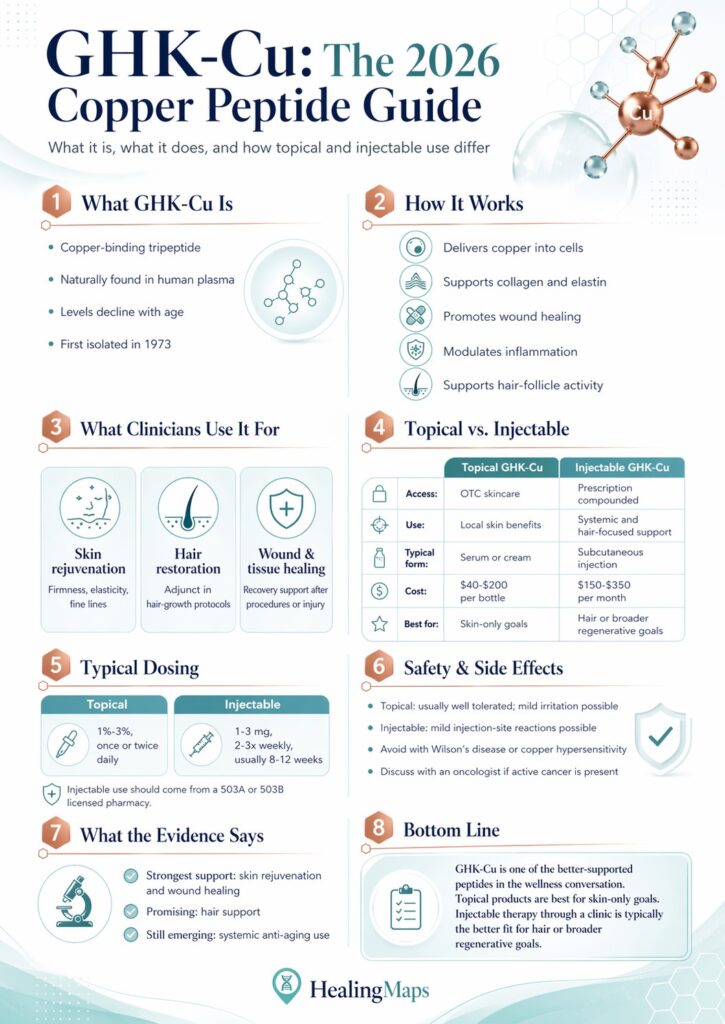
GHK-Cu stands for Glycyl-Histidyl-Lysine copper. It’s a tripeptide (three amino acids: glycine, histidine, and lysine) that naturally binds to copper ions with high affinity. The molecule occurs naturally in human plasma, saliva, and urine. It was first isolated in 1973 by biochemist Loren Pickart, who observed that serum from younger people could regenerate certain types of cells — and that GHK-Cu was one of the key molecules responsible.
Plasma levels of GHK-Cu decline significantly with age. Adults in their 20s have levels around 200 ng/mL; by age 60, levels drop to around 80 ng/mL. That age-related decline tracks loosely with reduced wound-healing capacity and slower skin turnover, which is part of why GHK-Cu has become a target for both cosmetic and regenerative applications.
How GHK-Cu Works
GHK-Cu has a remarkably broad set of effects at the cellular level. The key pathways:
- Copper delivery. Copper is an essential cofactor for dozens of enzymes, including lysyl oxidase (critical for collagen cross-linking) and superoxide dismutase (an antioxidant enzyme). GHK-Cu shuttles copper ions into cells where they’re needed.
- Collagen and elastin production. GHK-Cu stimulates fibroblasts to produce collagen, elastin, and glycosaminoglycans — the structural proteins that keep skin firm and tissue elastic.
- Wound healing. Promotes the migration of keratinocytes and supports blood vessel formation at injury sites. Multiple animal and cell-culture studies document faster wound closure with GHK-Cu application.
- Anti-inflammatory signaling. Modulates several inflammatory pathways that would otherwise slow tissue repair.
- Hair follicle stimulation. Demonstrated in animal studies to extend the anagen (growth) phase of hair follicles and potentially reverse some follicular miniaturization.
- Gene expression changes. Gene expression studies have shown GHK-Cu modulates hundreds of genes involved in regeneration, stress response, and DNA repair.
What Clinicians Actually Prescribe It For
Three main categories dominate practical use today:
Skin rejuvenation. This is the oldest and most well-established use. GHK-Cu stimulates collagen, improves skin elasticity, reduces fine lines and hyperpigmentation, and supports overall skin quality. Topical cosmetic products dominate this category, but injectable peptide protocols through compounding pharmacies produce more systemic effects.
Hair loss and restoration. GHK-Cu’s ability to extend the anagen phase of hair follicles has made it a popular adjunct in hair restoration protocols. Topical GHK-Cu serums are combined with minoxidil, finasteride, or PRP therapy. Injectable GHK-Cu is increasingly used in scalp-injection protocols alongside other hair-loss peptides.
Wound and tissue healing. Less discussed than skin and hair applications but clinically important. GHK-Cu accelerates healing of chronic wounds, surgical sites, and post-laser or post-microneedling recovery. Some clinicians use it in combination with BPC-157 or TB-500 for systemic tissue repair protocols.
Topical vs. Injectable — Two Different Products
This is the most commonly confused aspect of GHK-Cu. There are two distinct ways patients use it, and they’re not the same product:
Topical cosmetic GHK-Cu is available over-the-counter in countless skincare products — serums, creams, eye products. These are regulated as cosmetic ingredients, not drugs. They’re widely available without a prescription and range from budget drugstore formulations around $20 to premium products exceeding $200 per bottle. Topical GHK-Cu absorbs into the skin’s upper layers and affects localized tissue. It does not produce systemic effects.
Injectable compounded GHK-Cu is a different product entirely. It requires a prescription, comes from a licensed 503A or 503B compounding pharmacy, and is administered subcutaneously. Because it enters the bloodstream, it can produce systemic effects — broader regeneration signals throughout the body, stronger hair regrowth effects at the scalp, and support for general tissue repair. This is what peptide clinics mean when they prescribe “GHK-Cu peptide therapy.”
Patients considering GHK-Cu should be clear on which version they want. For skin-only goals, a quality topical product is usually sufficient. For hair or systemic regeneration goals, injectable through a clinic is typically more effective.
Dosing and Administration
Topical use: Apply as directed by the product (usually once or twice daily). Concentration varies significantly by brand — 1% to 3% GHK-Cu concentrations are typical in serious cosmetic formulations.
Injectable use: Subcutaneous injection 2–3 times per week is a typical protocol. Standard doses run 1 to 3 mg per injection. Cycles generally run 8–12 weeks with cycle-off periods in between. Some clinicians combine GHK-Cu with CJC-1295 and Ipamorelin for a broader anti-aging protocol.
Sourcing matters. Injectable GHK-Cu should always come from a 503A or 503B licensed pharmacy with third-party testing. Avoid online vendors selling “research-grade” GHK-Cu — those products are not tested for human use.
Cost
Topical: Quality GHK-Cu serums range $40–$200 per bottle, typically lasting 2–3 months. Pharmaceutical-strength formulations at the higher end of that range cost more but contain higher active concentrations.
Injectable: Compounded peptide protocols typically run $150–$350 per month through a 503A pharmacy, depending on dose frequency and whether clinical consultation is bundled. Insurance does not cover compounded peptide therapy.
Safety and Side Effects
GHK-Cu has one of the best safety profiles in the peptide category. Topical use is among the best-tolerated active skincare ingredients available — occasional mild irritation in sensitive skin, particularly at higher concentrations. Injectable use typically produces only mild injection-site reactions.
Patients with Wilson’s disease (a rare disorder affecting copper metabolism) or known copper hypersensitivity should avoid GHK-Cu. Patients with active cancer should discuss peptide therapy carefully with their oncologist — GHK-Cu’s regenerative and angiogenic effects could theoretically influence tumor environments.
What the Evidence Actually Says
GHK-Cu has stronger scientific backing than many of the peptides currently in the consumer-wellness conversation. It has been studied since the 1970s. Its mechanisms are well characterized. Its ability to stimulate collagen and wound healing has been demonstrated across multiple independent cell-culture and animal studies. That mismatch between evidence and adoption is the subject of our look at why clinics still rarely offer GHK-Cu.
That said, large randomized human trials for specific indications (like hair loss or systemic anti-aging) are still limited. The evidence for topical cosmetic use in skin rejuvenation is strongest. Evidence for hair regrowth is promising but less definitive. Evidence for systemic injectable use is emerging but not yet definitive. Realistic expectations: GHK-Cu is a real, well-studied peptide with genuine effects — but it isn’t a miracle compound, and individual response varies.
Frequently Asked Questions
Does topical GHK-Cu really work?
Yes, with realistic expectations. Evidence supports modest improvements in skin firmness, elasticity, and fine lines over 8–12 weeks of consistent use. It’s not a substitute for aggressive anti-aging treatments like tretinoin or in-office procedures, but it’s a legitimate addition to a well-designed skincare routine.
Will GHK-Cu help with hair loss?
There’s animal data and early human evidence showing GHK-Cu can extend the active growth phase of hair follicles. In practice, it’s most useful as an adjunct to established hair-loss treatments (minoxidil, finasteride, PRP) rather than a standalone therapy. Expect modest effects measured over months, not dramatic regrowth.
Can I combine GHK-Cu with other peptides?
Yes, commonly. Peptide clinics often combine GHK-Cu with BPC-157 and TB-500 for systemic tissue repair, or with CJC-1295/Ipamorelin for comprehensive anti-aging protocols. Combinations should be clinician-directed.
Is GHK-Cu legal?
Topical cosmetic use: yes, widely available. Injectable use: yes, through 503A compounding pharmacies with a clinician prescription. GHK-Cu is not on the FDA’s restricted peptide lists. It is not FDA-approved as a drug product.
How long until I see results?
Topical skin benefits typically become visible at 4–8 weeks of consistent use. Hair benefits take longer — 3–6 months of a well-designed protocol. Systemic anti-aging effects from injectable protocols unfold over a 2–3 month cycle.
The Bottom Line
GHK-Cu is the rare peptide where the science actually backs up the hype, at least for its established applications in skin and wound healing. Topical cosmetic products are widely available and genuinely effective for skin rejuvenation. Injectable peptide therapy through a compounding pharmacy extends those benefits systemically, making it useful for hair restoration and broader regenerative goals. Safety profile is excellent. The key patient-side decision is matching the delivery method to the goal: topical for skin-only applications, injectable (through a clinic) for hair or systemic goals.
Ready to find a clinic? Browse our directory of verified peptide therapy clinics to find a licensed provider.