Ketamine Infusion Therapy Cost in 2026 (376-Clinic Pricing Data)
Last reviewed and updated: May 11, 2026.
The short answer: A single ketamine infusion runs $300–$500 across most U.S. clinics — that’s the verified median from our verified pricing across 1,800 clinics, not the often-quoted “$525 average” that survey-based reports cite. A standard induction protocol is 6 infusions over 2–3 weeks, putting the typical out-of-pocket budget at $1,800–$3,000 for the induction phase, with booster infusions every 4–8 weeks adding $300–500 per session. Insurance covers it for fewer than 5% of patients. This guide walks through what drives the price differences, the hidden costs most patients miss, and where Spravato and at-home sublingual change the math.
Key Takeaways
| Verified median (2026) | $300–500 per IV infusion across 1,800 verified U.S. clinics. Coastal metros (NYC, SF, LA, Boston) run 10–30% above the national median. |
| Induction protocol budget | $1,800–3,000 total for the standard 6-infusion induction (over 2–3 weeks). |
| Annual maintenance budget | $2,400–4,800 typical, assuming 6–12 booster infusions per year after induction. Higher for more frequent maintenance. |
| What drives price differences | Provider credentials (MD vs CRNA), session length (40–90 min), location, infrastructure (private suite vs shared), bundled vs unbundled pricing. |
| Hidden costs to budget | Initial psychiatric evaluation ($150–400), follow-up integration sessions ($75–200 each), transportation for 6 sessions in 2 weeks, time off work. |
| Insurance reality | Fewer than 5% of IV ketamine patients have insurance coverage. Spravato is the FDA-approved alternative most insurers will cover. |
| Cheapest legitimate path | At-home sublingual ketamine via telehealth at ~$150/month all-in. Less intensive than IV but appropriate for many patients post-induction. |
Cost Compared Across the Three Main Treatment Pathways
IV ketamine is the most expensive of the three main pathways — but it’s also the most established protocol and the one most clinical research has been built on. The comparison below shows how it stacks up against insured Spravato and at-home sublingual on per-session price, coverage, frequency, and year-one budget.
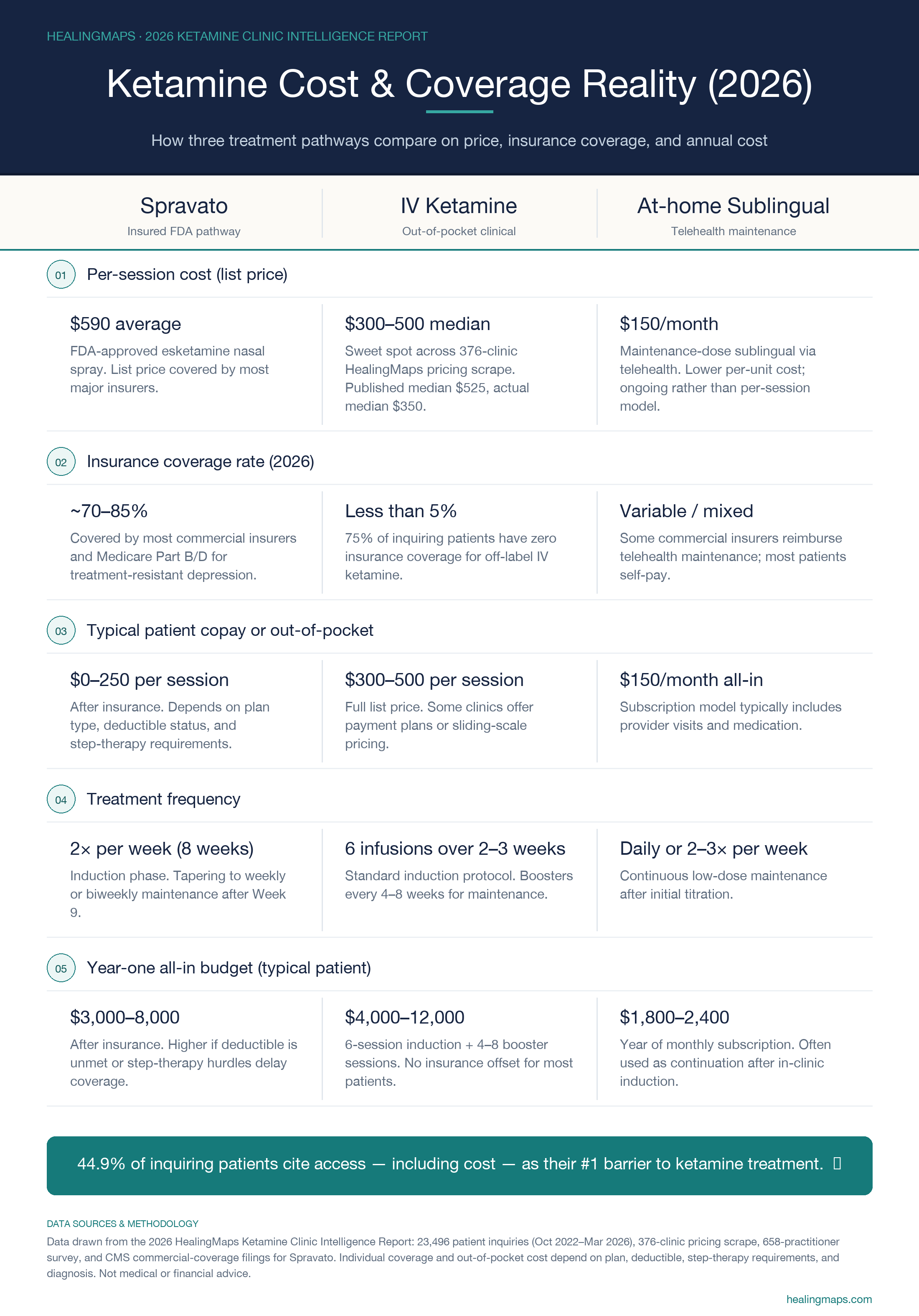
The detailed breakdown of IV ketamine pricing — what drives the differences, the hidden costs, and how to evaluate clinic pricing — follows below.
The number one question patients ask before seeking ketamine therapy is not clinical. It is financial. Cost is consistently the most common concern raised by patients researching ketamine therapy — more common than questions about side effects, eligibility, or even whether the treatment will work.
This guide walks through exactly what ketamine therapy costs in 2026, modality by modality, with the insurance landscape, out-of-pocket benchmarks, and the real-world spread between what patients expect to pay and what clinics actually charge.
| Key Takeaway | What It Means |
|---|---|
| IV ketamine averages $525 per session | A full induction series runs $3,000 to $3,600 out of pocket |
| IM injection is typically 25-30% cheaper than IV | Average $375 per session with similar clinical outcomes |
| Sublingual lozenges are the lowest-cost option | $275 per session equivalent for at-home maintenance |
| Spravato is the most expensive but often insurance-covered | $950 per session; Medicare, Medicaid, and most majors cover it |
| Most patients report zero insurance coverage for racemic ketamine | Most IV and IM treatment is fully out-of-pocket |
| Patients typically expect to pay slightly below the national average | Expectations tend to fall in the $475-$500 range vs the $525 benchmark |
National Ketamine Cost & Access Snapshot
Sources: HealingMaps Clinic Intelligence Report 2026 · CDC PLACES 2023 · r/TherapeuticKetamine patient pricing corpus · 132 clinic website pricing reviews · 658 practitioner survey responses.
- Median per-session cost (patient reported): $350, typical range $150 to $500
- IV Ketamine median: $450 per session (range $300 to $800)
- IM Ketamine median: $350 per session (range $200 to $500)
- Spravato (esketamine) cash-pay median: $750 per session (range $590 to $885 pre-insurance)
- KAP (ketamine-assisted psychotherapy) median: $650 per session (range $400 to $1,200)
- Patients with zero insurance coverage for ketamine: 75%
- Patients citing access as the #1 barrier to treatment: 44.9%
- Patients reporting at-home ketamine is “a bad idea”: 64.8%
Behind this data: HealingMaps has analyzed 23,496 patient inquiries (Oct 2022 – Mar 2026), mapped 1,800 verified clinics across 3,142 counties, scraped 132 clinic pricing pages, and collected 658 practitioner survey responses. This snapshot reflects our multi-source methodology.
Ketamine Treatment Cost Calculator
How Much Will Ketamine Therapy Cost?
The Four Modalities and What They Cost
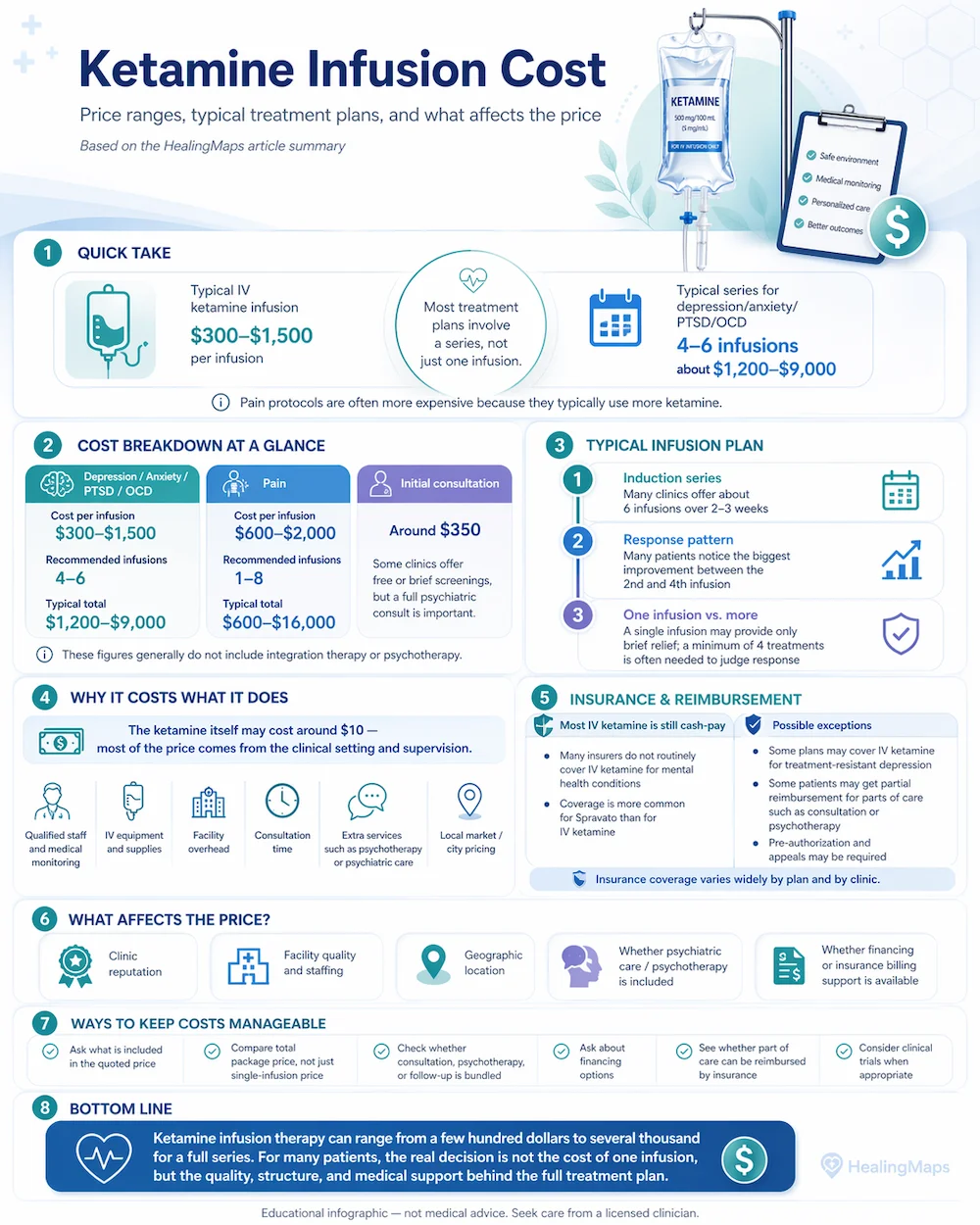
IV (Intravenous) Ketamine Infusion
The gold standard of ketamine therapy. A licensed clinician administers ketamine through an IV line over 40 to 60 minutes while the patient is monitored. This is the modality with the deepest research backing and the one most commonly offered at dedicated ketamine clinics.
Average cost: $525 per session (range: $400 to $900 depending on market and clinic)
Typical protocol: Six sessions over two to three weeks (induction), followed by maintenance infusions every four to eight weeks for responders
Full induction cost: $3,000 to $3,600 out of pocket
Annual maintenance cost: $2,500 to $4,500 for most responders
High-cost metros — New York, Los Angeles, San Francisco, and Boston — see prices toward the upper end of the range. Smaller markets and Midwestern clinics often fall below the national average.
IM (Intramuscular) Ketamine Injection
An alternative administration route that avoids the need for IV access. The ketamine dose is injected into the upper arm or thigh muscle. Session times are shorter — typically 10 to 20 minutes of active dosing — with similar monitoring requirements afterward.
Average cost: $375 per session (range: $250 to $550)
Typical protocol: Similar induction structure to IV
Full induction cost: $2,250 to $3,000
Why it’s cheaper: Lower supply cost (no IV kit), shorter staff time, and faster room turnover
Clinical outcomes between IV and IM are generally considered comparable for most indications. IM is often a better fit for patients who struggle with IV access, have a strong needle preference, or want to reduce per-session cost while keeping clinical supervision.
Sublingual Lozenges (At-Home Ketamine)
Compounded ketamine lozenges or troches, prescribed by a licensed clinician and self-administered at home under a structured protocol. This has become the most common format for maintenance and for patients with mild to moderate symptoms who cannot access in-person care.
Average cost: $275 per session equivalent
Typical program structure: Monthly subscription with telehealth check-ins ($200 to $450 per month depending on program)
Annual cost: $2,400 to $5,400 for most telehealth programs
At-home ketamine is the cheapest entry point into ketamine-based care. It is also the modality with the least clinical oversight, which is why reputable providers require psychiatric evaluation, ongoing check-ins, and clear exclusion criteria before prescribing.
Spravato (Esketamine Nasal Spray)
The only FDA-approved form of ketamine-adjacent therapy. Spravato is administered in a certified clinic under direct observation for two hours following each dose. It is approved for treatment-resistant depression and for major depressive disorder with suicidal ideation.
Average cost: $950 per session before insurance
Typical protocol: Twice-weekly for four weeks, then weekly for four weeks, then every two weeks for maintenance
Full induction cost: $14,000 to $19,000 before insurance
After insurance: Often $0 to $50 copay per session for covered patients
Spravato is the exception in the ketamine cost landscape. Because it is FDA-approved, Medicare, Medicaid, and most commercial insurers cover it for qualifying patients. For patients on Medicare or Medicaid in particular, Spravato is often the only ketamine-based treatment they can afford without significant out-of-pocket cost.
The Insurance Reality
The harshest cost truth for most ketamine patients is that insurance will not pay. The majority of patients who ask about insurance report that their plan does not cover racemic ketamine (the form used for IV and IM infusions). This aligns with broader industry data — the FDA has not approved racemic ketamine for any psychiatric indication, which means insurers classify its use as off-label and experimental.
Here is how coverage typically breaks down in 2026:
| Treatment | Insurance Coverage Likelihood | Typical Patient Cost |
|---|---|---|
| IV Ketamine for depression | Rare (5-10% of cases) | Full out-of-pocket |
| IV Ketamine for chronic pain | Sometimes (procedure coverage) | Partial, with significant deductibles |
| IM Ketamine | Rare | Full out-of-pocket |
| Sublingual / At-home | Almost never | Full out-of-pocket |
| Spravato (TRD) | Usually covered | $0-$50 copay common |
| Spravato (MDD with SI) | Usually covered | $0-$50 copay common |
A small but growing number of clinics accept HSA and FSA funds, which can soften the out-of-pocket impact. Some clinics offer cash-pay discounts, sliding scales, or financing through Care Credit or similar medical financing companies. These options do not change the underlying cost but can spread it over time.
What Drives the Price Differences
The $275 to $950 range across modalities reflects real differences in clinic infrastructure, medication costs, and regulatory requirements.
Clinic overhead
IV infusion requires a clinical suite, infusion chairs, monitoring equipment, trained nursing staff, and a supervising physician. Spravato requires all of that plus REMS certification — a formal program that imposes specific observation and documentation requirements. Sublingual at-home programs have almost none of that overhead, which is why the price can fall below $300 per session equivalent.
Medication costs
Racemic ketamine is off-patent and inexpensive in its drug form. The cost to the clinic is a small fraction of the session price. Esketamine (Spravato) is still patented and the drug cost alone accounts for a significant portion of the $950 per-session price.
Staff time
IV and IM require hands-on clinician time for at least an hour per session. Spravato requires two hours of post-dose observation. Sublingual requires a short check-in. Staff time is the largest single cost driver after facility overhead.
Regulatory burden
Spravato clinics must comply with the FDA’s REMS program, including patient registry entries and extended post-dose monitoring. That regulatory burden is built into the price. IV and IM clinics operate under general medical practice rules with less formalized oversight.
The Access Gap
Cost is not the only barrier patients face. A significant share of patients cite lack of local access to services as a primary concern, and the HealingMaps directory reflects demand from every state in the country. Rural and suburban patients often have to travel 100 miles or more to reach a dedicated ketamine clinic — a burden that layers on top of the cost of treatment itself.
This is part of why at-home sublingual programs have grown so quickly. For patients in underserved geographies, a telehealth-based ketamine program may be the only financially and logistically feasible option. The trade-off is reduced clinical supervision and, for some patients, reduced efficacy compared to IV or IM administration.
How to Reduce Your Out-of-Pocket Cost
If ketamine therapy is financially out of reach at list prices, here are the most common ways patients lower their costs:
- Check Spravato eligibility. If you have treatment-resistant depression (failed two or more antidepressants), Spravato may be covered by your insurance. For qualifying patients, this is almost always the cheapest path to ketamine-based treatment.
- Ask about package pricing. Many clinics offer discounted rates when you commit to a full six-session induction series upfront. Savings of 10-20% are common.
- Use HSA or FSA funds. Ketamine therapy is a qualified medical expense when prescribed by a physician. Paying with pre-tax dollars effectively reduces your cost by your marginal tax rate.
- Consider IM over IV. Clinical outcomes are comparable for most indications, but IM sessions cost roughly 25-30% less.
- Transition to maintenance at home. After an in-clinic induction series, many clinics will prescribe sublingual lozenges for maintenance at a fraction of the in-person cost.
- Look for clinical trials. ClinicalTrials.gov lists active ketamine studies, some of which cover treatment costs entirely.
- Ask about sliding scale or financing. Some clinics offer income-based pricing. Care Credit and similar financing can spread costs over 12 to 24 months.
The Bottom Line
In 2026, ketamine therapy costs between $275 and $950 per session depending on modality. The average patient will spend $3,000 to $3,600 on a standard IV induction series, and most will pay the full amount out of pocket because insurance rarely covers the off-label use. Spravato is the clear exception — its FDA approval for treatment-resistant depression means insurance coverage is the rule rather than the exception, including for Medicare and Medicaid patients.
For patients weighing ketamine therapy against the financial commitment, the most important step is an honest conversation with a qualified provider about Spravato eligibility, package pricing, and the modality most aligned with your clinical needs. The right treatment is not always the most expensive one. For many patients, the right treatment is the one they can actually afford to complete in full.
Ketamine Therapy Cost: 2026 Benchmarks at a Glance
- IV Ketamine: $525 per session / $3,000-$3,600 for induction
- IM Ketamine: $375 per session / $2,250-$3,000 for induction
- Sublingual (at-home): $275 per session equivalent / $200-$450 monthly programs
- Spravato: $950 per session / often $0-$50 copay with insurance
- Insurance coverage: Most patients report zero coverage for racemic ketamine
- Medicare and Medicaid: Represent a large share of insured patients seeking information
Source: HealingMaps aggregated industry benchmarks and Healing Health Alliance GPO network operational data (2022 – 2026). All data is anonymized and aggregated at the trend or operational level.
Frequently Asked Questions
How much does a full ketamine treatment series cost?
A standard six-session IV ketamine induction series costs $3,000 to $3,600 at the national average price of $525 per session. IM induction is typically $2,250 to $3,000. Spravato induction can exceed $14,000 before insurance but is often covered.
Is ketamine therapy ever covered by insurance?
Spravato (esketamine) is covered by most major insurers including Medicare and Medicaid for qualifying patients. Racemic ketamine (IV, IM, sublingual) is rarely covered because its use for psychiatric conditions is off-label.
Is at-home ketamine therapy cheaper than in-clinic treatment?
Yes. Most at-home sublingual programs run $200 to $450 per month, compared to $525 per session for in-clinic IV ketamine. The trade-off is reduced clinical supervision and, for some patients, reduced efficacy.
Can I use HSA or FSA funds for ketamine therapy?
Yes. Ketamine therapy prescribed by a licensed physician qualifies as a medical expense for HSA and FSA accounts. This effectively reduces the cost by your marginal tax rate.
Why is Spravato so much more expensive than IV ketamine?
Spravato is still under patent, which keeps the drug cost high. It also requires REMS-certified clinic infrastructure, two hours of post-dose observation, and mandatory patient registry documentation. These regulatory and operational requirements add significantly to the per-session cost.
Do clinics offer payment plans?
Many do. Common options include package pricing (10-20% off for a full induction series paid upfront), Care Credit financing, in-house sliding scales, and sometimes income-based programs. Ask before your first appointment.
More on Ketamine Cost & Coverage from HealingMaps
- Is Ketamine Infusion Covered by Insurance? (Full Guide)
- Solving the Insurance Puzzle: How to Get Your Ketamine Treatments Covered
- Ketamine Infusion Therapy Treatment Cost (2026 Pricing)
- Spravato Cost & Insurance Coverage
- Does California’s Medi-Cal Cover Ketamine?
- Does TRICARE Insurance Cover Ketamine Therapy?
- Does New York’s United Health Insurance Cover Ketamine?
- At-Home Ketamine vs In-Clinic (Comparison Guide)
- Find a Verified Ketamine Clinic Near You
Frequently Asked Questions
Why isn’t off-label IV ketamine covered when Spravato is?
Spravato (esketamine) received FDA approval in 2019 specifically for treatment-resistant depression — which gives insurers a clear, FDA-backed indication to cover. Generic IV ketamine is FDA-approved only as an anesthetic. When used for depression, anxiety, or PTSD, it’s prescribed off-label, which most insurers categorize as not medically necessary and refuse to cover. The pharmacology is similar; the regulatory and coverage landscape is not.
Can I submit a superbill for off-label IV ketamine?
Yes — and it sometimes works. If your insurance plan has out-of-network mental-health benefits, you can pay the clinic up front, request a superbill (an itemized receipt with procedure codes), and submit it to your insurer for partial reimbursement. Recovery rates are unpredictable but can run 40–70% in some plans. The process takes 4–12 weeks and may require appealing initial denials. Most ketamine clinics will provide a superbill on request.
What’s the step-therapy requirement for Spravato?
Most insurers — commercial and government — require documented failure of at least two FDA-approved antidepressants from different drug classes before authorizing Spravato. Typical sequence: SSRI (sertraline, escitalopram, fluoxetine) → SNRI (venlafaxine, duloxetine) → Spravato. Failure must be documented in clinical notes, with adequate trial duration (usually 6–8 weeks at therapeutic dose) and either lack of response or intolerable side effects. Your prescriber will manage this documentation.
Can I use HSA or FSA funds for ketamine therapy?
Yes, with a Letter of Medical Necessity (LMN) from your prescribing clinician. The LMN documents that ketamine therapy is being used to treat a specific medical condition (typically major depression, treatment-resistant depression, or PTSD). HSA and FSA reimbursements are generally easier to secure than insurance reimbursements because the rules are clearer and there’s no third-party adjudication. Off-label use does not disqualify ketamine from HSA/FSA eligibility.
How do I appeal an insurance denial?
Three levels typically: (1) Internal appeal to the insurer within 60 days of denial, including supporting clinical documentation and a clinician’s letter of medical necessity. (2) External review by an independent reviewer — required by federal law for all qualified plans. (3) State insurance commissioner complaint if external review fails. Roughly 40–60% of psychiatric-medication appeals are overturned at the external review stage, particularly when documentation is thorough.
Is at-home sublingual ketamine cheaper than IV?
Substantially — typically $150/month all-in via telehealth subscription, versus $300–500 per IV session. The trade-off is intensity and protocol: at-home sublingual delivers a lower bioavailable dose and is typically used for maintenance rather than acute induction. Many patients do IV ketamine for the 6-session induction (highest acute response rate) and then transition to at-home sublingual for ongoing maintenance — combining clinical-grade onset with sustainable long-term cost.