

Featured Clinic
Beōnd Ibogaine Treatment – Yucatan Peninsula
People suffering from addictions can find the help they need at Beōnd Ibogaine Treatment.

Featured Retreat
Experience Ibogaine – Tijuana, Mexico
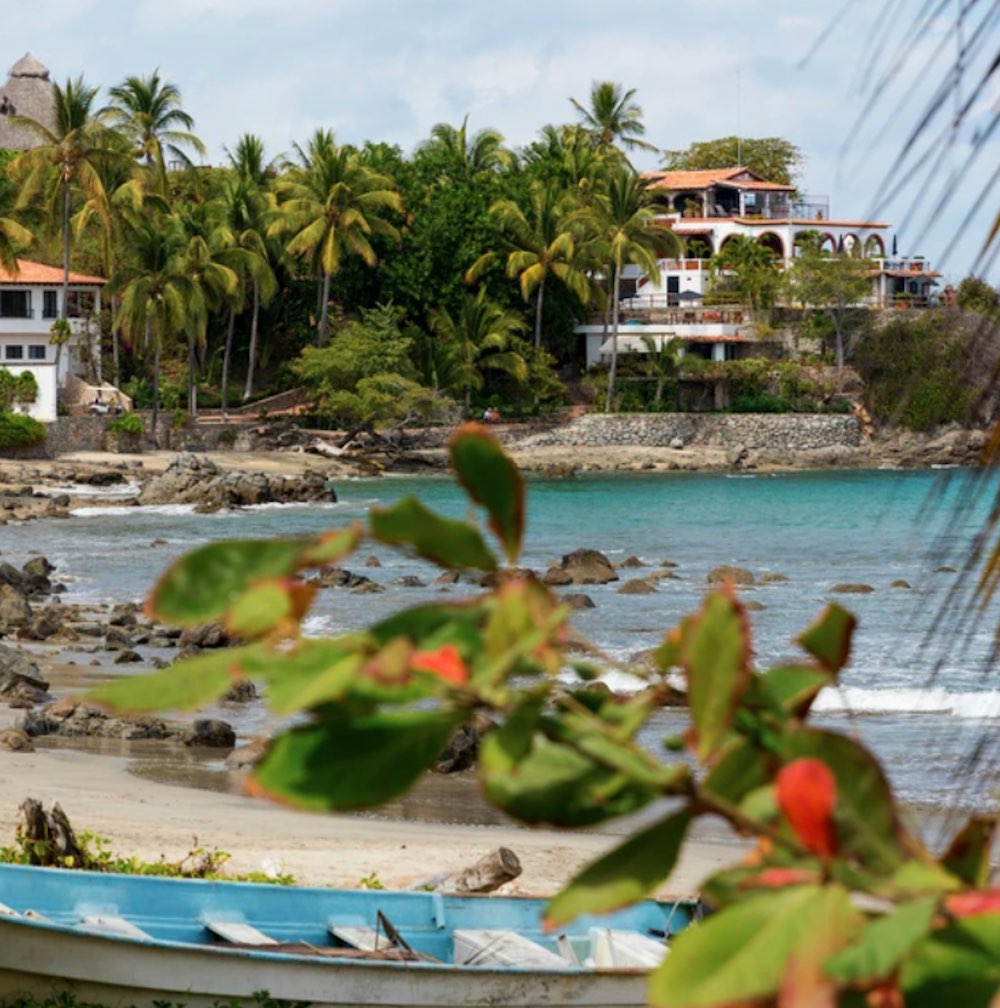
Located in Tijuana, Mexico, the Experience Ibogaine Treatment Center offers first-class care to its patients. With an ocean view setting and a private, gated community, guests get treated like luxury during their stay.
Featured Retreat
Sayulita Wellness Ibogaine Retreat – Puerto Vallarta, Mexico
The Sayulita Wellness Mushroom Retreat offers ibogaine treatment as well as a supportive, nurturing environment at its luxury retreat in Puerto Vallarta, Mexico.

Featured Retreat
Rooted Waters, Salt Spring, BC, Canada
Iboga Ceremonies, Psychedelic therapy & Immersive Retreats are crafted with care, offering opportunities for healing and exploring the intricate nature of being human.
Nearby Ibogaine Treatment Centers
Displaying ibogaine treatment centers near: Alexandria, Virginia US










What is Ibogaine?
Ibogaine is a psychedelic found in the iboga tree and is used traditionally by the Bwiti tribe in West Central Africa. Recent clinical trials show promise in using ibogaine to treat a variety of mental health issues. Important topics include:
Last reviewed and updated: May 11, 2026.
Key Takeaways for Choosing an Ibogaine Treatment Center
| What ibogaine treats | Most-studied for opioid use disorder. Active research for alcohol use disorder, stimulant dependence, PTSD, and traumatic brain injury. |
| How treatment works | A single supervised dose (typically 10–20 mg/kg) under medical monitoring across 24–72 hours, followed by structured aftercare. |
| U.S. legal status (2026) | Federal Schedule I. Limited access through Right to Try pathway (2025) and ClinicalTrials.gov-registered studies. No FDA-approved clinical use. |
| Where most treatment happens | Mexico (especially Tijuana, Cancun, Puerto Vallarta), Costa Rica, Portugal, Canada, and a small number of African retreat centers. |
| Typical cost | $5,000–$15,000+ per program. Travel, accommodation, and aftercare often add to the total. Insurance does not cover ibogaine treatment. |
| The non-negotiable safety screen | Pre-treatment ECG, electrolyte panel (especially magnesium), liver function, and full medication review. Centers that skip these should be avoided. |
| What aftercare looks like | Most reputable programs include 1–4 weeks of integration support: therapy, group work, follow-up medical monitoring, and a relapse-prevention plan. |
How Ibogaine Compares to Standard Addiction Medicine
The most common reason patients consider ibogaine is opioid use disorder — and the comparison most worth understanding is how ibogaine differs from FDA-approved Medication-Assisted Treatment (MAT) options like methadone and buprenorphine. The two approaches are not interchangeable.
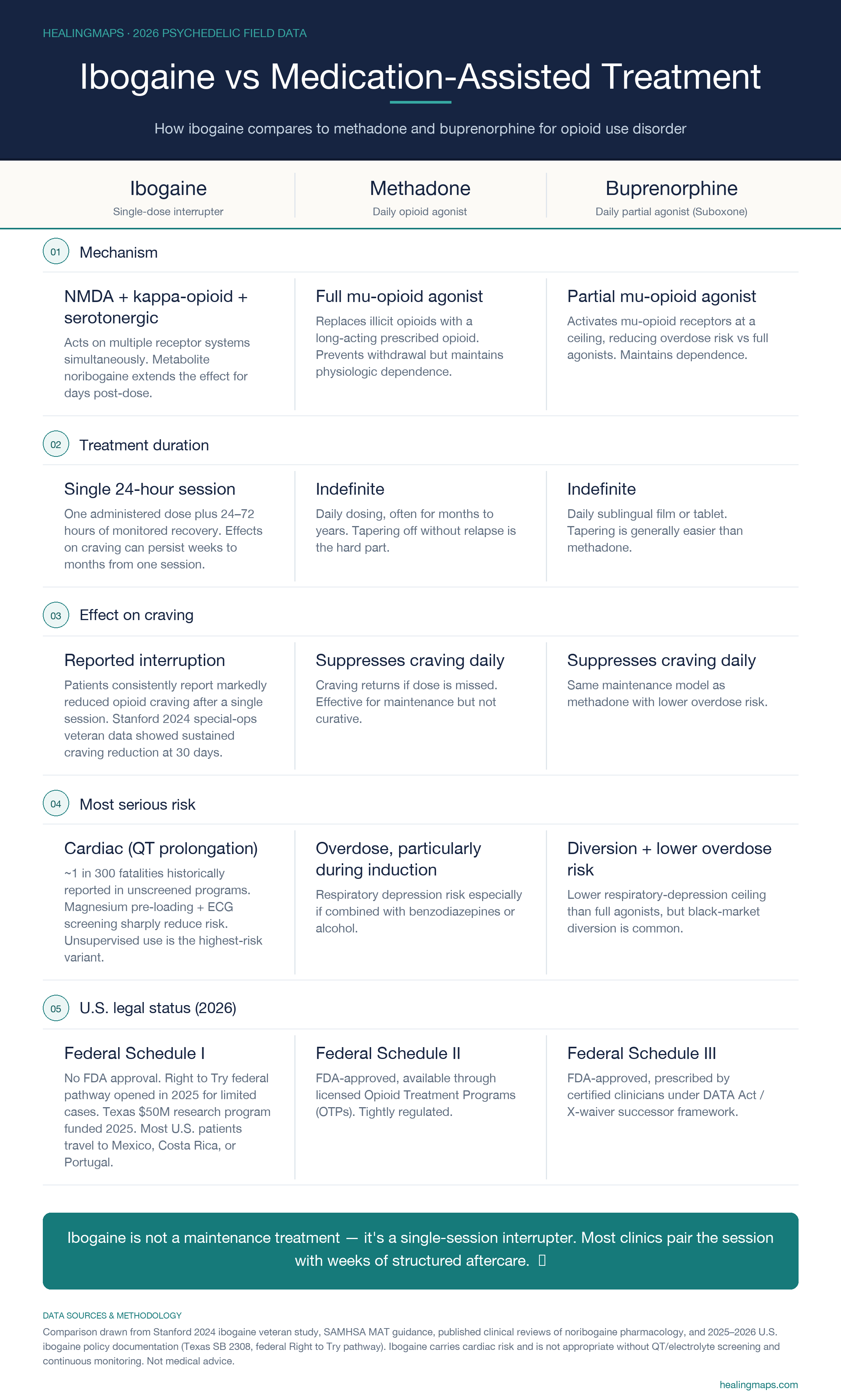
Ibogaine is a single-session interrupter, not a maintenance therapy. Patients who succeed with ibogaine typically pair the single session with weeks of structured aftercare — therapy, peer support, and continued medical monitoring. Centers that present ibogaine as a “one-and-done cure” without aftercare are red flags.
Safety: The Cardiac Risk Is Real
Ibogaine prolongs the QT interval — the electrical recovery phase between heartbeats. In screened, monitored programs the risk is manageable. In unscreened settings, historical estimates put serious adverse-event rates around 1 in 300, with the majority of fatalities tied to undetected cardiac arrhythmia or undisclosed interactions with other medications.
Stanford’s 2024 study of military veterans receiving ibogaine in Mexico documented dramatic improvements in PTSD, depression, and functional outcomes — paired with a magnesium-pre-loading protocol and continuous ECG monitoring that produced no cardiac events across the cohort. The screening protocol is the difference. Any treatment center that does not require pre-treatment ECG, electrolyte testing, and a full medication review before administering ibogaine should be excluded from consideration.
For the full breakdown of cardiac risk, the magnesium protocol, and what the Stanford data shows, see HealingMaps’ Is Ibogaine Safe? Cardiac Risks, the Magnesium Protocol, and What the Stanford Data Shows.
Legal Access in 2026
Ibogaine remains federally Schedule I in the U.S., which means it is not approved for any clinical use and is not available through licensed clinics. Two recent shifts have opened narrow legal pathways, but the practical reality for most patients is still international travel.
Federal Right to Try (expanded 2025)
Federal Right to Try was expanded in 2025 to include ibogaine for limited cases — primarily veterans with treatment-resistant PTSD or opioid use disorder. The pathway is narrow, requires sponsor and physician coordination, and is not yet widely available. See HealingMaps’ Right to Try Ibogaine for the full eligibility framework.
Texas $50M research investment
Texas appropriated $50 million in 2025 (SB 2308) for ibogaine clinical research — the largest single state investment in psychedelic medicine to date. The funded studies are administered through Texas medical centers in partnership with private sponsors and target FDA approval pathways. Participation requires meeting strict trial eligibility criteria.
ClinicalTrials.gov-registered studies
A handful of FDA-overseen ibogaine trials are recruiting in the U.S. as of 2026. ClinicalTrials.gov is the authoritative registry. Trial participation is the only fully U.S.-legal path to ibogaine treatment outside the Right to Try pathway.
For the complete 2026 federal, state, and trial-access framework, see HealingMaps’ Is Ibogaine Legal in the United States? A 2026 Guide.
International treatment
Most patients seeking ibogaine treatment in 2026 travel internationally. Mexico has the largest concentration of clinics, particularly in Tijuana, Cancun, and Puerto Vallarta. Costa Rica, Portugal, Canada, and a small number of African retreat centers also offer programs. Each jurisdiction has different regulatory frameworks — Mexico operates under traditional-medicine carve-outs, while Portugal works within decriminalized possession laws.
How to Choose an Ibogaine Treatment Center
Treatment-center quality varies more in ibogaine than in any other psychedelic-medicine setting, because there is no FDA framework standardizing care. The criteria below are what separate well-run centers from high-risk ones.
Non-negotiable medical infrastructure
- Pre-treatment cardiac screening — ECG, electrolyte panel (magnesium, potassium, calcium), liver function tests, and a full medication review. No screening = walk away.
- Continuous cardiac monitoring during dosing — ECG telemetry throughout the active treatment window (typically 24–48 hours).
- Magnesium pre-loading — IV or oral magnesium pre-treatment is now the standard cardioprotective protocol.
- Emergency response capability — on-site advanced cardiac life support, defibrillator, hospital partnership for transfer if needed.
- Medical staff present — physician (not just nurse or facilitator) on-site throughout the dosing window.
Aftercare quality
- Structured integration program — minimum 1–4 weeks of post-treatment therapy, group support, or coaching.
- Clear relapse-prevention plan — written, individualized, with specific action steps.
- Follow-up touchpoints — scheduled check-ins at 30, 60, and 90 days minimum.
- Referral network — connections to ongoing therapy or peer support in your home location.
Red flags to walk away from
- Treatment offered without cardiac screening
- “One-and-done cure” marketing without aftercare
- No physician on staff — only “facilitators” or “shamans” for medical dosing
- Pressure to pay full cost upfront before screening
- Refusal to share medical credentials or facility licensing
- No emergency response plan or hospital partnership
- Group dosing of multiple patients simultaneously without 1:1 medical attention
Typical Cost Structure
Ibogaine treatment programs are not covered by U.S. insurance. Out-of-pocket costs vary widely across jurisdictions and program types:
| Program type | Typical cost | What’s usually included |
|---|---|---|
| Mexico medical clinic (5–7 days) | $6,000–$12,000 | Medical screening, dosing, recovery monitoring, basic accommodation, transportation from airport |
| Costa Rica retreat (7–10 days) | $8,000–$15,000 | Above plus integration sessions, structured aftercare planning, more comprehensive program |
| Premium / extended programs (2–4 weeks) | $15,000–$25,000+ | Multi-week integration, ongoing therapy, follow-up support, premium accommodation |
| U.S. Right to Try (limited) | Variable | Sponsor- and physician-dependent. Often includes more rigorous medical oversight. |
| U.S. clinical trial enrollment | $0 (covered by trial) | Strict eligibility. Free to qualifying participants. |
Additional costs almost always include international travel, time off work, and ongoing therapy or coaching back home. Budget realistically for the full program — not just the dosing week.
More on Ibogaine from HealingMaps
- Is Ibogaine Safe? Cardiac Risks, the Magnesium Protocol, and What the Stanford Data Shows
- Is Ibogaine Legal in the United States? A 2026 Guide to Federal, State, and Clinical Trial Access
- Right to Try Ibogaine: The Federal Pathway Explained
- What Trump’s Psychedelics Executive Order Means for Ibogaine
- Texas Invests $50 Million in Ibogaine Research
- Ibogaine Therapy: Pros and Cons
- The Best Ibogaine Treatment Centers (Curated Editorial List)
Frequently Asked Questions
Is ibogaine treatment legal in the United States?
Federally, ibogaine is Schedule I and not approved for clinical use. Two narrow legal pathways exist as of 2026: the expanded federal Right to Try framework (2025) for specific cases, and FDA-overseen clinical trials. Outside these, most U.S. patients travel internationally for treatment.
How much does ibogaine treatment cost?
Mexico medical clinics typically run $6,000–$12,000 for a 5–7 day program. Costa Rica retreats run $8,000–$15,000 for 7–10 days. Premium multi-week programs can exceed $25,000. U.S. clinical-trial enrollment, when available, is free to qualifying participants. Insurance does not cover ibogaine treatment.
What’s the difference between ibogaine and iboga?
Iboga is the West African plant (Tabernanthe iboga) that contains ibogaine and several related alkaloids. Iboga is used traditionally in Bwiti ceremonies in Gabon, typically as root bark or full-spectrum extracts. Ibogaine refers specifically to the isolated alkaloid used in medical clinical settings. The pharmacology, dosing, and safety considerations differ between the two forms.
What conditions is ibogaine most effective for?
The strongest clinical evidence is for opioid use disorder — multiple observational studies show meaningful reductions in opioid cravings after a single supervised session. Active research is exploring ibogaine for alcohol use disorder, stimulant dependence (cocaine, methamphetamine), PTSD, and traumatic brain injury. Stanford’s 2024 special-operations veteran study reported sustained improvements in PTSD and functional outcomes.
Can I take ibogaine if I’m currently on methadone or buprenorphine?
Long-acting opioids like methadone and buprenorphine require a structured taper before ibogaine treatment — sometimes weeks. Direct combination is contraindicated and dangerous. Any reputable treatment center will require a medication review and tapering plan as part of intake. Programs that skip this step should be excluded from consideration.
How long do the effects of ibogaine treatment last?
The active dose produces effects across 24–72 hours: an intense visionary phase (8–14 hours), a cognitive-reflective phase (12–24 hours), and a residual recovery phase (24–72 hours). The therapeutic effect on cravings — which is the primary clinical outcome — can persist for weeks to months from a single session, particularly when paired with structured aftercare.
What’s the role of magnesium in modern ibogaine protocols?
Magnesium pre-loading (oral or IV) has emerged as the standard cardioprotective protocol because it reduces the risk of QT-prolongation-related arrhythmia. Stanford’s 2024 cohort used magnesium pre-loading paired with continuous ECG monitoring and reported zero cardiac events. Centers using this protocol represent the current standard of care.