MK-677 (Ibutamoren): The Oral Growth Hormone Stimulator 2026 Guide
Last reviewed and updated: May 5, 2026 — medically reviewed by Dr. Jonathann Kuo, MD.
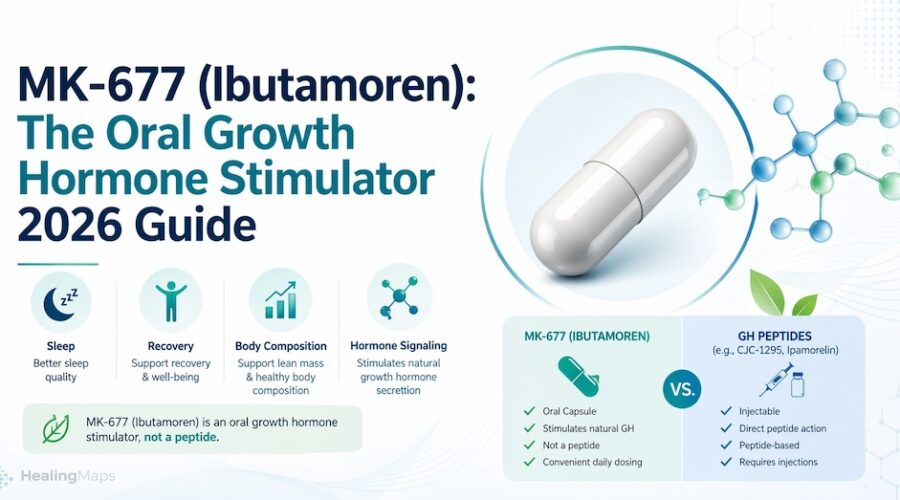
The Key Insight: MK-677 is often grouped with growth-hormone peptides but is technically not a peptide — it’s a non-peptide small molecule that mimics ghrelin’s effect. The practical advantage: MK-677 is taken orally as a once-daily capsule, while CJC-1295, Ipamorelin, and Sermorelin all require daily subcutaneous injection.
MK-677 shows up constantly in peptide-therapy conversations, often alongside compounds like CJC-1295 and Ipamorelin. Patients reasonably assume it’s another peptide. It isn’t — MK-677 is a small-molecule non-peptide, and that distinction matters because it means oral administration is possible. For patients who’ve resisted growth-hormone peptide therapy because of daily injections, MK-677 is often the pivotal option that changes the conversation.
Looking for a clinic? Find verified peptide therapy clinics near you.
What MK-677 Actually Is
MK-677 (also called Ibutamoren or sometimes MK-0677) is a small-molecule, non-peptide compound that acts as a ghrelin receptor agonist. Ghrelin is the “hunger hormone” — released by the stomach when empty — but the ghrelin receptor also controls growth-hormone release in the pituitary. MK-677 binds the ghrelin receptor, triggering a pulse of growth-hormone release, without the direct ghrelin molecule. It was originally developed by Merck in the 1990s as an oral alternative to injected growth hormone.
Despite being frequently lumped in with peptides, MK-677 is structurally a small organic molecule. It’s chemically more similar to a conventional drug than to Sermorelin or Ipamorelin. The peptide label sticks for historical and marketing reasons — clinics prescribe it alongside peptides, pharmaceutical naming categories aren’t always consumer-friendly, and the effects overlap significantly with peptide-based GH stimulation.
How It Works
MK-677 activates the ghrelin receptor in the pituitary gland, triggering a growth-hormone pulse. Unlike the injected peptides that typically produce a single pulse per dose, MK-677 has a long half-life — approximately 24 hours — which means once-daily dosing produces sustained elevation in growth hormone and IGF-1 (the downstream hormone that mediates most of GH’s effects) throughout the day. This sustained elevation is different from the pulsatile pattern produced by CJC-1295 and Ipamorelin, and clinicians debate whether sustained or pulsatile is preferable.
Because MK-677 also activates the ghrelin receptor for its primary signaling function, it produces a secondary effect that peptide GH stimulators don’t: increased appetite. This is often a patient’s first noticeable sign that the medication is working (or, for some, the main side effect that causes them to stop).
What Clinicians Prescribe It For
MK-677 shows up in three main clinical contexts:
Sleep depth and recovery. This is the most common patient-reported benefit. MK-677 increases both total sleep time and the amount of slow-wave (deep) sleep, which has downstream effects on muscle recovery, cognitive clarity, and overall well-being. Patients often describe sleep effects as apparent within the first week.
Body composition for active adults. Elevated GH and IGF-1 support muscle preservation during caloric restriction and lean-mass gains during training phases. MK-677 is popular among recreational athletes and bodybuilding-adjacent users.
Age-related decline. Growth hormone declines with age, and MK-677 has been studied as a way to restore levels toward a younger baseline. Elderly patients in clinical trials have shown improvements in bone density, lean body mass, and functional metrics after sustained MK-677 use.
MK-677 vs. Injectable GH Peptides
The choice between MK-677 and an injectable stack like CJC-1295 + Ipamorelin or Sermorelin comes down to a few distinct trade-offs:
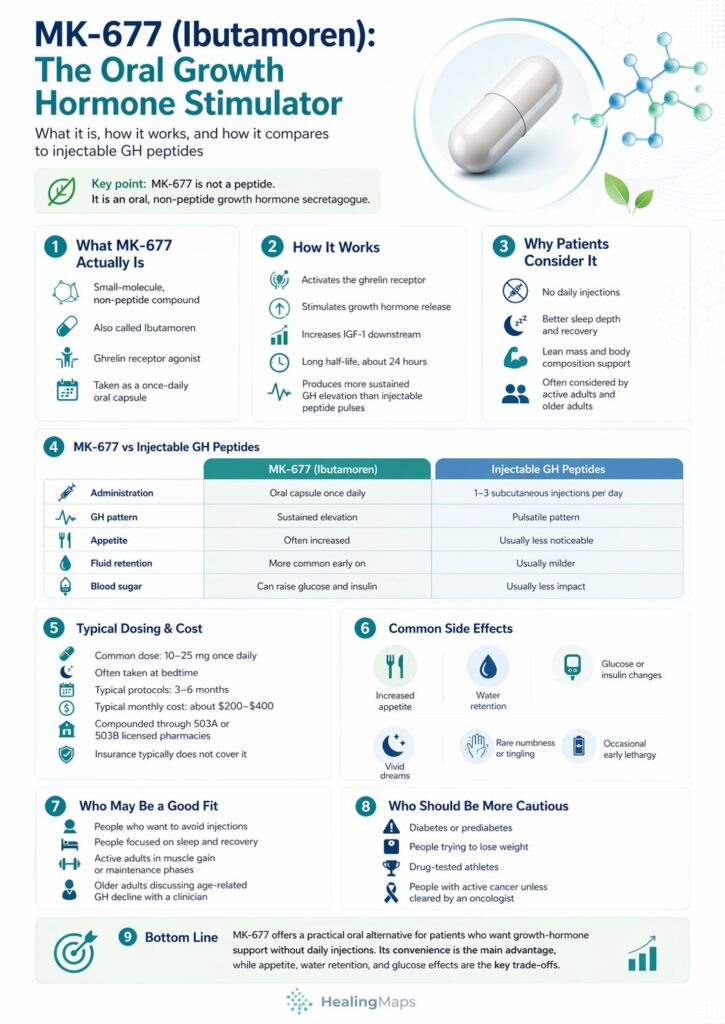
- Administration: MK-677 is a once-daily oral capsule. Injectable peptides require 1–3 subcutaneous injections per day. This is the single biggest practical difference — the compliance advantage of MK-677 is real.
- GH pattern: MK-677 produces sustained GH/IGF-1 elevation for 24 hours per dose. Injectable peptides produce a pulsatile pattern closer to natural physiology. Both have theoretical pros and cons; the clinical research doesn’t definitively favor one approach.
- Appetite: MK-677 significantly increases appetite. Injectable peptides typically don’t. This can be good or bad depending on your goals.
- Fluid retention: MK-677 produces more noticeable fluid retention than the peptides, particularly in the first 4–6 weeks.
- Blood sugar: MK-677 raises fasting insulin levels and can cause mild insulin resistance in some patients. Peptides also affect glucose metabolism but usually to a lesser degree.
For a broader head-to-head of the injectable GH peptide options, see Sermorelin vs. CJC-1295 vs. Ipamorelin.
Dosing and Protocol
Standard clinical doses range 10–25 mg once daily, typically taken at bedtime to align the GH pulse with the body’s natural nighttime GH release cycle. Some patients start at 10 mg to assess tolerance, then titrate to 20 or 25 mg after 2–4 weeks. Cycles typically run 3–6 months, with some clinicians running longer protocols under ongoing supervision.
MK-677 should be sourced through 503A or 503B licensed compounding pharmacies. Like other investigational compounds, “research-grade” products sold online are not tested for human use and carry serious quality and contamination risks.
Cost and Access
Compounded MK-677 typically runs $200–$400 per month through a 503A pharmacy. This is comparable to monthly costs for injectable GH peptide stacks. Insurance does not cover compounded MK-677.
MK-677 is not FDA-approved as a drug product. Merck originally developed it but discontinued the program without seeking approval. It remains an investigational compound available only by prescription through licensed compounding pharmacies with clinician oversight.
HealingMaps may earn a commission when readers sign up through Strut Health. This does not affect our editorial coverage or your price. Sermorelin is a prescription medication; eligibility is determined by a licensed clinician. Pricing reflects Strut Health’s published $99/month rate and may change.
Side Effects
MK-677 has a distinct side-effect profile worth understanding:
- Increased appetite. Direct effect of ghrelin receptor activation. Can be substantial — many patients describe persistent hunger, especially in the first 4–6 weeks. Some adapt; others find it intolerable.
- Water retention. Mild fluid retention is common in the first month, typically resolving as the body adjusts. Some patients notice puffiness or slight weight gain from water alone.
- Fasting glucose changes. MK-677 can raise fasting blood glucose and insulin levels. Diabetic or prediabetic patients need careful monitoring. Some clinicians order baseline HbA1c and check it during use.
- Vivid dreams. Reported by a notable minority of patients, particularly in the first few weeks. Usually subsides.
- Numbness or tingling. Rare, but reported at higher doses. Usually resolves with dose reduction.
- Lethargy. Occasionally reported in the first week as the body adjusts to elevated GH and IGF-1.
Sports Use and WADA Status
MK-677 is prohibited under WADA category S2 as a growth-hormone secretagogue — banned in and out of competition. Athletes subject to drug testing should not use MK-677. Detection is possible via direct testing for the compound itself and via indirect markers of elevated GH/IGF-1.
Who Should Consider MK-677
- Patients averse to daily injections. The primary practical advantage. If injections are the barrier, MK-677 opens access to GH-based therapy.
- Patients with poor sleep and recovery. The sleep-depth effect is well documented and often the most noticeable benefit.
- Active adults in muscle-gain or maintenance phases. Appetite boost + sustained GH elevation aligns with goals of gaining lean mass or preserving it during training.
- Older adults looking at age-related GH decline. Clinical data supports modest improvements in lean mass and bone density with sustained use.
Who should probably not: patients with diabetes or prediabetes (blood sugar monitoring required), patients trying to lose weight (appetite effect works against the goal), athletes in drug-tested sports (WADA prohibited), and patients with active cancer (discuss with oncologist).
Frequently Asked Questions
Is MK-677 a steroid?
No. MK-677 is not a steroid. It does not interact with androgen receptors and does not have the anabolic steroid safety profile. It works entirely through the ghrelin receptor to stimulate endogenous growth hormone release.
How long do I need to take MK-677 to see results?
Sleep and appetite effects typically appear within 1–2 weeks. Body composition changes and lean-mass improvements typically become visible at 2–3 months. Bone-density changes require 6+ months of use to measure.
Can I combine MK-677 with injectable GH peptides?
Some clinicians do, though it’s not standard. The mechanisms overlap somewhat, and combining them may offer diminishing returns. More commonly, clinicians choose one approach based on patient preference and goals. Any combination should be clinician-directed with blood sugar and IGF-1 monitoring.
Will MK-677 cause weight gain?
Some, yes — though the composition matters. Increased appetite typically leads to increased food intake. Combined with fluid retention and lean-mass gains, scale weight often rises in the first 1–3 months of use. Whether that’s “weight gain” depends on the composition (lean mass vs. fat vs. water). Patients focused on weight loss should probably choose a different approach.
Is MK-677 safe long-term?
Clinical trials have run up to 2 years without significant safety concerns beyond the expected metabolic effects (glucose, appetite, fluid retention). Longer-term data is limited, which is why most clinicians cycle patients off after 3–6 months or monitor key lab values (HbA1c, IGF-1, fasting insulin) during sustained use.
The Bottom Line
MK-677 is the pragmatic oral option for patients who want growth-hormone benefits without daily injections. It’s not technically a peptide but functions clinically as one — it stimulates the body’s own GH release, produces similar downstream effects to injectable GH peptides, and is prescribed through the same 503A compounding pharmacy channels. The appetite boost and fluid retention are meaningful trade-offs that make it a better fit for some patients than others. For the right patient, it’s a convenient and effective tool. For others, the injectable peptide stack is a better match.
Ready to discuss options with a clinician? Browse our directory of verified growth-hormone peptide clinics to find a licensed provider.