Klee Irwin And His Plan To Bring Psychedelic Therapy To The Masses
Last reviewed and updated: June 30, 2026.
Key Takeaways
| Current access gap | Legal in OR/CO but $500–$2,500/session out of pocket — not mass access; insurance coverage is the key unresolved bottleneck |
| Pharmaceutical path | COMPASS rolling NDA Q4 2026 (psilocybin); DT120 Phase 3 positive June 2026 (LSD) — once FDA-approved, insurance coverage becomes the next fight |
| Philanthropic impact | Ferriss/Johns Hopkins, Usona, Heffter funded early research → created the Phase 3 data now driving FDA approval submissions |
| April 2026 EO | Federal research priority + VA access expansion — most plausible near-term mechanism for meaningful mass access (veteran population) |
| Access timeline | Ketamine: now; psilocybin therapy ~2027–2028; LSD therapy ~2028–2029; MDMA furthest from approval |
For the past few decades as an author, physicist and businessman, Klee Irwin’s public persona has been split between two worlds: nutraceuticals and the study of consciousness through quantum physics.
Now, through his plan to build the largest network of affordable psychedelics therapy clinics, Irwin is building a bridge between his business persona and his second identity as an independent physics researcher.
The chain of clinics, launching under the banner “Irwin Naturals Emergence,” will take advantage of a large-scale operation to bring pricing down and “bring psychedelics therapy to the masses.”
RELATED: What Is The Psychedelic Therapy Container – And Why Is It Important?
From Dietary Supplements To Psychedelics Clinics (With A Stop In Quantum Physics!)
Irwin’s household brand, Irwin Naturals, has been in the market since 1994 and can now be found across the country in stores like Walmart and Whole Foods, among thousands of other retailers.
The company has been on a profitability streak since its founding and its shares are traded publicly on the Canadian Securities Exchange and the American OTC.
Irwin Naturals adopted a cannabis strategy in 2018 after CBD sales exploded across the country with the signing of the 2018 Farm Bill that made the cannabinoid legal throughout the US.
In parallel, Irwin developed a career as a scientific researcher. In 2009, he founded Quantum Gravity Research, “a not for profit scientific institute, working on the connection between mathematical physics and consciousness,” in his words.
Since 2012, Irwin has co-authored numerous research papers and scientific articles that build up the corpus of what he and his colleagues call the “Emergence Theory.”
Today, Irwin’s research into the scientific principles behind a theory of everything spills into his business ventures in the psychedelics industry. This relationship, at first glance, is set up by the concept of “emergence.”
“I’m trying to create a kind of cross branding between what I do in the psychedelic and nutraceutical spaces and what I’m doing in the scientific world, connecting unification physics to consciousness,” he said in an exclusive interview.
“Irwin Naturals Emergence” is the name of a chain of mental health clinics that Irwin Naturals is building as a subsidiary.
Irwin explained that the name for his emergence theory comes from the idea that complex things emerge from simpler things. The theory essays to explain how, for instance, consciousness can emerge from the behavior of quarks and electrons in one’s body.
In the field of mental health, the concept of emergence appears in motifs like “emerging from the dark waters of depression,” he says.
Irwin Naturals Emergence: The Jenny Craig Of Psychedelics
At the time of this writing (July 2022), Irwin Naturals owns eleven mental health clinics, and hopes to be at 50 by the end of the summer.
The company’s clinic strategy began in February of 2022.
“It’s entirely through acquisitions, which is what allows it to go so quickly,” says Irwin. “We have about a $1 billion market cap, and most of our acquisitions are done by stock. So they’re really not technically acquisitions, they’re mergers.”
Irwin says he began to think about a mental health strategy for his company after looking at the global mental health crisis and how, at least in North America, one out of four adults is suffering from a mental disorder.
“It’s just a growing trend, as though the world is going progressively and collectively insane,” he says
Irwin realized he can use the influence and resources of his supplements brand “to effectively endorse and help validate this mental health revolution, which is psychedelic mental health treatment.”
“We can create this chain of psychedelic mental health clinics called Irwin Naturals Emergence, and we can use our stock as a public company to do a roll-up and really become the Jenny Craig of psychedelic mental health clinics,” says Irwin.
Jenny Craig is a chain of weight loss clinics that was able to “bring weight loss clinics to the masses,” through the 1980s and 1990s, by providing a reduced cost structure when compared to the luxury weight loss clinics of the day.
Part of Jenny Craig’s ability to bring pricing down was related to the scope of its market presence, which today runs at more than 700 centers in Australia, the U.S., Canada, and New Zealand.
Irwin Naturals plans to follow a similar strategy. By centralizing certain administrative processes like insurance billing, Irwin expects to reduce the final cost of treatment for the patient.
Irwin expects that, by bringing prices down while maintaining good quality, competitors will be forced to bring their own prices down to live up to a new standard. This will “overall help the patients out there.”
What Happens At Irwin Naturals Emergence Clinics?
“As these clinics come in and they join up with us in a strength-in-numbers play; we want to standardize pricing, we want to standardize the name of the business and we want to standardize what we offer,” says Irwin.
His plan is to offer consistency of service across all clinics in a similar way to the Starbucks model, where “they’re not all identical inside, but they have a style guide that gives a similarity from Starbucks to Starbucks.”
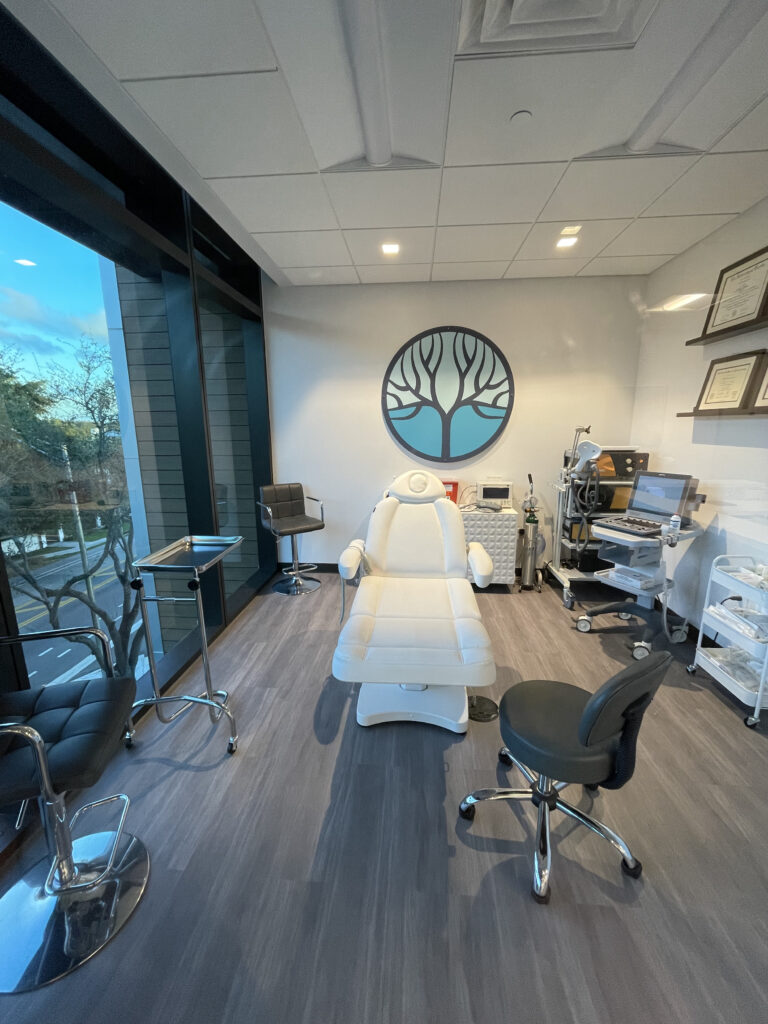
Today, the company’s plan is to offer ketamine as a psychedelic, being the only psychedelic-type compound currently legal.
Ketamine will complement a base group of treatments that will be offered in all clinics from the start. These include stellate ganglion block, an injection of an anesthetic into a group of nerves in the neck, which Irwin describes like “a computer reboot of your brain.”
“It resets a fight or flight mechanism that gets locked in some people who have PTSD, for example,” he says.
Transcranial magnetic stimulation is also offered. This is a non-invasive treatment for neurological conditions that works by stimulating the brain’s magnetic waves through an external magnetic field.
Irwin says there are thousands of behavioral health clinics that the company could eventually absorb and train to provide these treatments.
As other psychedelic compounds become approved by the FDA, Irwin Naturals expects to add them to their roster of service offerings.
“We have a big responsibility to set the bar of quality and make it as good as we can make it, because then the competition will copy us. And some of them will do better than us, and then that will force us to do even better. And it sort of starts from where we set the bar,” he concludes.
Discover Irwin’s current Ketamine Clinic locations
- Ketamine Health Centers – Bonita Springs, Florida; Weston, Florida; Orlando, Florida; West Palm Beach, Florida; Mexico City, Mexico; Miami, Florida
- Midwest Ketafusion – Iowa City, Iowa
Bringing Psychedelic Therapy to the Masses: Where the Vision Stands in 2026
When this article was written, the idea of psychedelic therapy at scale — accessible to ordinary patients, not just those who could afford private retreats or qualify for clinical trials — was genuinely aspirational. The vision has not been abandoned; if anything, it has become more concrete. But the path to mass access has clarified into something more complicated than simple legalization. Oregon became the first U.S. state to allow licensed psilocybin service centers in 2023, and Colorado followed in 2024 with its own framework. Today, over 300 licensed facilitators operate in Oregon, and sessions are legally available. The catch: legal psilocybin sessions currently cost between $500 and $2,500 per session, paid entirely out of pocket. That is not mass access. That is boutique access with a legal imprimatur. The access gap — between the people who need this most (often underserved, treatment-resistant, uninsured) and the people who can currently access it — is the central unsolved problem in the field.
The philanthropic work that figures like Klee Irwin have supported — funding basic research, clinical trials, and advocacy — has had a concrete and measurable impact on where the field now stands. The Tim Ferriss / Johns Hopkins funding partnership, Usona Institute, and Heffter Research Institute collectively funded much of the Phase 2 psilocybin research that built the efficacy dataset that enabled Phase 3 trials to proceed. COMPASS Pathways’ Phase 3 COMP360 psilocybin trials, which generated the data now underpinning a rolling NDA expected in Q4 2026, would not exist without the philanthropic investment that de-risked early research. This is a case where philanthropic money demonstrably moved a clinical and regulatory outcome: the data did not come from nowhere. But research funding and patient access are different problems. The therapy that reaches patients through a prescription model in 2027 or 2028 will be a pharmaceutical product sold at pharmaceutical margins — a different thing than the cheap, accessible treatment that philanthropic vision typically envisions.
The most meaningful development for access in 2026 is the April 2026 executive order naming psychedelic medicine a national research priority and directing the Department of Veterans Affairs to expand access programs for veterans with PTSD and treatment-resistant depression. For the veteran population specifically — which has disproportionately high rates of both conditions and has been systematically underserved by conventional treatment — this EO represents a real access expansion, not a rhetorical one. The VA system, with its national infrastructure and existing patient relationships, is the most plausible mechanism for genuinely broad access at scale in the near term. Ibogaine has also gained significant momentum in the veteran access conversation, driven by the 2024 Stanford Nature Medicine study (18 Special Forces veterans, dramatic improvements in PTSD/TBI/depression) and a Texas $50M state investment in ibogaine research and access.
The realistic timeline for mass access looks something like this: ketamine is available now — out-of-pocket costs are significant, but the infrastructure exists. Psilocybin therapy is likely 2027–2028 for prescription access, with insurance coverage a subsequent fight that will take additional years. LSD therapy (Definium DT120 Phase 3 positive, June 2026) is potentially 2028–2029 on a similar trajectory. MDMA remains the furthest from approval after the 2024 FDA Complete Response Letter, with a rework process underway. Each of these timelines leads to the same insurance bottleneck: until psilocybin or LSD is approved as a prescription drug and covered by payers, the $500–$2,500 cost floor does not come down. The pharmaceutical path to approval is the prerequisite for the insurance fight; the insurance fight is the prerequisite for actual mass access. The philanthropic visionaries who funded the research have done their part. The next phase belongs to payers, regulators, and policymakers.
Frequently Asked Questions
Who is Klee Irwin and what is his connection to psychedelic therapy?
Klee Irwin is the founder of Quantum Gravity Research, a Los Angeles-based theoretical physics research organization he funds personally through proceeds from his company Irwin Naturals. His connection to psychedelic therapy comes from his philanthropic and advocacy work: Irwin has been vocal about supporting research into psilocybin and other psychedelic compounds as tools for mental health treatment, particularly with the goal of making such therapy accessible to people who cannot afford the current private-market costs. He represents a broader category of tech- and business-world philanthropists — alongside figures like Tim Ferriss, who funded Johns Hopkins psilocybin research — who helped de-risk early psychedelic research through private funding at a time when government and pharmaceutical funding was not available. His interest is driven by a stated belief that psychedelic therapy has the potential to address large-scale mental health suffering that conventional treatments have failed to adequately address.
How much does legal psychedelic therapy cost today?
Legal psilocybin sessions in Oregon (the only state with a fully operational licensed service center framework as of mid-2026) cost between approximately $500 and $2,500 per session, paid entirely out of pocket. No insurance coverage exists for psilocybin services. The cost variation reflects differences in setting, facilitator experience level, session duration, and preparation/integration support included. Colorado began licensing psilocybin healing centers in 2024 and prices are broadly similar. Ketamine therapy — legal nationally at the prescription level and more widely available — costs roughly $400–$800 per IV infusion (out-of-pocket) or somewhat less for oral/IM forms; Spravato (esketamine nasal spray) is the exception and can be covered by insurance under certain criteria. MDMA is not yet approved. Legal ayahuasca is available through certain religious organizations (Native American Church; some ayahuasca churches) with varying cost structures. There is no path to legal psilocybin therapy that is currently affordable for low-income patients without financial assistance.
Will insurance ever cover psychedelic therapy?
Yes, almost certainly — but not soon, and not without a fight. The pathway runs through pharmaceutical approval: once psilocybin or LSD is approved by the FDA as a prescription drug, payers (private insurance, Medicaid, Medicare) come under pressure to cover it. Coverage is never automatic with FDA approval — the insurance industry reviews cost-effectiveness and clinical evidence, and drugs can remain uncovered for years after approval. However, if COMPASS Pathways’ COMP360 receives NDA approval (expected Q4 2026 submission, potential approval 2027–2028) and if the clinical evidence is as strong as trial data suggests, payers covering treatment-resistant depression will face significant pressure to include it in formularies. Esketamine (Spravato) received FDA approval in 2019 and is now covered by most major insurers for qualifying TRD patients — this is the most likely template for psilocybin coverage. The VA system covering psychedelic therapy for veterans is a second, potentially faster path given the April 2026 executive order directing VA access expansion.
When will psychedelic therapy be widely accessible?
The most realistic timeline, as of June 2026: ketamine therapy is accessible now at out-of-pocket costs; Spravato is covered by most major insurers for qualifying patients. Psilocybin prescription therapy is on a trajectory for FDA approval 2027–2028 (COMPASS rolling NDA Q4 2026), with insurance coverage following some years after that — a reasonable optimistic estimate is meaningful insurance coverage by 2029–2031. LSD therapy (Definium DT120) completed Phase 3 positive in June 2026; an NDA would follow, with potential approval 2028–2029 and insurance coverage on a similar trailing timeline. MDMA is furthest from approval after the 2024 FDA Complete Response Letter. “Widely accessible” in the sense of affordable, covered, available to average patients without out-of-pocket burden is probably 5–10 years away for psilocybin under an optimistic scenario. The April 2026 executive order directing VA expansion could make veteran access meaningful sooner — the VA’s institutional infrastructure is the most plausible near-term mass-access mechanism.