
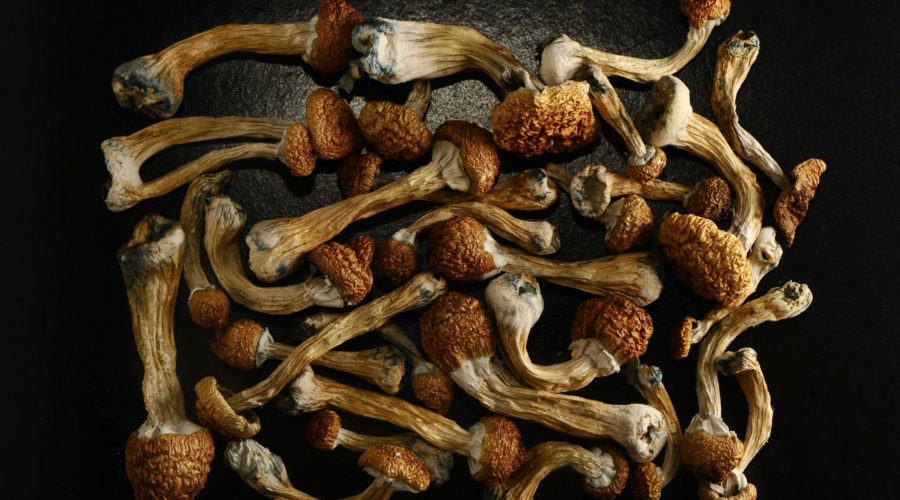
Golden Teacher Mushrooms Are Enlightening But Inconsistent – What People Like and Don’t Like
Last reviewed and updated: June 20, 2026.
Key Takeaways
| Species | Psilocybe cubensis strain — the same species used in most psilocybin clinical research; same active molecule as synthetic research psilocybin |
| Potency | Moderate: ~0.5–0.75% psilocybin by dry weight; 3.5g (eighth) = ~15–26 mg psilocybin; less potent than Penis Envy or Tidal Wave strains |
| Experience profile | Introspective, philosophical, insight-oriented — less overwhelmingly visual than some strains; often described as “teaching” rather than “overwhelming” |
| Legal status | Home cultivation legal for adults 21+ in Colorado (Prop 122); licensed service centers only in Oregon; illegal to cultivate in all other U.S. states |
| Why beginners choose it | Reliable fruiter, consistent moderate potency, well-documented experience profile, extensive cultivation and harm reduction documentation |
Planning to try Golden Teacher? For dose-by-experience-level breakdowns, weight-based guidelines, and what to expect at each level, see our complete shrooms dosage guide.
Golden Teacher mushrooms are one of the most commonly used psilocybin mushrooms. They are not a species, but instead a strain of Psilocybe cubensis mushrooms.
As with other psilocybin mushrooms, the main psychoactive compounds it contains are psilocybin and psilocin. Cultivators and psychonauts like this magic mushroom strain for different reasons.
My Experiences with Golden Teacher Mushrooms
I found the “teacher” part of their name intriguing because I discovered that they offered me insightful and revelatory experiences. However, any strain of magic mushroom can, of course, offer important insights, as if I’m learning life lessons from a teacher. Since Golden Teachers have a moderate potency level, they became my ideal entry point when I was new to psychedelics.
Their mild nature reduced the risk of a bad trip for me. As a more experienced user, I could choose to take a larger dose of Golden Teachers to achieve unique effects, such as mystical experiences. I always approached Golden Teacher mushroom doses carefully. Even though they are considered medium-strength mushrooms, I recognized that, as someone who hadn’t tripped before or was new to psychedelics, it was best for me to start with a low dose.
This way, I could get used to the effects first and then decide to take a higher dose next time if I felt comfortable. I reminded myself that I could always take more, but I couldn’t take less. In my experience, the effects of a Golden Teacher mushroom trip typically lasted 4-6 hours.
RELATED: We Just Discovered a New Magic Mushroom Species
What are People Saying about Golden Teacher Mushrooms?
What they like about their Golden Teacher experiences:
1. Introspective Experience: Many users report that the Golden Teacher strain provides a profound, introspective trip that can be spiritually enlightening. It’s often described as offering a deep connection to one’s inner self and the universe, making it popular for those seeking personal growth and insight.
2. Mild and Tolerable Potency: For many, the Golden Teacher offers a balanced psychedelic experience that’s neither too overpowering nor too mild. This makes it suitable for both novice and experienced users, allowing for a manageable and enjoyable trip.
3. Visuals and Aesthetics: Users often report vibrant and colorful visual hallucinations with the Golden Teacher strain. Additionally, the physical appearance of the mushroom, with its golden-hued cap, is appealing to many cultivators and enthusiasts.
4. High Yield: One of the reasons the Golden Teacher strain is popular among cultivators is its potential for high yields. With proper care and a suitable growing environment, Golden Teacher can produce abundant flushes.
5. Robustness: Golden Teacher is known for its resilience, which makes it a suitable strain for beginners. It can tolerate a range of conditions and is less sensitive to minor mistakes in the cultivation process compared to other strains.
6. Distinct Appearance: The characteristic golden caps of this strain make it relatively easy to identify, reducing the risk of confusion with other strains during cultivation.
What they don’t like about their Golden Teacher experiences:
1. Inconsistency in Potency: Some users have noted that the effects can vary between batches or even individual mushrooms. This inconsistency can be challenging for those trying to gauge a specific dosage or achieve a consistent experience.
2. Physical Side Effects: As with many psychedelic mushrooms, some users might experience physical discomforts like nausea, body temperature fluctuations, or muscle twitching. These effects can be off-putting for some individuals.
3. Can be Overwhelming: While many find the introspective nature of the Golden Teacher beneficial, others might find the depth of introspection overwhelming or confrontational. It can bring up suppressed emotions or memories that some users are not prepared to face.
4. Contamination: Like all mushroom cultivation, maintaining a sterile environment is crucial. Golden Teacher, while robust, can still fall victim to mold, bacteria, and other contaminants. Regularly sanitizing equipment and using sterile techniques can help mitigate these risks.
5. Inconsistent Growth: Even within a single batch, growers might notice inconsistency in the size and maturity rate of the mushrooms. This can make it challenging to determine the best time to harvest the entire flush.
6. Environmental Sensitivity: While Golden Teacher is more forgiving than some other strains, it still requires a specific balance of humidity, temperature, and light for optimal growth. Deviations from these conditions can lead to reduced yields or health issues for the mushrooms.
– Have you tried Golden Teachers? Leave a review below
READ NEXT: B+ Mushrooms: Psilocybin that’s Not a Quite a Perfect Score, Yet Never a Fail
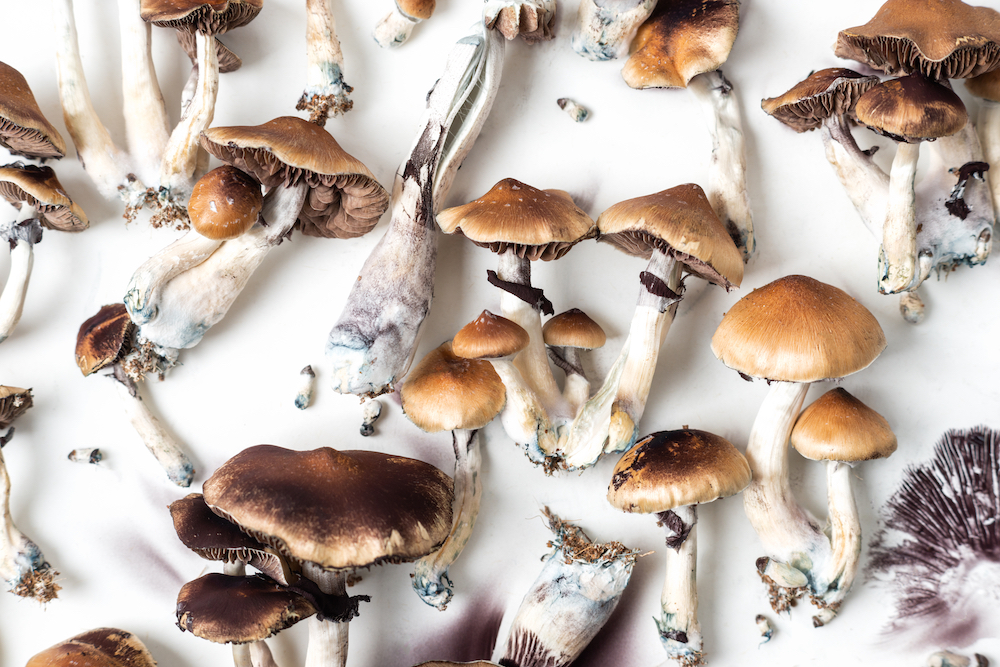
What Golden Teachers Look Like
Part of what makes strains distinct is their appearance. Let’s describe what Golden Teachers look like.
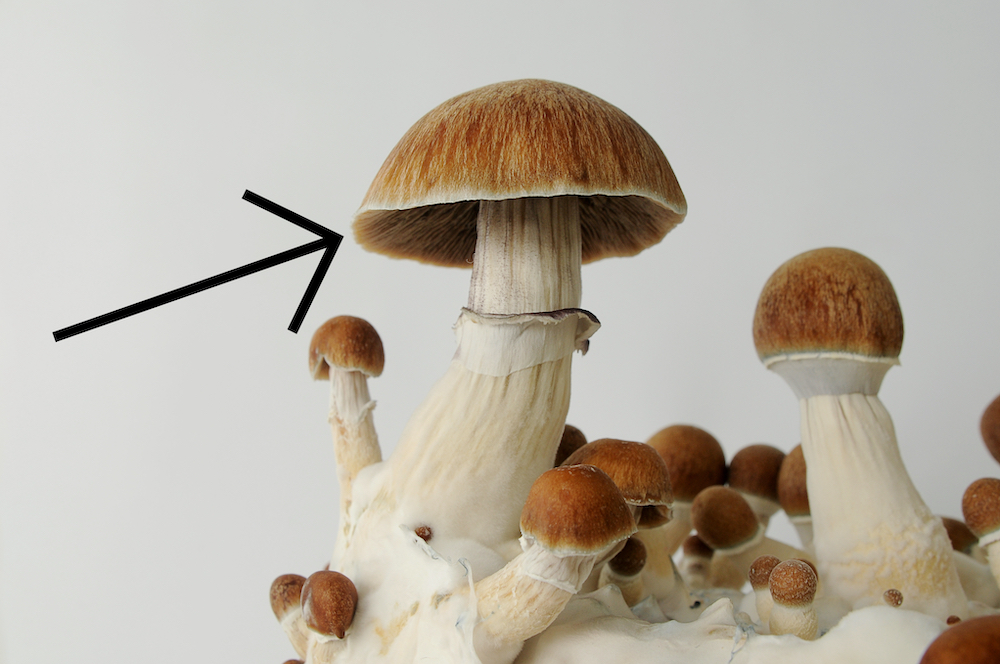
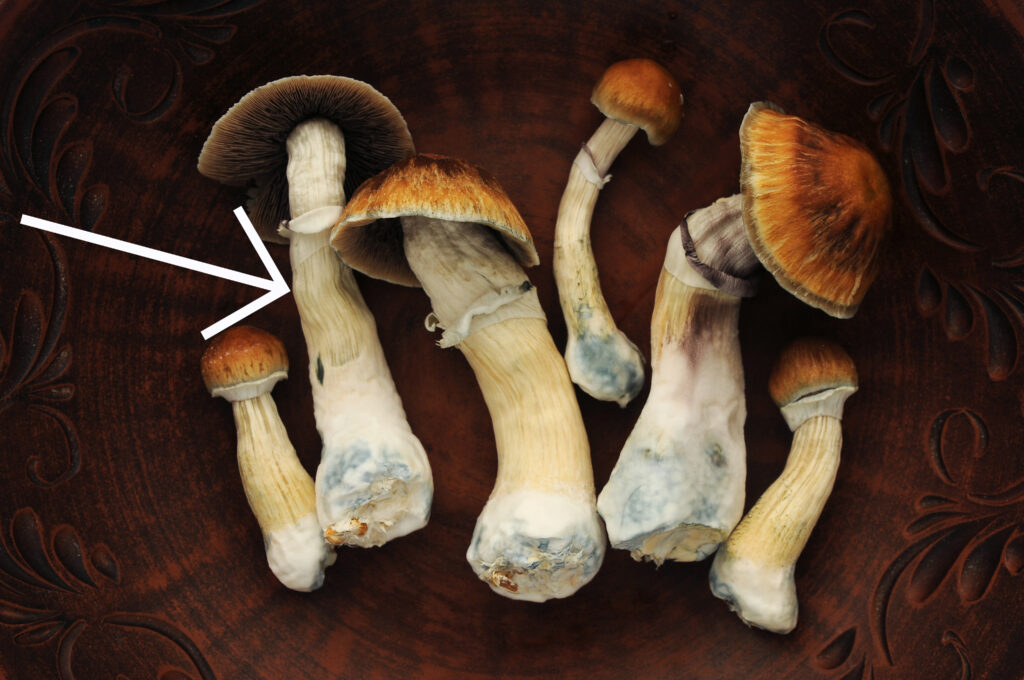
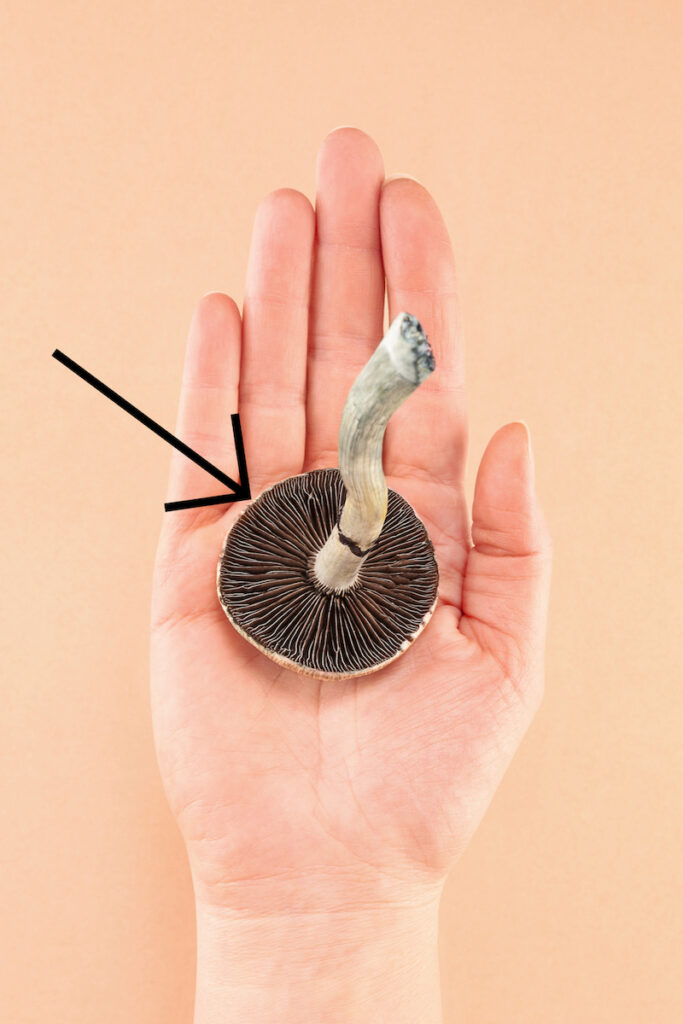
You will get a medium-sized Golden Teacher mushroom from the first flush (crop), but mushrooms in later flushes can be massive in size. Cultivators tend to like Golden Teachers because they grow in great flushes.
Golden Teacher Lookalikes
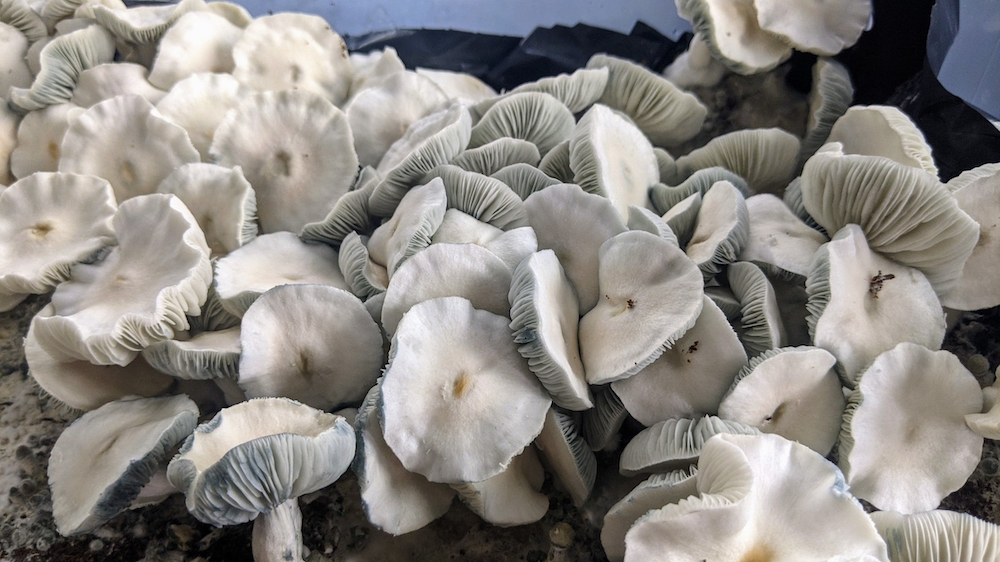
There are other varieties of this strain, however, such as Albino Golden Teacher mushrooms. If we compare Albino mushrooms vs. Golden Teacher mushrooms, what are the differences? Well, the main difference, as the name ‘albino’ tells us, is the color.
Albino Golden Teacher mushrooms are white in color, and this is because they originate from the cross-breeding of Golden Teachers with Albino A+ (another Psilocybe cubensis strain).
RELATED: The Best Ways to Store and Dry Magic Mushrooms
It’s also important to be aware of Psilocybe cubensis lookalikes, as it is possible to mistake some of these for Golden Teachers. One way to eliminate the possibility of consuming poisonous lookalikes is to know that Golden Teachers don’t grow in the wild. However, if you’ve bought some magic mushrooms and you’re not sure if they’re Golden Teachers or not, you should be able to tell based on the description of them provided above. Their gold cap is distinctive.
The only way to be 100 percent certain that you don’t have a Golden Teacher mushroom lookalike is to grow these mushrooms yourself (providing you’ve bought the right spores).
RELATED: What Are Liberty Caps – One Of The Most Potent Magic Mushrooms
The Potency Of Golden Teacher Mushrooms
One of the aspects of different psilocybin mushrooms that users care the most about is potency. And different strains can have varying degrees of potency, with the differences sometimes being pretty large.
It’s worth noting that the appearance of the mushroom does not necessarily reflect potency. The genetic characteristics that translate into potency are independent of those that translate into aspects like color and size.
We do have some scientific studies on the differences in potency between species of psilocybin mushrooms.
For example, Psilocybe azurenscens is one of the most potent, containing 1.78 percent psilocybin, 0.38 percent psilocin, and 0.35 percent baeocystin. Baeocystin is another compound found in psilocybin mushrooms. It could potentially contribute to an entourage effect, with baeocystin modulating certain psychedelic effects. The entourage effect is said to apply to cannabis, too, with compounds other than THC synergistically acting on it to modulate the overall psychoactive effects.
Psilocybe cubensis is a moderately potent magic mushroom. It contains 0.63 percent psilocybin, 0.60 percent psilocin, and 0.25 percent baeocystin. However, the various strains of Psilocybe cubensis, like the strains of any other species, can differ in their potency.
Until very recently, we didn’t know much about the potency between different varieties. Mushroom connoisseurs would hold up Penis Envy as one of the most potent strains. But this was based on anecdotal self-experimentation. There wasn’t high-quality data to back up this claim.
Nonetheless, Penis Envy mushrooms still have the reputation of being a highly potent magic mushroom.
RELATED: Divinity for the Non-religious: How Shroom Churches Offer Meaning
Growing Golden Teachers
If you want to find out how to grow golden teachers, you should consult our guide on how to grow psilocybin mushrooms. This explains all the ingredients and equipment you need to obtain, as well as step-by-step descriptions of how to grow, harvest, and store your mushrooms.
Golden Teachers are a good choice for cultivation. If you’re just starting out, any Psilocybe cubensis strain is easy to grow and all the strains have similar cultivation requirements (e.g. temperature, humidity, and light).
Golden Teachers are said to be particularly easy when growing magic mushrooms at home. This is because they are able to grow in less than optimal conditions.
To grow Golden Teachers, you’ll first need Golden Teacher spores. Just make sure that you spend some time researching vendors and select one that is trusted with good reviews.
Are Golden Teachers easy to grow? Many cultivators say they are. In fact, this type of mushroom — like other Psilocybe cubensis strains — are known to be relatively easy to grow, making it a great choice for first-time growers. And how long does it take to grow Golden Teachers? Expect the process to take 4-6 weeks from spore inoculation to fruiting harvest.
The Benefits Of Psilocybin Mushrooms
There is a growing body of research demonstrating that psilocybin can treat a variety of mental health issues, including depression, end-of-life anxiety, and post-traumatic stress disorder (PTSD), as well as smoking addiction.
Imperial College London’s Psychedelic Research Centre also has an upcoming trial looking at psilocybin as a treatment for anorexia. These benefits depend on the quality of the psilocybin experience; they are related to effects like mystical experiences, connection to one’s emotions, and emotional breakthroughs.
Besides the conditions above, many people find psilocybin mushrooms help in many other areas of their life, including their relationships, worldview, lifestyle, spirituality, and overall level of life satisfaction.
Using Golden Teacher mushrooms has the potential to provide some of these same benefits.
However, it’s crucial to remember that using magic mushrooms in this way is not the same as using them in a clinical, supervised setting. Taking them with a guide, as well as in the right mindset and environment, can, nonetheless, increase your chances of having a positive, therapeutic experience.
Are Golden Teacher Mushrooms Legal?
Golden Teacher mushrooms, like all other psilocybin-containing mushrooms, are illegal in most countries. In the U.S., they are a Schedule I substance under the Controlled Substances Act. This means they have no recognized medical value and a high potential for abuse.
Of course, studies on psilocybin and anecdotal reports from many users seem to suggest otherwise.
Nevertheless, Golden Teacher spores are legal to possess in most of the U.S., except in the states of California, Idaho, and Georgia. Therefore, if you are a U.S. citizen and don’t live in these three states, you can legally buy and own Golden Teacher spores.
But as soon as you cultivate these mushrooms, you will then be committing a crime, according to federal law. This is because when the spores begin to germinate, they can form mycelium and then mature mushrooms, which contain the illegal compound psilocybin.
However, possessing psilocybin mushrooms for personal use has been decriminalized (but not legalized) in some areas in the U.S. These include the following.
- Oregon
- Seattle, Washington
- Denver, Colorado
- Ann Arbor, Michigan
- Washington D.C.
- Oakland and Santa Cruz, California
- Somerville and Cambridge, Massachusetts.
This means that if you possess Golden Teachers in these areas, you won’t face any legal penalties.
Other Legal Areas Around The World
Magic mushrooms like the Golden Teacher variety are fully legal in a number of countries around the world. The list includes the following.
- The Bahamas
- Brazil
- Jamaica
- Nepal
- Samoa
In these countries, you can legally sell, cultivate, transport, and possess psilocybin mushrooms. In the Netherlands, “magic truffles”, which contain psilocybin, are legal. And you can find the Golden Teacher variety in the form of truffles.
More and more states are changing their laws around psilocybin. Soon, it may be legal (in various states) to buy, cultivate, and possess all kinds of magic mushrooms, including the much-desired Golden Teacher strain.
Find a provider: Renew Vitality
Golden Teacher Mushrooms and Psilocybin Research in 2025
Golden Teacher is one of the most widely cultivated Psilocybe cubensis strains — and Psilocybe cubensis is the species used in virtually all psilocybin clinical research. This matters because the clinical evidence base for psilocybin therapy is directly relevant to what people using Golden Teacher mushrooms might expect, and the legal context for Psilocybe cubensis specifically has changed meaningfully since this article was written.
Psilocybin clinical research — and its connection to Golden Teacher. The landmark psilocybin trials at Johns Hopkins, NYU, and COMPASS Pathways use synthetic psilocybin rather than mushroom extracts — allowing precise dosing control that mushroom material can’t provide. However, the psychoactive compound is identical: the psilocybin in a clinical 25 mg capsule is the same molecule as the psilocybin in a Golden Teacher mushroom. What differs is consistency and predictability: synthetic capsules allow therapists to know exactly what dose a patient received; mushroom material varies in psilocybin content between strains, flushes, and parts of the mushroom. For people using Golden Teacher mushrooms outside clinical settings, this variability is the primary reason experiences at a given dry weight can differ significantly from one batch to the next.
Legal context: Colorado and Oregon changes. Colorado’s Proposition 122 (2022) legalized personal possession and home cultivation of Psilocybe cubensis mushrooms — the species that includes Golden Teacher — for adults 21 and older. This is one of the most significant legal developments in U.S. psilocybin history, and Golden Teacher, as the most widely grown Psilocybe cubensis strain, is directly affected. Colorado residents can now legally cultivate and possess Golden Teacher mushrooms for personal use. Oregon’s Measure 109 authorized supervised psilocybin services in licensed facilities — psilocybin is available through licensed service centers using trained facilitators, but home use is not permitted. At least a dozen U.S. cities have decriminalization ordinances that deprioritize enforcement of personal mushroom possession.
Why Golden Teacher remains the go-to strain for beginners. Golden Teacher’s enduring popularity — it has been one of the most cultivated Psilocybe cubensis strains for decades — comes down to a consistent set of practical advantages: it is a reliable fruiter (produces mushrooms consistently without demanding conditions), produces moderate potency levels (generally 0.5–0.75% psilocybin by dry weight, though this varies), offers a well-characterized experience profile that tends toward introspection and insight rather than overwhelming intensity, and is well-documented in cultivation and harm reduction resources. For people new to psilocybin, Golden Teacher’s consistency and predictability are more important safety features than they might seem — less consistent strains mean more dose variability and a higher chance of unexpectedly intense experiences.
Frequently Asked Questions
What are Golden Teacher mushrooms and why are they called that?
Golden Teacher is a well-known strain of Psilocybe cubensis — the most commonly cultivated species of psilocybin-containing mushroom. They are not a separate species but a cultivated variety within Psilocybe cubensis, distinguished by golden-capped mushrooms with white and yellow speckling on the caps and a somewhat larger size than some other cubensis strains. The “teacher” part of the name reflects reports from users that Golden Teacher experiences tend to offer insight, clarity, and a sense of being taught something meaningful — a more reflective and philosophical quality compared to some strains that users describe as more visually intense or chaotic. The “Golden” comes from the characteristic color of the caps.
How potent are Golden Teacher mushrooms?
Golden Teacher is generally considered a moderate-potency strain — neither the most potent Psilocybe cubensis varieties available (some cultivated strains like Penis Envy or Tidal Wave can be significantly more potent) nor among the weakest. Typical psilocybin content in Golden Teacher is estimated at 0.5–0.75% by dry weight, though this varies between grows, flushes, and parts of the mushroom (caps typically more potent than stems, first flush often more potent than subsequent flushes). At a 3.5 gram (eighth) dose of typical Golden Teacher — a common full experience dose — a person would be consuming roughly 15–26 mg of psilocybin, consistent with the lower end of doses used in clinical trials. The moderate, predictable potency is part of what makes it a popular choice for beginners.
What does a Golden Teacher experience feel like?
Users consistently describe Golden Teacher experiences as having an introspective, philosophical quality — a sense of being guided through meaningful insights rather than overwhelmed by intense visuals. At low to moderate doses (1–2.5 grams), the experience typically involves enhanced sensory perception, mood elevation, mild visual enhancement, and increased reflective thinking. At full doses (3.5+ grams), effects become more pronounced — geometric visual patterns, deeper emotional processing, and at high doses, ego dissolution. The “teacher” framing in the name reflects the common report that experiences feel meaningful and instructive rather than purely recreational. This profile makes Golden Teacher one of the more therapeutic-feeling strains, which aligns with why it remains popular in harm reduction and retreat contexts.
Is it legal to grow Golden Teacher mushrooms?
In Colorado, yes — Proposition 122 (2022) legalized personal possession and home cultivation of psilocybin mushrooms including Psilocybe cubensis (Golden Teacher’s species) for adults 21+. In Oregon, psilocybin is only available through licensed service centers — home cultivation is not permitted. In all other U.S. states, growing Psilocybe cubensis remains illegal, though several cities have decriminalization ordinances that deprioritize enforcement for personal possession. Psilocybin mushroom spores (which don’t contain psilocybin) are legal to purchase in most states for microscopy purposes, except in California, Georgia, and Idaho where spore possession itself is illegal. The cultivation — when mycelium begins producing psilocybin — is where most states’ laws apply.




Mark FAIRLIE
May 29, 2023 at 10:04 pmGreat to read.. Thank you….