
How Long Do Magic Mushrooms Last? Trip Duration, Onset & Peak Timing (2026)
Last reviewed and updated: May 11, 2026.
The short answer: A magic mushroom trip typically lasts 4–6 hours from first dose to back-to-baseline, but the full window runs anywhere from 2 to 8 hours depending on dose, species, preparation method, and stomach state. Clinical psilocybin sessions (Johns Hopkins, COMPASS Pathways, Usona) are scheduled for 6–8 hours because 25 mg synthetic doses sit at the upper end of that range. This guide shows you the duration phase by phase and lets you estimate your own window with the calculator below.
Key Takeaways
| Typical total trip length | 4–6 hours from first dose to back-to-baseline at a common 1.5–3.5 g dose of Psilocybe cubensis. |
| Full possible range | 2–8 hours. Microdoses can run 1–3 hours; heavy doses (3.5 g+) can run 6–8 hours. |
| Onset | Usually 20–40 minutes after ingestion. A full stomach can push onset to 60–90 minutes. |
| Peak | Hits 60–90 minutes in, lasts 1.5–3 hours at a common dose. Most therapeutic and integrative work happens here. |
| Method changes the curve | Lemon tek shortens onset by ~15 minutes and total trip by ~30 minutes. Capsules add ~25 minutes to onset. |
| Species matters | Very-strong species (P. azurescens, penis envy) hit faster per gram. Weaker species (banded mottlegill, P. mexicana) need more material for the same window. |
| Afterglow ≠ trip | The acute trip ends within 8 hours. A subtle mood-and-clarity afterglow can persist 24–48 hours, sometimes longer. |
The numbers above are a summary. The framework underneath them — pulled from a synthesis of clinical-trial protocols and verified species data — is what’s new in this update.
The estimator below uses the same framework — published trial data plus species-potency adjustments — to give you a personalized duration window. It is an educational tool, not medical advice.
Trip Duration Estimator
Estimate your come-up, peak, total trip, and time-to-baseline based on dose, method, and stomach state.
Educational estimate based on published clinical-trial timing data and species-potency ranges. Individual response varies with body weight, tolerance, set, and setting. Not medical advice. Psilocybin remains a Schedule I substance under U.S. federal law except in regulated state programs.
The 4–6 Hour Trip, Phase by Phase
The “magic mushrooms last 4–6 hours” answer is correct but coarse. Inside that window are five distinct phases, and each one feels different. The timestamps below are for a common 1.5–3.5 g dose of Psilocybe cubensis on an empty stomach. Heavier doses and slower preparation methods stretch each phase proportionally.
Phase 1 — Come-Up (0:00–1:00)
Onset typically begins 20–40 minutes after eating dried mushrooms on an empty stomach. The first signal is usually a body cue — a subtle warmth, a tingling in the limbs, or a soft sense of pressure behind the eyes. Visual changes follow quickly: edges soften, colors look slightly more saturated, patterns in textiles or natural surfaces start to breathe. Many users feel mild nausea or a heavy-stomach sensation as the body breaks down the mushroom material. This usually resolves on its own within 30–60 minutes.
Phase 2 — Plateau (1:00–2:00)
Effects build steadily through the first hour. Time perception shifts. Music feels physical. Closed-eye visuals start to appear as geometric patterns or shifting fields of color. Emotionally, the plateau tends to amplify whatever was already in the room — comfort if set and setting are good, anxiety if they aren’t. This is the window where preparation work pays off most. The plateau ends with a clear transition into peak intensity, often felt as a sudden deepening or a sense of “now we’re really doing this.”
Phase 3 — Peak (2:00–4:00)
The peak lasts 1.5–3 hours at a common dose and is what most people picture when they think “psychedelic experience.” Visual distortion is at its strongest. Thought patterns loosen. The boundary between self and surroundings can dissolve. Users in structured trip settings often report mystical-type experiences, autobiographical insights, or emotional release here. This is also the window where a difficult trip can become destabilizing, which is why clinical protocols use a trained sitter throughout. Heavy doses (3.5 g+) extend the peak to 2.5–4 hours and increase the likelihood of ego dissolution.
Phase 4 — Wind-Down (4:00–6:00)
The peak fades gradually. Visuals soften, then quiet. The body returns to a more familiar state. Thinking becomes clearer but feels gentler — the “things make sense again” quality that many integration practitioners point to as the most useful window for journaling or talking with a sitter. Energy can dip sharply at the end of this phase; most users feel mentally clear but physically tired by hour six.
Phase 5 — Afterglow (6:00–48:00)
The acute trip is over, but the experience is not. Most users describe a 24–48 hour afterglow: lifted mood, mental quiet, a sense of “everything is a little softer.” This is the window that draws the most therapeutic attention — studies of psilocybin for depression (Imperial College 2021, COMPASS Pathways 2022) repeatedly find the largest symptom improvements measured one to two days post-session. Sleep on the night of the trip is often light or fragmented; full sleep usually returns within 24 hours.
How Dose Changes Duration
Dose is the single largest variable. A microdose and a heroic dose are not the same drug in two amounts — they are functionally different experiences with different timelines. The dose tiers below reflect the convention used by most psychedelic researchers and self-experimenters.
| Dose tier | Dried P. cubensis | Total trip length | What it feels like |
|---|---|---|---|
| Microdose | 0.1–0.3 g | 1–3 hours | Sub-perceptual. Mood or focus lift; no acute psychedelic effect. |
| Low (museum dose) | 0.3–1.0 g | 2–4 hours | Mild perceptual softening, social and creative lift. Functional in public. |
| Common | 1.5–3.5 g | 4–6 hours | Classic psychedelic experience. Defined peak, clear come-down. |
| Strong | 3.5–5.0 g | 5–7 hours | Intense peak, possible ego dissolution. Sitter recommended. |
| Heroic | 5.0 g+ | 6–8 hours | Terence McKenna’s framing. Reliable mystical-type experience. Sitter essential. |
The clinical 25 mg synthetic psilocybin dose used in most Phase 2 and Phase 3 trials roughly corresponds to a 2.5–3.5 g dried mushroom dose, which is why monitored sessions are scheduled for the full 6–8 hour window.
How Preparation Method Changes Duration
Once a dose is fixed, the next biggest variable is how the mushrooms are prepared. The lemon tek method — soaking dried mushrooms in lemon or lime juice for 15–20 minutes before consumption — uses citric acid to partially convert psilocybin to its active metabolite psilocin before ingestion. This compresses the onset and shortens the total trip, with a noticeably more intense come-up.
| Method | Onset | Total trip | Notes |
|---|---|---|---|
| Raw / chewed dried mushrooms | 20–40 min | 4–6 h | Baseline. Chewing thoroughly improves absorption. |
| Lemon tek | 10–25 min | 3.5–5 h | Faster, more intense come-up. Total window shortens ~30 min. |
| Tea | 15–30 min | 4–5.5 h | Gentler on the stomach. Onset slightly faster than raw. |
| Capsules (ground powder) | 45–75 min | 5–7 h | Stretched onset; preferred for microdosing protocols. |
| Mushroom honey / blue honey | 20–40 min | 4–6 h | Similar to raw. Preservative method, not a duration changer. |
| Mushroom chocolates | 30–60 min | 4–6 h | Onset slowed by fat content. Total window roughly matches raw. |
How Stomach State Changes Duration
An empty stomach produces the fastest onset and the most predictable peak. Most experienced users dose after a 4–6 hour fast for this reason — and because the same empty-stomach window reduces the nausea common during the come-up.
A light meal eaten 2 or more hours before dosing pushes the onset back roughly 15 minutes and slightly softens the come-up curve. A heavy meal eaten less than 2 hours before dosing can delay onset 30–45 minutes, mute peak intensity, and stretch the total trip by 20–30 minutes — usually without changing the overall character of the experience.
Foods high in tyramine — fresh citrus, dried fruits, aged cheeses, cured meats, smoked fish, and unpasteurized beers — can subtly extend the duration of effects through their interaction with monoamine metabolism. The effect is mild but real, and a reason most retreat protocols recommend a clean, simple diet for 24 hours before a session.
How Species Changes Duration
The total psilocybin content per gram varies widely across Psilocybe species. P. azurescens averages around 1.78% psilocybin by dry weight; common P. cubensis averages closer to 0.63%. That nearly threefold difference means a 1 g dose of azurescens can produce effects similar to a 2.5 g dose of cubensis — at the same trip-length window. The species you have changes how much you need, not how long the trip will last.
| Species | Dosage range (dried) | Total trip length | Potency tier |
|---|---|---|---|
| Psilocybe cubensis | 0.1–5+ g | 4–8 h | Moderate |
| McKennaii (P. cubensis) | 0.075–4+ g | 4–8 h | Strong |
| Penis Envy (P. cubensis) | 0.075–3+ g | 4–8 h | Very strong |
| Golden Teachers (P. cubensis) | 0.1–5+ g | 2–8 h | Moderate |
| Flying Saucer (P. azurescens) | 0.075–2.5 g | 4–8 h | Very strong |
| P. mexicana | 0.15–5+ g | 4–8 h | Moderate-weak |
| Wavy Caps (P. cyanescens) | 0.075–3.3+ g | 4–8 h | Very strong |
| Magic Truffles (P. tampanensis) | 0.125–4.5+ g | 4–8 h | Moderate-strong |
| Liberty Caps (P. semilanceata) | 0.075–4+ g | 4–8 h | Strong |
| Blue Meanie (Panaeolus cyanescens) | 0.075–2.5+ g | 4–8 h | Very strong |
| Banded Mottlegill (P. cinctulus) | 0.15–6+ g | 4–8 h | Weak |
The pattern is consistent: the species affects how many grams you need to reach a given dose tier, but the total trip length stays in the same 4–8 hour window across all of them.
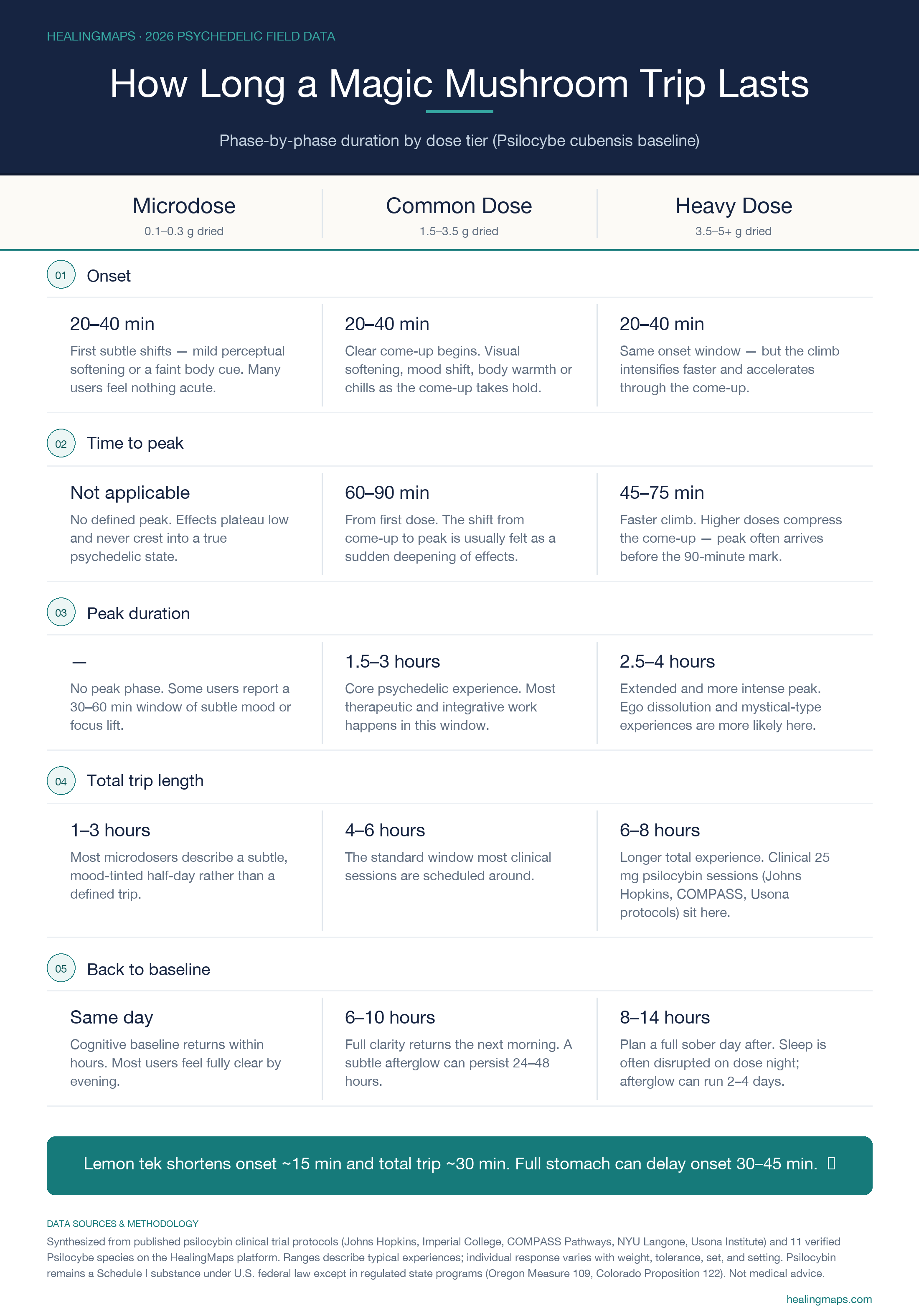
Trip Duration at a Glance
The infographic below summarizes how each phase changes with dose tier — onset, time to peak, peak duration, total trip, and return to baseline — using the same data sources as the estimator above.
Three Different “How Long” Questions
Search traffic for “how long do magic mushrooms last” actually splits across three distinct intents. This guide answers the first one. The other two have their own dedicated articles, because the answers are different in kind.
| The question | What it means | Where to read |
|---|---|---|
| How long does a trip last? | Duration of acute psychedelic effects from ingestion to baseline. | This article. |
| How long until shrooms kick in? | Onset window — when you’ll first feel effects after eating. | How Long for Shrooms to Kick In |
| How long do shrooms stay potent? | Shelf life — how long dried mushrooms remain psychoactive in storage. | Do Shrooms Go Bad? |
Clinical Sessions and Legal Programs
In the U.S., psilocybin remains a Schedule I substance under federal law. Two state programs have created regulated paths to legal, supervised psilocybin experiences — and both build their session protocols around the 6–8 hour duration window.
- Oregon (Measure 109) — Service centers have been operating since 2023 under Oregon’s psilocybin services framework. Sessions are scheduled for a full day to accommodate the clinical-equivalent dose plus integration time.
- Colorado (Proposition 122) — Healing centers began opening in 2025 under the state’s natural medicine program. Session structure mirrors Oregon’s, with a licensed facilitator present from come-up through wind-down.
Most international retreat centers — including those quoted by HealingMaps in Europe, the Netherlands, and Jamaica — schedule ceremonies for 8 to 12 hours. The longer block isn’t because the trip itself lasts that long; it’s because ceremonies typically include preparation, optional second-dose timing for slow responders, and structured integration before participants leave.
Interested in joining a Psychedelics Clinical Trial? Sign up here and we will connect you with a clinical trial in your area when one becomes available.
Frequently Asked Questions
Can a magic mushroom trip last longer than 8 hours?
Yes, but it’s uncommon. Heroic doses (5 g+ dried), very-strong species, and slow-absorption preparations (capsules with food) can push the acute experience past 8 hours. Most reports of “12-hour trips” are either ceremony durations (preparation + dose + integration), or include the afterglow window rather than the acute trip itself.
Can a magic mushroom trip be shortened once it starts?
Partially. Eating a substantial meal, taking a benzodiazepine (under medical guidance), or sleeping can each shorten the perceived intensity, though the underlying duration doesn’t change much. Niacin, vitamin C, and most “trip-stopping” home remedies have no clinical support. The most reliable approach is supportive set and setting — letting the trip run its course in a safe environment.
Does tolerance change how long the trip lasts?
Tolerance affects intensity, not duration. Psilocybin builds tolerance quickly — a second dose taken within 24–48 hours of the first will produce a markedly shorter and weaker experience. Full tolerance reset takes about two weeks.
How long do magic mushrooms stay in your system after the trip ends?
Psilocybin metabolites are typically undetectable in urine within 24 hours. Standard drug-screen panels do not test for psilocybin. Specialized panels can detect it for 1–3 days in urine. See Do Shrooms Show Up on a Drug Test? for the full breakdown.
Why are clinical psilocybin sessions scheduled for 6–8 hours?
The 25 mg synthetic psilocybin dose used as the clinical standard sits at the upper end of a strong recreational dose. At that level, the acute trip runs 6–8 hours from come-up to baseline, with the most therapeutically relevant content happening in the middle 3–4 hours. The full window allows the participant to remain in a supervised setting from dose to clear-headed wind-down.
Is the afterglow part of the trip?
Not in the pharmacological sense — psilocin is fully metabolized within hours. But subjectively, most users describe a mood and clarity lift that persists 24–48 hours. Some clinical research suggests measurable mood and openness changes can persist for weeks after a single session, particularly in trial protocols paired with integration support.


Tom
July 23, 2023 at 9:02 pmI think its cruel to dose your dog or any animal for that matter. I simply dont understand why anyone who cares and loves their dog would put it though torture like that. A dog cannot understand what is happening. This is my opinion.
Fred
August 5, 2023 at 11:37 pmI’m not sure what Tom is going on about. No, you should not give hallucinogenics to animals. No, you shouldn’t give any psychotropic drugs to animals, short of perhaps CBD to take the edge off fireworks or something similar. This isn’t covered anywhere in the article, but I’m glad Tom was compelled to inform us of his “opinion”. In other news, don’t smother your dog’s kibble in Tabasco sauce because you think he might appreciate the spicy kick. He won’t.