Shrooms vs. Acid: Understanding The Differences Between Psilocybin And LSD
Last reviewed and updated: June 18, 2026.
Key Takeaways
| Duration | LSD: 8–12 hours (peak 3–5hr) · Psilocybin: 4–6 hours (peak 1.5–3hr) |
| Experience character | LSD: stimulating, mental, sharp · Psilocybin: warmer, emotionally resonant, nature-connected |
| Clinical evidence (2025) | Psilocybin leads — FDA Breakthrough Designation, Phase 3 trials, Australia TGA approval, OR/CO legal programs · LSD: Phase 2 for anxiety/ADHD |
| Physical risk | Neither physiologically toxic or addictive at typical doses; both elevate heart rate/BP; LSD illicit supply has contamination risk (NBOMe analogues) |
| Legal access | Psilocybin: Oregon + Colorado service programs, clinical trials · LSD: no legal supervised pathway currently in the U.S. |
The two most popular kinds of psychedelics that people use are psychedelic mushrooms (also known as magic mushrooms or shrooms) and LSD (acid). There are many different reasons as to why these are the most popular psychedelics.
Psychedelic mushrooms are a popular choice because they grow in the wild all over the world, in many different climates. It is also relatively easy to grow them at home.
LSD, meanwhile, is a common psychedelic because it is inexpensive to produce and the doses are very small, so it is easy for chemists to produce large quantities of the substance.
Interested in joining a Psychedelics Clinical Trial? Sign up here now and we will connect you with a clinical trial in your area when one becomes available.
But if we compare shrooms vs. acid, we find many important differences between the two psychedelics. These substances differ in terms of their history, as well as their physical, perceptual, and psychological effects.
You want to get acquainted with these differences so you can decide which psychedelic is right for you. Some people find that the mushroom experience meets their needs and preferences, whereas others tend to prefer the LSD experience.
RELATED: Magic Truffles vs. Magic Mushrooms: Comparing The Similarities And Differences
An Overview Of Shrooms
A Brief Description Of Psilocybin Mushrooms
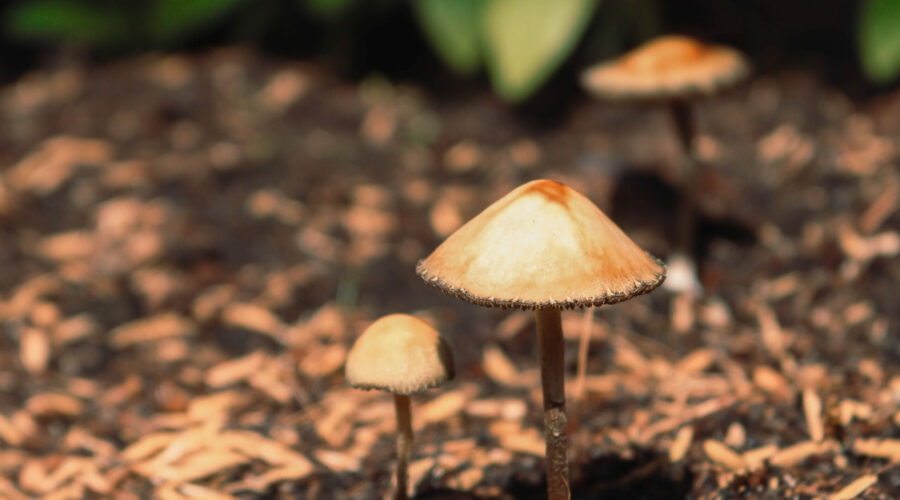
Magic mushrooms are psychedelic because they contain the psychedelic compounds psilocybin and psilocin. They are also a completely natural psychedelic.
Psilocybin is a prodrug, meaning it is only psychoactive when consumed and processed in the body. When you take mushrooms containing psilocybin, the body will convert the psilocybin into psilocin, which is psychoactive.
Both psilocybin and psilocin belong to a group of chemicals known as tryptamines. This grouping also includes compounds like DMT and 5-MeO-DMT.
The History Of Psilocybin Mushrooms
In discussing shrooms vs. acid, one important difference to note between the two substances is that psilocybin mushrooms have a longer and richer cultural history compared to LSD.
Magic mushroom use is thousands of years old. The earliest evidence of mushroom use comes from a cave in the Tassili-N-Ajjer region of the Sahara Desert in Algeria.
This cave exhibits a mural (around 7,000 to 9,000 years old) of a bee-headed shaman whose body is covered in mushrooms. Researchers have identified these mushrooms as Psilocybe maireri. This is one such species of psilocybin mushroom, native to the region.
Psilocybin mushrooms also have a history of ceremonial use in pre-Columbian societies. Archaeologists have discovered “mushroom stones” in Mexico and Guatemala, which are around 3,000 to 3,500 years old. Experts state that these represent psilocybin mushrooms.
You can find the first written account of magic mushroom use in the Florentine Codex (1560), authored by the Spanish missionary priest Fray Bernardino de Sahagún. In this book, there are descriptions of the Aztecs engaging in ceremonies involving psilocybin mushrooms.
Magic mushrooms entered public awareness with the publication of an article about magic mushrooms in Life magazine in 1957. Written by the then vice-president of J.P. Morgan R. Gordon Wasson, this article detailed a magic mushroom ceremony in Oaxaca, Mexico, that Wasson took part in. His guide was the famous mushroom shaman Maria Sabina.
More Westerners began experimenting with psilocybin mushrooms in the 1960s. But this was not the psychedelic drug of choice at the time — it was LSD. When we compare shrooms vs. LSD, we can see that psilocybin mushrooms had a less influential role in popular culture in the 60s.
Magic Mushroom Dosage
The threshold dose of dried magic mushrooms is 0.25 g. This means you generally need to take this amount to achieve psychedelic effects. The normal shrooms dosage range for dried psilocybin mushrooms is 1-5 g.
The Duration Of The Psilocybin Experience
The duration of the effects of magic mushrooms can depend on the dose. So if you’re microdosing shrooms below the threshold dose, the effects may only last a few hours. Whereas a very high dose could last more than six hours. Generally, though, a magic mushroom experience will last 4-6 hours.
Additionally, it’s important to understand how long it takes for shrooms to kick in, as each person is different.
RELATED: Is Microdosing Shrooms an Effective way to Find Yourself?
An Overview Of Acid
A Brief Description Of LSD
LSD is a semi-synthetic psychedelic. It is semi-synthetic because a chemist will produce it through a chemical process; however, the compound was originally derived from alkaloids found in ergot, a fungus that grows on rye. LSD itself is not found in the natural world, in contrast to magic mushrooms.
Ergot contains lysergic acid. Through a chemical process, you can turn this chemical into lysergic acid diethylamide (LSD).
LSD belongs to a group of compounds known as ergolines, distinct from tryptamines. Other ergolines include ergine, also known as lysergic acid amide (LSA), which is found in Hawaiian baby woodrose and morning glory seeds.
RELATED: What Is Bicycle Day – The World’s Biggest Psychedelic Holiday?
The History Of LSD
In 1938, the Swiss chemist Albert Hofmann was the first to prepare LSD by altering lysergic acid found in ergot. Then, in 1943, he became the very first person to use LSD, taking 250mcg (micrograms) of the substance that he had produced himself. The origin and use of LSD are, therefore, much more recent compared to mushrooms.
In the 1950s, well-known scientists and thinkers experimented with LSD, including the psychiatrist Stanislav Grof and the philosopher Alan Watts.
In the 1960s, underground chemists manufactured millions of doses of LSD and distributed them to the public. LSD was widely available and easily accessible at the time. Many famous and influential people experimented with LSD in the 60s too, such as Jimi Hendrix, the Beatles, Ken Kesey, Aldous Huxley, and Timothy Leary.
RELATED: Study Suggests Psychedelics May Help With Healing Childhood Trauma
LSD Dosage
Another difference between the two compounds is in the dosage. For an LSD dosage, the threshold dose is around 20 mcg, so about 1,000th the dose of mushrooms. The typical dosage range for acid is 75-300 mcg.
The Duration Of An LSD Experience
But when comparing shrooms vs. acid, we find noticeable differences as well in effects. For example, the effects of LSD last much longer than those of mushrooms. While a magic mushroom experience may last up to six hours, an LSD experience can last up to 12 hours, and even longer sometimes if the dose is high enough.
The Experiential Difference Between Shrooms And Acid
While both shrooms and acid can produce the classic psychedelic experience, many people who have experimented with both report different qualities between the two. Part of this may come down to the chemical difference between tryptamines and ergolines.
Let’s look at some of the most important experiential differences between shrooms vs. acid.
Visual Differences
There are visual differences between the two experiences.
For shrooms, the visuals:
- Are organic and ‘earthy’
- Move gently and smoothly in how they evolve
- Involve more morphing and distortions of objects
- Can be quite intense with eyes closed
For acid, the visuals:
- Are more crisp and clean
- Involve more detail in objects
- Shift rapidly
- Are less likely to be intense with eyes closed
Some people find that the visual effects of LSD are stronger than those produced by magic mushrooms, but others find the opposite to be true.
Differences In Headspace
The headspace of acid and shrooms can also be quite different.
People find that the magic mushroom headspace is:
- Harder to control and direct
- More confusing and disorientating
- More introspective
The acid headspace, on the other hand, tends to be:
- More lucid
- Easier to control
- More prone to sociability
Physical Differences
The physical effects of psilocybin mushrooms are usually distinct from those you will experience with LSD.
With mushrooms there can be the following:
- Nausea
- Vomiting
- Stomach discomfort
- The feeling of being drowsy and tired
- The feeling that your body is heavy
In contrast, for LSD, the physical effects can involve:
- More stimulation and energy
- Restlessness
- Less body load
- More of a body high
Emotional Differences
Both acid and shrooms can produce strong emotional changes, but the way in which they change your mood and emotions can differ, as well.
When it comes to mushrooms, you are more likely to:
- Be on the fence between a positive and negative experience
- Experience inconsistent and volatile emotions
If you take acid, you are:
- More likely to remain positive
- More likely to be in control of your emotions
RELATED: Candy Flipping: What Is It, And Is It Safe?
Shrooms vs. Acid: Which Experience Is Right For You?
Now that we’ve explored shrooms vs. acid in a bit of depth, you may have a sense of which experience sounds more appealing to you. Often, the right experience for you will come down to personal preferences.
To help you in making a decision about choosing a magic mushroom or LSD experience, it will be useful to highlight the advantages and disadvantages of both compounds.
The Advantages Of Magic Mushrooms
Magic mushrooms will be the right choice for you if:
- You’re looking to feel more connected to nature
- You want to experience mushrooms in a legal retreat setting (magic mushrooms are legal and used in retreats in countries like the Netherlands and Jamaica)
- You want to source the substance yourself (by picking them)
- You’re hoping for a shorter experience
The Disadvantages Of Magic Mushrooms
Magic mushrooms may not be the right choice for you if:
- You want to avoid physical discomfort
- You’d prefer a longer psychedelic journey
- You’re hoping to be more in control of your trip
- You want a clearer headspace
The Advantages Of LSD
LSD will be the right choice for you if:
- You’re hoping for a more sociable psychedelic experience
- You want to embark on a longer psychedelic journey
- You want less of a body load
- You’d prefer to feel more in control of your trip
- You’re looking for a more lucid headspace
The Disadvantages Of LSD
LSD may not be the right choice for you if:
- You’re looking for a shorter experience. Since acid can last 12+ hours, depending on the time you take it, it may make sleeping difficult
- You want to have a psychedelic experience in a legal, controlled setting. In this case, a magic mushroom retreat would be more suitable
- You want to be sure you are taking the desired dosage. If you buy LSD, a dealer may claim it is a certain dose, but there is no way to personally verify that. With magic mushrooms, you can weigh them yourself and so more reliably aim for the kind of experience you want
In this comparison between shrooms and acid, you will see that there are many similarities between these two common psychedelics. You can very easily take a psychedelic dose of either substance and have an intensely visual, emotional, and introspective experience.
But you will have picked up on many of the substantial — as well as subtle — differences between psilocybin mushrooms and LSD.
If you are thinking of embarking on a psychedelic journey with either substance, be mindful of your personal needs, preferences, and comfort levels and see which substances best match them. This will help guide you to one psychedelic over the other and increase your chances of having a beneficial experience.
Which Has More Clinical Evidence in 2025?
When this article was first written, both psilocybin and LSD were almost exclusively studied in small academic trials. The research landscape has shifted substantially — and unevenly — since then.
Psilocybin now has the most robust clinical evidence base of any classic psychedelic. COMPASS Pathways completed a large Phase 2b trial (n=233) of psilocybin therapy for treatment-resistant depression in 2022, showing that a single 25mg dose produced significant symptom reduction vs. placebo. Johns Hopkins published positive Phase 2 results for psilocybin in major depressive disorder (MDD), nicotine addiction, and alcohol use disorder. Oregon and Colorado have launched regulated psilocybin service programs. Australia’s Therapeutic Goods Administration (TGA) approved psilocybin for treatment-resistant depression as a prescription treatment in 2023 — a global first. The FDA granted psilocybin Breakthrough Therapy Designation for both MDD and treatment-resistant depression; Phase 3 trials are underway.
LSD has a longer history of research but a more fragmented current pipeline. MindMed (formerly Mind Medicine) has conducted Phase 2 trials of LSD for anxiety disorder and ADHD with mixed results. MAPS has explored LSD microdosing. The primary barrier to LSD’s clinical development has been pharmacological: its 8–12 hour duration makes it logistically difficult for supervised therapy sessions compared to psilocybin (4–6 hours) or ketamine (45–90 minutes). Some researchers are working on truncated-duration LSD analogues (like VALNOCTAMIDE combinations) to address this. For now, psilocybin leads LSD significantly in clinical evidence, research infrastructure, and regulatory momentum.
Frequently Asked Questions
Which is stronger — shrooms or acid?
Both can produce similarly intense experiences at appropriate doses, but the intensity profiles differ. LSD tends to produce a more stimulating, mental, and sharply defined experience — many users describe it as “brighter” and more energetic. Psilocybin tends to produce a warmer, more emotionally resonant experience that many find feels more connected to the body and nature. At high doses, both can produce complete ego dissolution. The key difference is dose sensitivity: LSD is more potent by weight (active at 75–150 micrograms vs. 3–5 grams of dried mushrooms), and psilocybin potency varies significantly between mushroom batches — meaning dosing is less predictable with mushrooms.
Which lasts longer — psilocybin or LSD?
LSD typically lasts 8–12 hours, with peak effects at 3–5 hours. Psilocybin typically lasts 4–6 hours, with peak effects at 1.5–3 hours. This duration difference has real implications: psilocybin’s shorter window makes it more practical for supervised therapy sessions, which is one reason it has attracted more clinical investment than LSD. For recreational use, many people find LSD’s longer duration both an appeal and a challenge — it requires a full day’s commitment and can extend into nighttime sleep disruption if taken late. Both can cause after-effects (fatigue, reflective mood) the following day.
Which has more clinical research behind it in 2025?
Psilocybin leads significantly. It has completed large Phase 2b trials (COMPASS Pathways, n=233 for TRD), received FDA Breakthrough Therapy Designation for two indications, launched Phase 3 trials, and received Australia’s TGA approval as a prescription treatment. Oregon and Colorado have active legal service programs. LSD has Phase 2 data from MindMed for anxiety and ADHD but faces the logistical barrier of its 8–12 hour duration for supervised therapy. For accessing psychedelic-assisted therapy through legal channels, psilocybin currently has more routes than LSD.
Which carries more physical risk?
Neither psilocybin nor LSD is physically toxic at typical doses — neither causes organ damage, neither is physiologically addictive, and neither has a known lethal dose in humans from direct pharmacological effect. Both elevate heart rate and blood pressure moderately — relevant for people with cardiovascular conditions. LSD can be more stimulating physically (jaw clenching, restlessness) and its longer duration extends the physiological activation window. The most significant risks for both are psychological: anxiety, confusion, and impaired judgment during the experience, which is why set, setting, and a sober guide are emphasized consistently. LSD sourced from illicit channels also carries higher contamination risk (adulterants, NBOMe analogues) than mushrooms, which can be verified visually.